Sony TC-WR870 Dual Cassette Deck
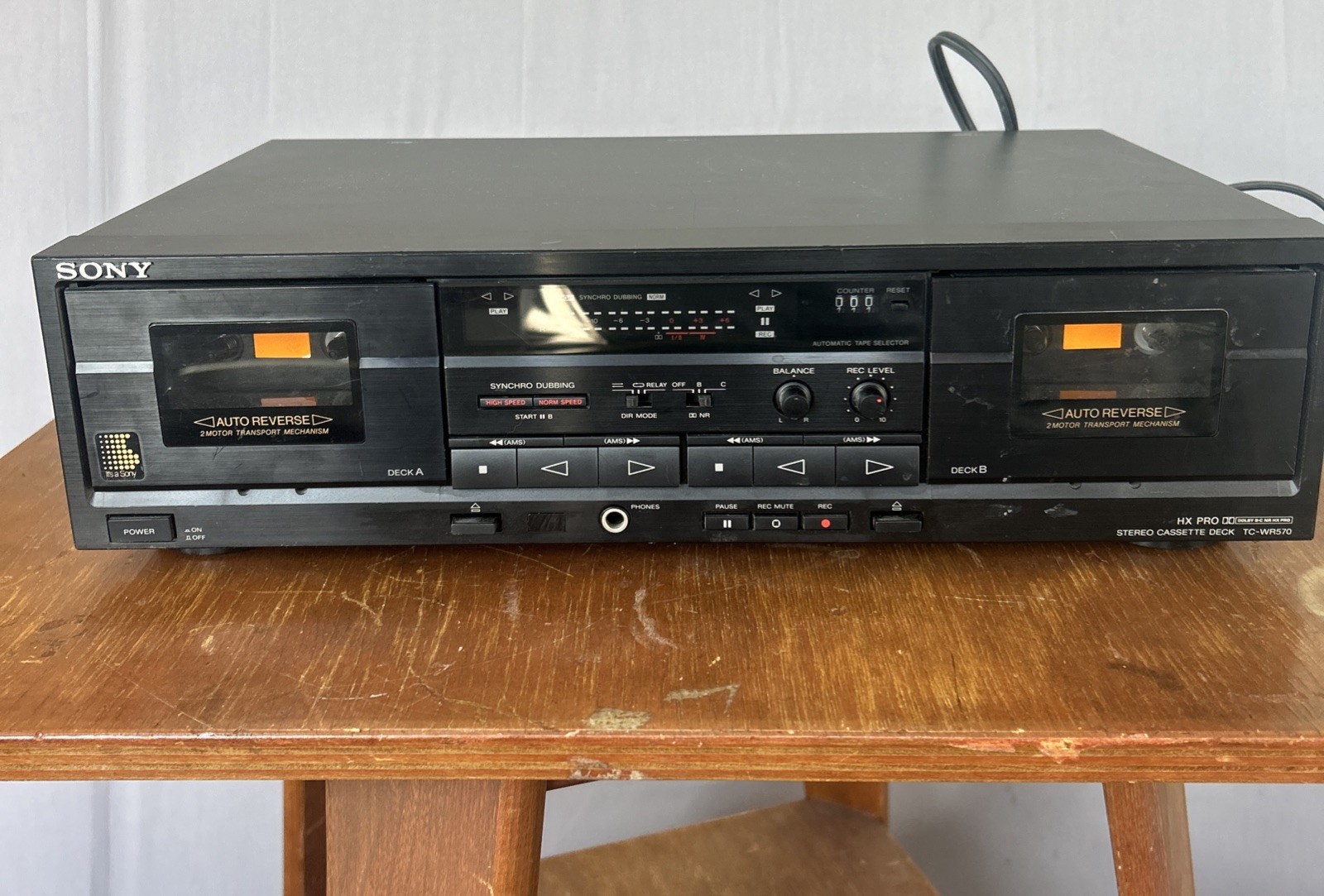
Meet the Sony TC-WR870—a quiet workhorse from the final chapter of cassette culture. Built between 1996 and 1998, this dual-deck machine arrived when CDs were king and cassettes were fading fast. Yet Sony wasn’t ready to let tape go quietly. The WR870 packed smart automation, solid engineering, and real usability into a no-nonsense design that made copying tapes, recording off the radio, or building mixtapes effortless. It’s not flashy, but it’s built to last—typical Sony precision wrapped in late-’90s practicality.
Key Features
- Dual cassette transport with auto-reverse on both decks
- Dolby B and C noise reduction for improved audio fidelity
- Automatic tape calibration (AZIMUTH) for optimal playback alignment
- Tape type selector for Type I (Normal), Type II (Chrome), and Type IV (Metal) tapes
- Music search function for quick navigation through recordings
- Timer recording and playback with clock-based scheduling
- Soft-touch mechanical controls with illuminated display
- Copy function for direct deck-to-deck dubbing
Specifications
| Specification | Detail |
| Model | TC-WR870 |
| Brand | Sony |
| Year of Release | 1996 |
| Production Period | 1996–1998 |
| Cassette Function | Dual deck with auto-reverse (both sides) |
| Noise Reduction | Dolby B, Dolby C |
| Tape Types Supported | Type I (Normal), Type II (Chrome), Type IV (Metal) |
| Calibration | Auto tape calibration (AZIMUTH) |
| Recording/Playback Modes | Normal, Copy, Timer Record, Timer Play |
| Search Function | Music Search (fast forward/rewind scan with audio) |
| Display | Fluorescent display with time, mode, and tape status |
| Control Interface | Soft-touch buttons |
| Dimensions (W×H×D) | 430 × 142 × 325 mm |
| Weight | 7.5 kg |
| Power Requirements | Not specified (assumed AC 120V/230V, 50/60 Hz) |
| Impedance | Unknown |
| Sensitivity | Unknown |
| Output Level | Standard line-level output (RCA) |
| Audio Frequency Response | Approx. 20 Hz – 20 kHz (Type IV, with Dolby C) |
| Signal-to-Noise Ratio | >70 dB (with Dolby C) |
| Wow and Flutter | <0.08% (weighted, RMS) |
Historical Context
The TC-WR870 landed just as the cassette era was winding down. By 1996, CDs had taken over living rooms and car stereos, but tape wasn’t dead yet. It was still the go-to for recording radio shows, making mixtapes, or playing music on the move. Sony, ever the tape loyalist, kept refining the format—not for audiophiles this time, but for everyday users who wanted simplicity and reliability.
The WR870 embodies that shift. Gone are the finicky manual adjustments of the ’80s. In their place: one-touch dubbing, auto-reverse on both decks, and timer recording that actually works. It’s a machine built for convenience, not critical listening. Sony knew cassette decks were becoming utility devices, and the WR870 delivered exactly that—smart, seamless, and ready to copy your favorite FM broadcast while you slept.
It wasn’t a flagship, but it carried the Sony badge with pride. Solid construction, clean layout, and thoughtful automation made it a dependable part of many home audio setups. Today, it stands as a snapshot of cassette tech’s final evolution—automated, refined, and quietly efficient, right up until digital formats pulled the plug.
Sound Signature
Don’t expect tube warmth or analog bloom—the WR870 delivers sound with clinical clarity. Sony tuned it for accuracy, not character. Playback is clean, balanced, and detailed, especially when using Type IV metal tapes with Dolby C engaged. Hiss fades into the background, high frequencies stay crisp, and stereo imaging holds firm thanks to the auto-azimuth calibration.
It won’t outperform a high-end manual deck from the early ’80s, but that wasn’t the point. The WR870 excels in consistency. Drop in a tape, press play, and you’ll get faithful reproduction every time. It’s ideal for casual listening, archiving old recordings, or making reliable copies without babysitting levels or alignment.
Maintenance and Common Issues
After nearly three decades, the WR870 needs attention to run smoothly. These decks were built well, but time takes its toll—especially on rubber and lubricants.
Common Problems:
- Belt degradation: Rubber belts can dry out and crack after 25+ years, leading to transport failure.
- Idler tire wear: The idler wheel may harden or lose grip, causing slow or uneven tape movement.
- Solenoid issues: Mechanical solenoids controlling tape loading can stick or fail.
- Dirt accumulation: Dust and oxide buildup on heads, capstan, and pinch roller degrade performance.
- Lubrication drying: Factory lubricants in gears and sliders can gum up over time.
Maintenance Tips:
1. Clean the tape path regularly using isopropyl alcohol and lint-free swabs.
2. Demagnetize the heads and tape path every few months using a cassette demagnetizer.
3. Inspect and replace worn belts—this is often the first fix needed on vintage decks.
4. Lubricate sparingly—use synthetic lubricants on gears and sliding rails; avoid petroleum-based oils.
5. Use tapes sparingly until the deck is serviced; old tapes can shed oxide and clog the mechanism.
6. Store in a dry, dust-free environment to prevent corrosion and mold.
A proper service breathes new life into the WR870. With fresh belts and a full cleaning, it can run like new—for another 25 years, if treated right.
Market Value and Collectibility
- Current Market Value: $50–$100 USD, depending on condition and functionality
- Collectibility Rating: 4/10
The TC-WR870 isn’t a grail machine. It won’t turn heads at a vintage audio show. But for practical use, it’s a gem. Its blend of automation, durability, and Sony reliability makes it a favorite among those still copying tapes or digitizing old recordings. It’s not about rarity—it’s about function.
For under a hundred bucks, you get a fully capable dual deck that does exactly what it promises. No fuss, no failures—just dependable tape handling from the last wave of cassette innovation. If you need a working deck that won’t quit, the WR870 is one of the smartest buys from the format’s final days.
eBay Listings


As an eBay Partner, we earn from qualifying purchases. This helps support our independent vintage technology research.
Related Models
- Sony TC-2050SD (1978)
- Sony TC-2130A (1974)
- Sony TC-2220 (1972)
- Sony TC-FX6 (1982)
- Sony TC-K96R (1986)
- Aiwa AD-F990 (1993)
- Kenwood KX-3060 (1982)
- Stromberg-Carlson RS-404 (1975)
- Akai CS-F33R (1985)
- Akai DX-59 (1983)