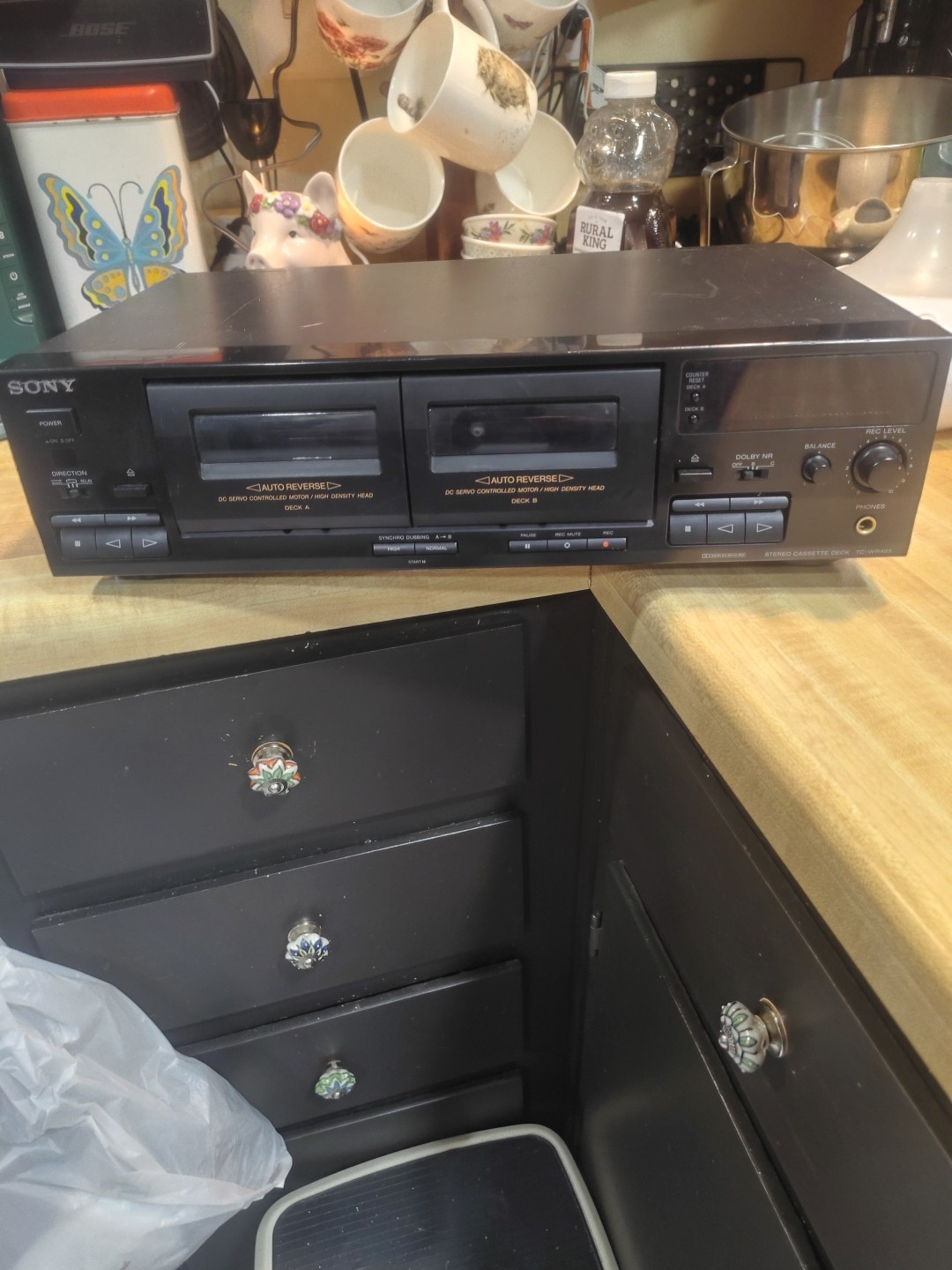
Sony TC-WR795 Dual Cassette Deck
By 1998, the cassette tape was on borrowed time. CDs ruled the mainstream, and digital audio loomed on the horizon. Yet in that twilight moment, Sony released the TC-WR795—a no-nonsense, dual-deck workhorse that distilled decades of analog refinement into one sleek, functional chassis. Built for taping, dubbing, and preserving mixtapes with precision, the WR795 wasn’t flashy, but it delivered where it counted: reliability, smart automation, and solid sound. With auto-reverse on both decks, Dolby B/C noise reduction, and an auto-calibrating record system, this was Sony’s promise of hassle-free analog fidelity, right up to the format’s final curtain.
Key Features
- Dual cassette operation with auto-reverse on both sides
- Dolby B and C noise reduction for improved audio fidelity
- Automatic tape type detection (Normal, CrO2, Metal)
- Auto calibration function (Deck 1 only)
- Music search forward/reverse for quick navigation
- Soft-touch mechanical controls
- Digital tape counter with index memory
- Line input/output with standard RCA connectors
Specifications
| Parameter | Specification |
| Year of Production | 1998–2000 |
| Format Support | Compact Cassette (Normal, CrO2, Metal) |
| Playback/Recording System | 2-head, 3-motor (dual capstan) |
| Tape Speed | 4.76 cm/s (1⅞ ips) |
| Wow and Flutter | 0.08% WRMS (weighted) |
| Frequency Response | 20 Hz – 20 kHz (Metal tape, Dolby C) |
| Signal-to-Noise Ratio | >68 dB (Dolby C, Metal) |
| Total Harmonic Distortion | <1.5% |
| Line Input Sensitivity | 200 mV (for 0 dB recording level) |
| Line Input Impedance | 50 kΩ |
| Line Output Impedance | 2.2 kΩ (typical) |
| Power Consumption | 25 W |
| Dimensions (W×H×D) | 430 × 145 × 338 mm |
| Weight | 7.5 kg |
Historical Context
Launched in 1998, the TC-WR795 arrived as the cassette era quietly wound down. CD players were now household staples. MP3s were creeping in. Yet cassettes still had life—especially for recording radio shows, dubbing tapes, or making mixtapes by hand. Sony didn’t position the WR795 as a flagship, but it packed features once reserved for high-end decks: full auto-reverse on both sides, Dolby C noise reduction, and automatic tape type detection. The real gem? Auto-calibration on Deck 1—an uncommon touch in a mid-tier unit, ensuring consistent recording levels without manual tweaking.
This was Sony’s answer to the practical user: someone who wanted clean, reliable dubbing without fuss. No azimuth adjustments. No manual bias controls. Just plug in, press play and record, and let the machine handle the rest. For home archivists and mixtape enthusiasts, the TC-WR795 became a quiet favorite—a final, refined expression of what analog tape could do when automation met precision.
Sound Signature
Expect clarity, not color. The TC-WR795’s sound is clean and balanced, a hallmark of Sony’s late-era solid-state design. With a wow and flutter rating of just 0.08%, tape speed is rock-steady, delivering tight bass and crisp highs. Dolby C works quietly in the background, taming high-end hiss—especially effective with CrO2 and Metal tapes. The dynamic range feels open, distortion stays low even at higher volumes, and head alignment ensures consistent tracking across tapes.
It’s not a “warm vintage” sound. It’s accurate, reliable, and trustworthy—ideal for preserving tapes or making high-quality copies without sonic surprises. Enthusiasts often praise its azimuth stability, a subtle but critical trait for long-term archiving.
Maintenance and Common Issues
All vintage decks demand care, and the TC-WR795 is no exception. After decades in storage or heavy use, rubber and moving parts wear. Left unchecked, performance suffers. Here’s what to watch for:
- Belt degradation: Rubber belts and idler tires dry out, crack, or lose grip. Replacing them restores smooth tape loading and drive.
- Idler tire wear: A slipping idler causes speed instability. Replacement or careful rejuvenation brings back proper capstan engagement.
- Mode switch oxidation: The Normal/CrO2/Metal selector can develop intermittent contact. A quick spray of contact cleaner often solves the issue.
- Capstan motor wear: Motors may weaken or hum after years of use. Lubrication helps, but replacement is sometimes necessary.
- Pinch roller contamination: Oxide buildup reduces grip. Clean gently with isopropyl alcohol and a lint-free swab.
Maintenance Tips
1. Clean tape heads and guides regularly with 99% isopropyl alcohol and a cotton swab—every 10–20 hours of use.
2. Demagnetize the tape path every 50 hours using a non-powered demagnetizer. It’s cheap insurance for clear, distortion-free playback.
3. Use cleaning tapes sparingly—they can wear rubber parts and don’t clean as thoroughly as manual methods.
4. Store tapes properly—avoid heat, humidity, and magnetic fields to keep your collection intact.
5. Replace belts preemptively if the deck has been dormant for years. Even intact-looking belts can be brittle and prone to failure.
Collectibility and Market Value
The TC-WR795 isn’t a grail item. With a collectibility rating of 3/10, it was too common and too utilitarian to attract trophy hunters. But functionality has its own appeal. Dual-deck auto-reverse models like this remain popular among users who still tape, archive, or relive the mixtape era.
As of 2024, working units in good condition sell for $30–80 USD. Those professionally serviced—with fresh belts, cleaned heads, and calibrated recording—often fetch prices at the upper end. While it won’t appreciate like a rare Revox or Nakamichi, the WR795 delivers real-world value: a capable, no-drama machine for enjoying cassette culture exactly as it was meant to be used.
eBay Listings


As an eBay Partner, we earn from qualifying purchases. This helps support our independent vintage technology research.
Related Models
- Sony TC-2050SD (1978)
- Sony TC-2130A (1974)
- Sony TC-2220 (1972)
- Sony TC-FX6 (1982)
- Sony TC-K96R (1986)
- Aiwa AD-F990 (1993)
- Kenwood KX-3060 (1982)
- Stromberg-Carlson RS-404 (1975)
- Akai CS-F33R (1985)
- Akai DX-59 (1983)