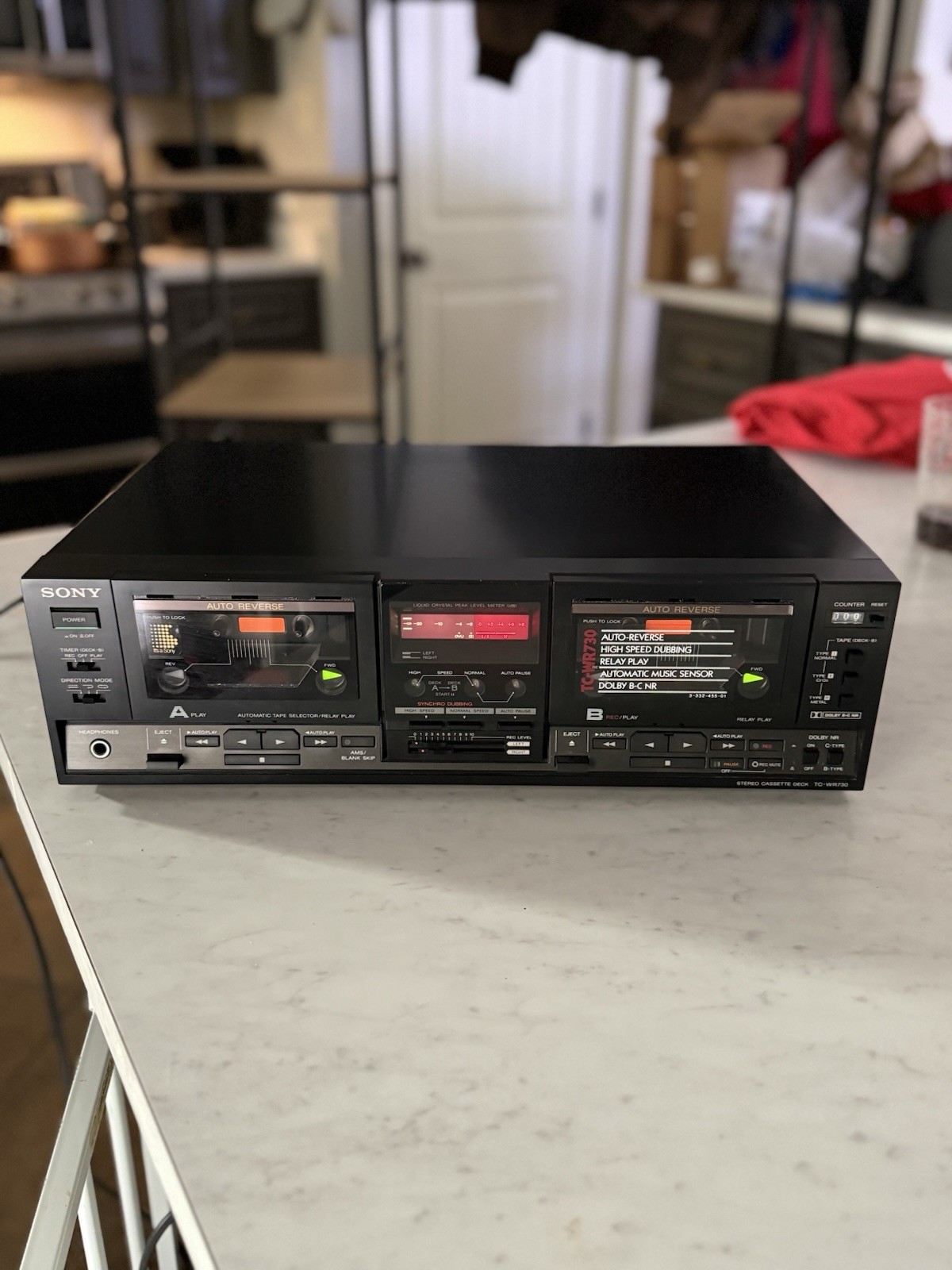
Sony TC-WR730 Dual Cassette Deck
The Sony TC-WR730 is a dual cassette deck produced from 1998 to 2000, positioned as a mid-range home audio solution during the twilight years of the compact cassette format. Designed for convenience and reliability, the TC-WR730 catered to users who wanted to copy tapes, build mixtapes, or preserve vinyl collections onto cassette. With a suite of user-friendly features and solid build quality, it reflects Sony's engineering expertise during the analog-to-digital transition era.
Key Features
- Dual Cassette Design: Enables direct C-90 tape copying at 1x speed.
- Auto Reverse Playback: Allows uninterrupted playback of both sides of a cassette.
- Dolby Noise Reduction: Dolby B and C systems for reduced tape hiss and improved clarity.
- Tape Selector: Supports Type I (Normal), Type II (Chrome), and Type IV (Metal) tapes with auto calibration.
- Soft-Touch Controls: Gentle button operation for transport functions.
- Digital Tape Counter: Facilitates cueing and timing during recording or playback.
- Auto Tape Calibration: Adjusts bias and level settings automatically based on tape type.
Specifications
| Specification | Detail |
| Model | TC-WR730 |
| Brand | Sony |
| Year of Release | 1998 |
| Production Period | 1998–2000 |
| Cassette Function | Dual Deck with Copy & Playback |
| Tape Speed | 4.76 cm/s (1⅞ ips) |
| Tape Types Supported | Type I (Normal), Type II (Chrome), Type IV (Metal) |
| Noise Reduction | Dolby B, Dolby C |
| Playback System | Auto Reverse (both decks) |
| Calibration | Automatic (via tape selector) |
| Counter Type | 4-digit digital counter |
| Display | Fluorescent display with function indicators |
| Inputs | Line In (RCA) |
| Outputs | Line Out (RCA) |
| Power Requirements | Unknown (integrated power supply) |
| Dimensions (W×H×D) | 430 × 136 × 298 mm |
| Weight | Approx. 5.5 kg |
| Color | Silver with charcoal faceplate |
Historical Context
The Sony TC-WR730 emerged at a pivotal moment in audio history—the late 1990s—when compact discs were becoming the dominant format and MP3 players were on the horizon. Despite the shift, cassette decks remained popular in households for their affordability, ease of use, and ability to record from radios, turntables, and other sources.
As part of Sony’s mid-tier dual cassette lineup, the TC-WR730 offered a balance of functionality and cost. It was not a high-end audiophile machine like the Esoteric or TC-K series, but it provided reliable performance for everyday users. Its inclusion of auto-calibration and support for metal tapes signaled Sony’s effort to maintain cassette quality even as the format declined.
The TC-WR730 exemplifies the final generation of cassette decks designed for mass-market home use, serving as a bridge between analog traditions and the digital future.
Sound Quality
The TC-WR730 delivers clean and accurate playback typical of mid-tier cassette decks of its era. With Dolby B and C noise reduction active, background hiss is well-controlled, especially on chrome and metal tapes. Frequency response is solid across the audible range, with good stereo imaging and minimal wow and flutter.
While not matching the performance of professional or high-end decks, it offers respectable fidelity for casual listening, tape dubbing, and archival projects. The auto-calibration system helps maintain consistent recording levels across tape types, enhancing usability.
Maintenance and Common Issues
Due to its age, the TC-WR730 may require servicing to perform optimally. Common issues include:
- Belt Degradation: Rubber belts can dry out, crack, or lose elasticity, leading to transport malfunctions.
- Idler Tire Wear: The idler wheel may harden or become glazed, causing slow or uneven tape movement.
- Motor Lubrication: Motors and gear trains may need cleaning and relubrication after decades of inactivity.
- Dirty Tape Heads and Guides: Oxide buildup can degrade sound quality and cause dropouts.
- Capstan and Pinch Roller Issues: Pinch roller hardening can result in speed instability.
Maintenance Tips
1. Clean the Tape Path: Use 99% isopropyl alcohol and lint-free swabs to clean heads, capstan, and guides.
2. Inspect and Replace Belts: If the deck fails to transport or operates erratically, belt replacement is likely needed.
3. Demagnetize Regularly: Use a cassette demagnetizer every few months to prevent dull sound and high-frequency loss.
4. Service the Idler Tire: Consider replacing or rejuvenating the idler tire for consistent tape speed.
5. Use Fresh Tapes: Avoid old or damaged cassettes that may shed oxide or jam the mechanism.
6. Store Properly: Keep in a dry, dust-free environment to prevent corrosion and mechanical wear.
Market Value and Collectibility
The Sony TC-WR730 is not considered a rare or highly collectible model. With a collectibility rating of 3/10, it appeals primarily to users seeking a functional dual cassette deck for practical purposes rather than audiophiles or collectors.
- Market Value: $30–$80 USD, depending on condition and functionality.
- Refurbished Units: May command higher prices if professionally serviced.
- Parts Availability: Generally available through online electronics recyclers or vintage audio suppliers.
While not a showpiece, the TC-WR730 remains a capable and nostalgic component for those preserving or enjoying analog audio formats.
Conclusion
The Sony TC-WR730 stands as a reliable and user-focused dual cassette deck from the final era of cassette dominance. Its blend of convenience features, solid build, and straightforward operation made it a household staple in the late 1990s. Though now vintage, it remains a functional tool for tape copying and playback—especially when properly maintained.
For enthusiasts, educators, or anyone revisiting analog audio, the TC-WR730 offers a no-frills entry point into cassette technology with the trusted Sony name behind it.
eBay Listings


As an eBay Partner, we earn from qualifying purchases. This helps support our independent vintage technology research.
Related Models
- Sony TC-2050SD (1978)
- Sony TC-2130A (1974)
- Sony TC-2220 (1972)
- Sony TC-FX6 (1982)
- Sony TC-K96R (1986)
- Aiwa AD-F990 (1993)
- Kenwood KX-3060 (1982)
- Stromberg-Carlson RS-404 (1975)
- Akai CS-F33R (1985)
- Akai DX-59 (1983)