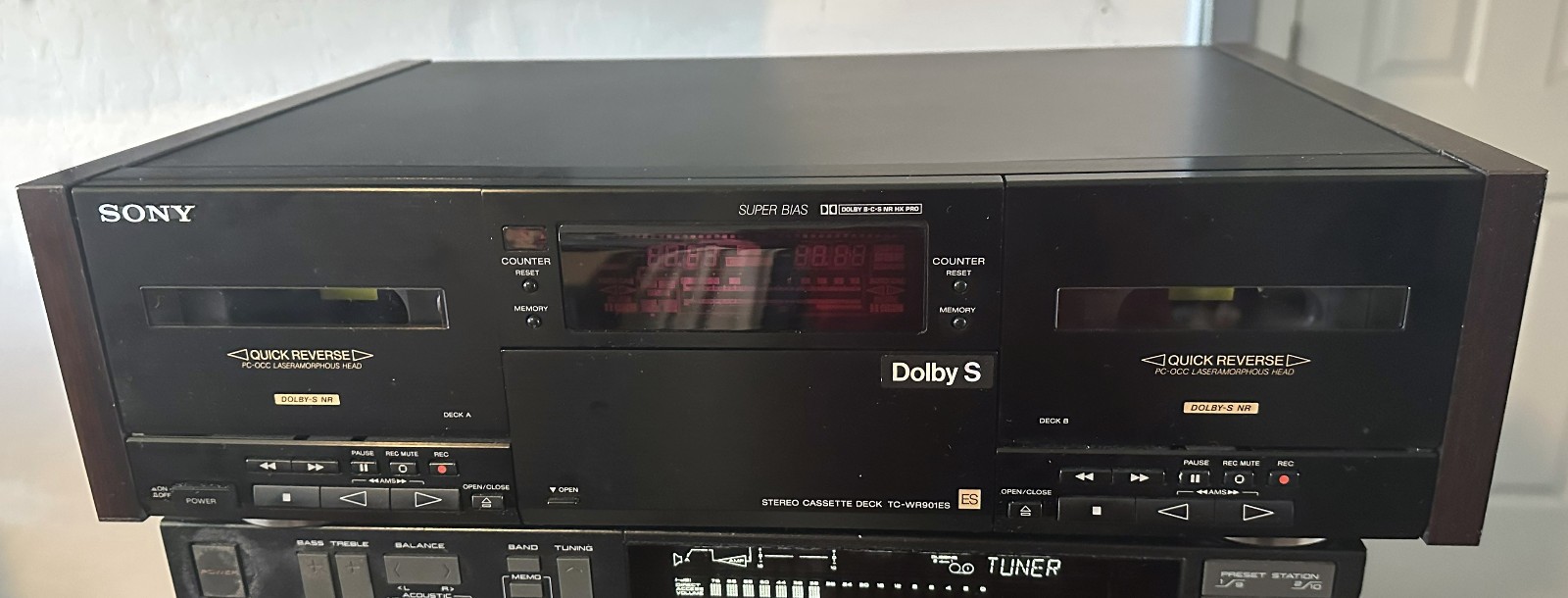
Sony TC-WR705S Dual Cassette Deck
The Sony TC-WR705S is a dual cassette deck produced from 1998 to 2000, designed for convenient tape dubbing, timer recording, and everyday playback. As part of Sony's mid-range cassette deck offerings in the late 1990s, the TC-WR705S prioritized user-friendly features over audiophile-grade performance. It reflects the transitional period in consumer audio when cassette technology was being phased out in favor of CDs and early digital formats, yet still served a practical role in home recording and media duplication.
Key Features
- Dual Cassette Decks: Enables direct tape-to-tape dubbing without external equipment.
- Auto Reverse Playback/Recording: Allows continuous playback or recording on both sides of a cassette.
- Dolby Noise Reduction: Supports Dolby B and C for improved signal-to-noise ratio during playback.
- Tape Selector: Switchable between Normal (Type I), CrO2 (Type II), and Metal (Type IV) tapes with auto calibration.
- Auto Tape Calibration: Automatically adjusts bias and equalization for optimal recording levels.
- Soft-Touch Controls: Gentle-button interface for transport and timer functions.
- Timer Recording & Playback: Schedule recordings or playback sessions up to 7 days in advance.
- Line Input/Output: Standard RCA jacks for connecting to external audio sources.
Specifications
| Specification | Detail |
| Model | TC-WR705S |
| Brand | Sony |
| Year of Release | 1998 |
| Production Period | 1998–2000 |
| Category | Dual Cassette Deck |
| Recording/Playback Modes | 4-track, 2-channel stereo |
| Tape Speed | 4.76 cm/s (1 7/8 ips) |
| Wow and Flutter | Not specified (typical mid-fi range) |
| Frequency Response | Approx. 40Hz – 14kHz (with Dolby C, Type I tape) |
| Signal-to-Noise Ratio | Up to 68 dB (Dolby C on CrO2 tape) |
| Harmonic Distortion | <1.5% (at 3% THD) |
| Input Impedance | 50k ohms (line) |
| Output Impedance | 2.2k ohms (line) |
| Power Consumption | 18W |
| Dimensions (W×H×D) | 430 × 145 × 302 mm |
| Weight | 6.5 kg |
| Accessories | Remote control (optional), power cord |
Historical Context
The TC-WR705S arrived at a time when cassette decks were shifting from high-fidelity components to convenience-oriented devices. By the late 1990s, CD players and recorders had become mainstream, and digital audio was on the horizon. Sony’s dual cassette decks like the TC-WR705S catered to users who still relied on cassettes for recording radio broadcasts, creating mixtapes, or transferring personal recordings.
Unlike the high-end TC-K series decks of the 1980s, the TC-WR705S focused on automation and ease of use. Features like auto reverse, timer programming, and one-touch dubbing made it ideal for casual users. It was not marketed toward audiophiles but rather as a functional, reliable unit for home use. Its design reflects the era’s aesthetic—sleek black casing with a large fluorescent display and intuitive button layout.
Sound Quality
The TC-WR705S delivers typical mid-fi cassette sound. With Dolby B or C noise reduction engaged and high-quality tapes (CrO2 or Metal), it achieves decent clarity and dynamic range for voice and music playback. However, it lacks the precision, low noise floor, and extended frequency response of professional or high-end consumer decks. Bass response is adequate but not deep, and high frequencies can sound slightly rolled off. It performs best when used with well-maintained tapes and clean heads.
Common Issues and Reliability
While generally reliable when well-maintained, the TC-WR705S is subject to age-related wear common in cassette mechanisms:
- Belt Degradation: Rubber belts can dry out and crack, leading to transport malfunctions.
- Idler Tire Wear: Causes sluggish tape loading or inconsistent speed.
- Capstan Motor Failure: Results in speed instability or no playback movement.
- Mode Switch Oxidation: The auto reverse mechanism uses mechanical switches that can corrode, causing erratic behavior or failure to reverse.
- Head Wear: Playback and record heads may wear or become misaligned after heavy use, affecting audio quality.
Regular cleaning and demagnetizing can extend the life and performance of the unit.
Maintenance and Tips
To keep the TC-WR705S functioning well:
1. Clean Regularly: Use isopropyl alcohol and cotton swabs to clean pinch rollers, capstans, and heads after every 10–15 hours of use.
2. Demagnetize: Use a cassette demagnetizer (or handheld type) every few months to prevent dull sound and dropouts.
3. Replace Belts: If the tape transport is sluggish or non-functional, replace all internal rubber belts.
4. Check Idler Tire: Resurface or replace if sticky or hardened.
5. Lubricate Sparingly: Apply light-grade lubricant only to moving gears and shafts—avoid oil on belts or rubber parts.
6. Use Quality Tapes: Stick to reputable brands (e.g., TDK, Maxell, Sony) and avoid heavily worn tapes that can shed oxide.
7. Store Properly: Keep in a dry, dust-free environment away from magnetic fields.
Market Value and Collectibility
The Sony TC-WR705S is not considered a collectible item, with a collectibility rating of 3/10. It lacks the prestige of Sony’s earlier high-end decks and was mass-produced for mainstream consumers. However, it remains functional and practical for cassette enthusiasts, hobbyists, and those digitizing old tapes.
- Current Market Value: $30–$80 USD
- Factors Affecting Value: Working condition, completeness (remote, manual), cosmetic state, and tape mechanism reliability.
Units that have been professionally serviced command higher prices, especially among users seeking reliable dubbing solutions.
Conclusion
The Sony TC-WR705S is a capable dual cassette deck that exemplifies the practical, feature-rich designs of the late analog era. While not a high-fidelity powerhouse, it offers solid performance for everyday use, making it a useful tool for tape preservation, duplication, and nostalgic listening. With proper maintenance, it can continue to serve as a reliable component in vintage audio setups or as a bridge between analog and digital media.
eBay Listings



As an eBay Partner, we earn from qualifying purchases. This helps support our independent vintage technology research.
Related Models
- Sony TC-2050SD (1978)
- Sony TC-2130A (1974)
- Sony TC-2220 (1972)
- Sony TC-FX6 (1982)
- Sony TC-K96R (1986)
- Aiwa AD-F990 (1993)
- Kenwood KX-3060 (1982)
- Polk AUDIO-SRS-1.2TL (1991)
- Stromberg-Carlson RS-404 (1975)
- Akai CS-F33R (1985)