Sony TC-RX80 Double Cassette Deck
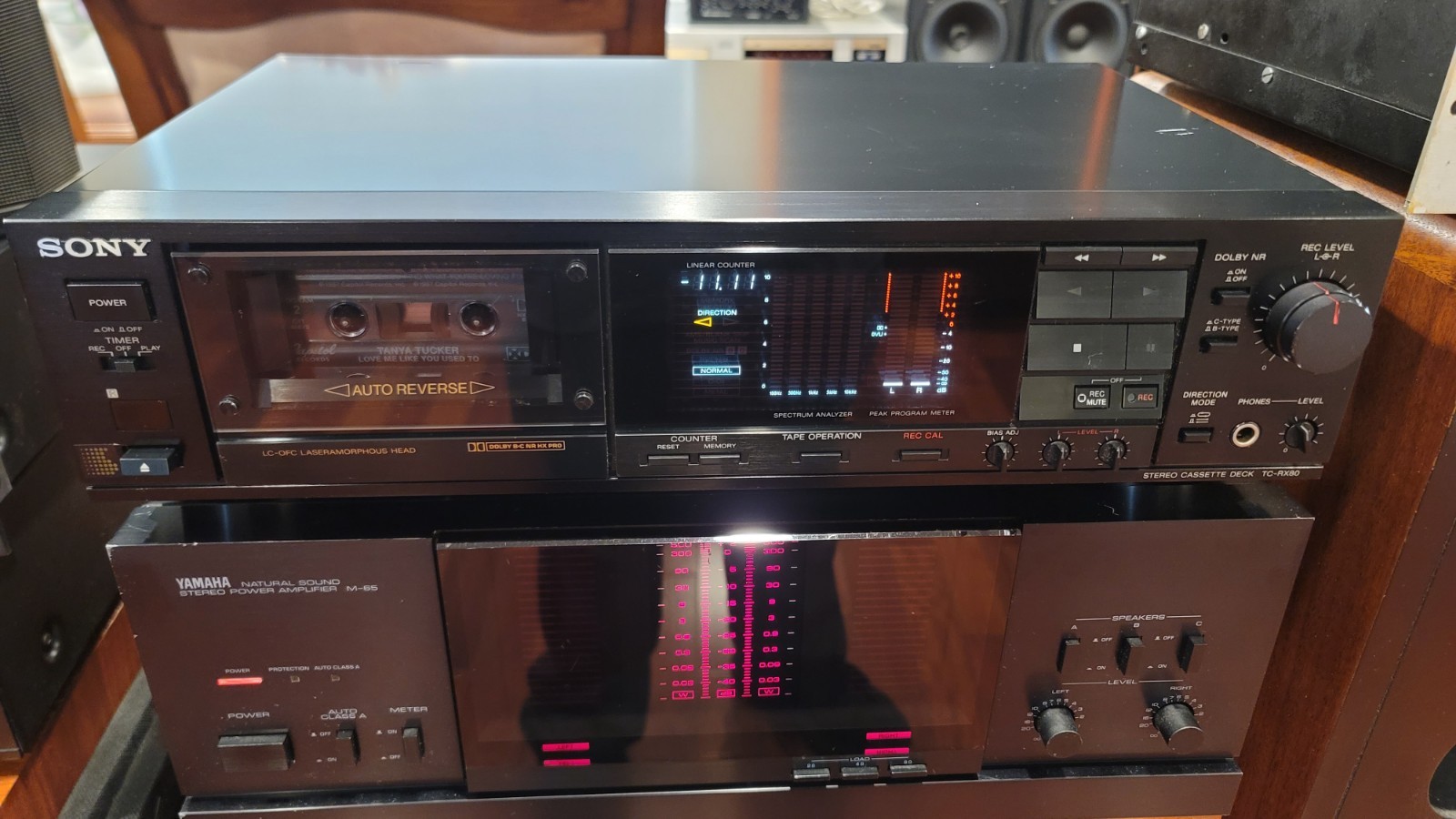
The Sony TC-RX80 is a dual-cassette deck released in 1989 as part of Sony's mid-tier home audio lineup during the final peak years of cassette tape popularity. Designed for convenient music dubbing, radio recording, and home library management, the TC-RX80 combines practical features with solid build quality typical of late-1980s Japanese audio engineering.
Key Features
- Double cassette transport – Enables direct tape-to-tape copying without external sources
- Auto-reverse playback – Allows continuous playback of both sides of a cassette
- Dolby B and C noise reduction – Reduces tape hiss for cleaner audio reproduction
- Music Search – High-speed tape scanning with audible playback to quickly locate tracks
- Tape Selector – Supports Type I (Normal), Type II (Chrome), and Type IV (Metal) tapes
- Auto Tape Bias Calibration – Optimizes recording levels based on tape type
- Soft-touch control panel – Modern, responsive interface with illuminated function indicators
- Line-level inputs and outputs – Standard RCA jacks for integration with home stereo systems
Specifications
| Specification | Detail |
| Model | TC-RX80 |
| Brand | Sony |
| Year of Release | 1989 |
| Production Period | 1989–1991 |
| Cassette Functionality | Dual-deck, copy and play |
| Playback Direction | Auto-reverse (both decks) |
| Noise Reduction | Dolby B, Dolby C |
| Tape Types Supported | Type I (Normal), Type II (Chrome), Type IV (Metal) |
| Bias Calibration | Automatic |
| Recording Modes | Stereo, dual-channel mono |
| Input/Output | Line in (RCA), Line out (RCA) |
| Power Consumption | 12W |
| Impedance (Input/Output) | Line-level (typically 10kΩ input, 600Ω output) |
| Frequency Response (Playback) | 20Hz – 20kHz (Type IV, with Dolby C) |
| Signal-to-Noise Ratio | >70dB (with Dolby C) |
| Wow and Flutter | <0.08% (weighted) |
| Dimensions (W×H×D) | 430 × 142 × 326 mm |
| Weight | 7.5 kg |
| Finish | Black with silver control panel |
Historical Context
The Sony TC-RX80 arrived at a time when cassette tapes were at their cultural zenith—widely used for music distribution, mixtapes, and portable listening via Walkmans. As consumers sought ways to build personal music libraries and record from radio or vinyl, dual cassette decks became household staples. The TC-RX80 offered a balance of automation and audio fidelity, targeting users who wanted more than basic functionality but didn’t need the precision of high-end models like the TC-K655 or professional decks.
With features like auto-reverse, Dolby C noise reduction, and music search, the TC-RX80 reflected Sony’s focus on user convenience and mass-market appeal. It was commonly paired with Sony’s STR or MHC series receivers and was a common sight in home entertainment centers of the late 1980s and early 1990s.
Sound Quality
The TC-RX80 delivers clean and accurate playback typical of mid-range cassette decks of its era. Its three-head configuration (record, playback, erase) ensures precise alignment and minimal crosstalk. With Dolby C engaged, tape hiss is significantly reduced, especially on chrome and metal tapes, allowing for a more transparent listening experience.
Frequency response is well-balanced across the spectrum, with tight bass, clear mids, and smooth highs. While not matching the dynamics of high-end decks, it performs admirably for casual listening and dubbing tasks. The auto bias system helps maintain consistent recording quality across different tape types.
Maintenance and Common Issues
Like all vintage cassette decks, the TC-RX80 requires periodic maintenance to remain functional and reliable. Common issues include:
- Degrading rubber belts and idler tires – Leads to transport malfunctions, uneven tape speed, or failure to engage mechanisms
- Sticky or worn potentiometers – Causes channel imbalance, distortion, or no sound; can often be cleaned with contact cleaner
- Aging capacitors – Electrolytic capacitors in the power supply and audio circuits may leak or dry out, affecting performance
- Worn pinch rollers – Can cause speed instability or poor tape-to-head contact; cleaning or replacement recommended
- Head misalignment – Results in dull sound or channel imbalance; professional alignment advised
Maintenance Tips
1. Clean tape heads and guides regularly with isopropyl alcohol and a cotton swab
2. Demagnetize the tape path every 50–100 hours of use using a non-contact tape demagnetizer
3. Replace rubber parts every 10–15 years, even if still functional
4. Use sparingly – Avoid continuous operation for extended periods
5. Store tapes properly – Keep away from heat, moisture, and magnetic fields to preserve recordings
Market Value and Collectibility
The Sony TC-RX80 is moderately collectible with a collectibility rating of 4/10. While not a rare or high-end model, it remains sought after by retro audio enthusiasts, cassette preservationists, and those nostalgic for 1980s home audio.
- Working condition: $100–$150
- Non-working or untested: $50–$80
- Cosmetically excellent + fully serviced: Up to $180
Value is highly dependent on functionality, cosmetic condition, and completeness (original remote, manual, packaging).
Conclusion
The Sony TC-RX80 stands as a reliable and feature-rich representative of the late cassette era. While overshadowed by higher-end models, it offers excellent value for users looking to digitize tapes, create mixtapes, or enjoy analog warmth with modern convenience. With proper care and maintenance, the TC-RX80 can continue to serve as a functional piece of audio history well into the future.
eBay Listings


As an eBay Partner, we earn from qualifying purchases. This helps support our independent vintage technology research.
Related Models
- Sony TC-2050SD (1978)
- Sony TC-2130A (1974)
- Sony TC-2220 (1972)
- Sony TC-FX6 (1982)
- Sony TC-K96R (1986)
- Aiwa AD-F990 (1993)
- Kenwood KX-3060 (1982)
- Stromberg-Carlson RS-404 (1975)
- Akai CS-F33R (1985)
- Akai DX-59 (1983)