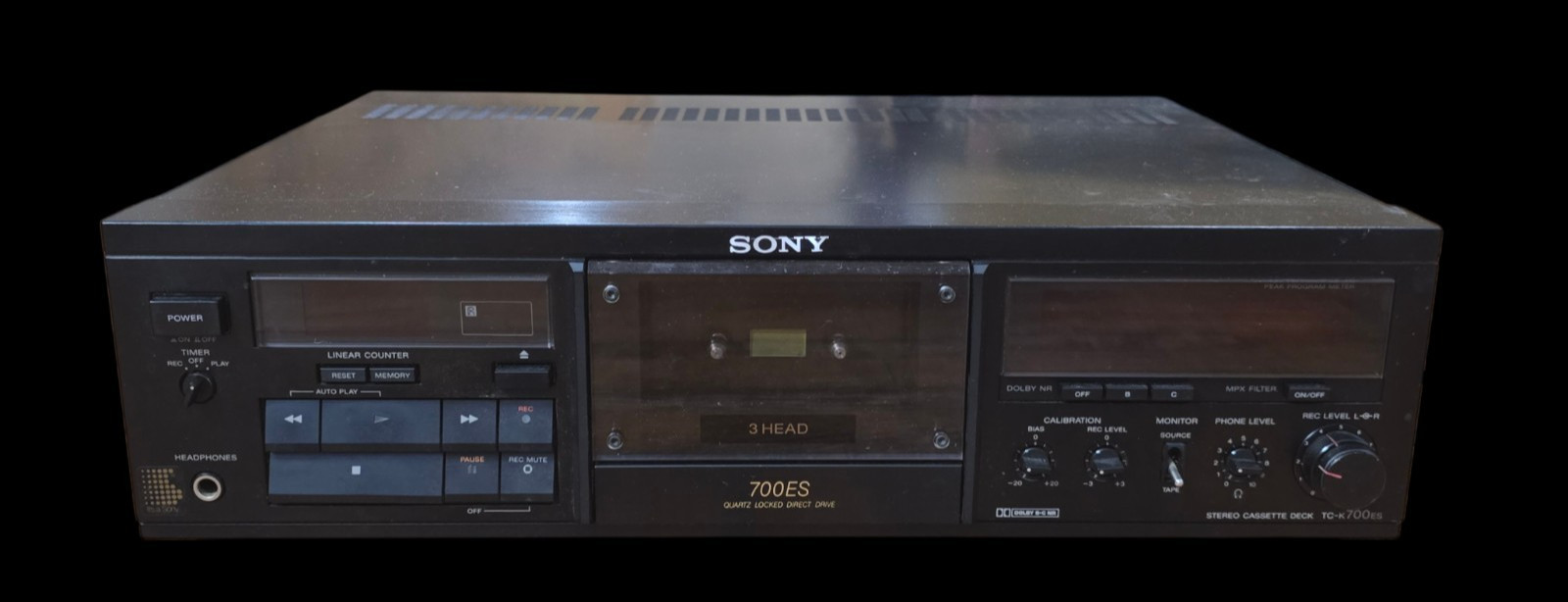
Sony TC-K777 Cassette Deck
The Sony TC-K777 is a high-fidelity cassette deck released in 1982 as part of Sony’s prestigious ES (Elevated Standard) series. Renowned for its precision engineering, robust build quality, and exceptional audio performance, the TC-K777 was designed for audiophiles and professional users who demanded the highest standards in analog tape reproduction.
Key Specifications
| Feature | Specification |
| Year of Production | 1982–1984 |
| Category | 3-Head, Dual Capstan Cassette Deck |
| Recording System | 4-track, 2-channel stereo |
| Tape Speed | 4.76 cm/s (1⅞ in/s) |
| Head Configuration | Separate record, playback, and erase heads |
| Head Type | Sendust (record/playback), Ferrite (erase) |
| Motor Type | Direct Drive (DD) |
| Transport System | Dual Capstan |
| Noise Reduction | Dolby B, Dolby C |
| Auto Tape Selector | Yes (Type I, II, IV detection) |
| Bias Adjustment | Front-panel fine bias control |
| Level Meters | Dual peak level LED meters |
| Frequency Response | 20Hz – 20kHz (Type IV, Dolby C) |
| Wow and Flutter | < 0.045% (JIS WTD) |
| Total Harmonic Distortion | < 1.0% |
| Signal-to-Noise Ratio | > 68 dB (Dolby C, Type IV) |
| Inputs | Line In (RCA), Mic In (RCA, 3.5mm mini) |
| Outputs | Line Out (RCA) |
| Power Requirements | Not specified (internal power supply) |
| Dimensions (W×H×D) | 430 × 142 × 330 mm |
| Weight | 10.5 kg |
Historical Context
The Sony TC-K777 was a flagship model in Sony’s ES (Elevated Standard) line, a series known for pushing the boundaries of consumer audio technology during the 1980s. Positioned as a professional-grade cassette deck, the TC-K777 combined advanced engineering with meticulous attention to detail, reflecting Sony’s commitment to high-fidelity sound reproduction.
As part of the early 1980s cassette deck arms race, the TC-K777 competed with high-end models from brands like Nakamichi, TEAC, and Denon. Its dual capstan transport system minimized tape flutter and ensured consistent tape-to-head contact, while the direct drive motor eliminated the need for belts in the capstan mechanism—enhancing long-term reliability and speed accuracy.
The inclusion of Dolby B and C noise reduction, combined with an auto tape type selector and manual bias fine-tuning, allowed users to optimize recordings across Type I (ferric), Type II (chrome), and Type IV (metal) tapes. This flexibility, along with its neutral and transparent sound signature, made the TC-K777 a favorite among recording enthusiasts and audiophiles.
Sound Signature
The TC-K777 delivers a neutral, detailed, and highly accurate sound profile. It is praised for its wide frequency response, low distortion, and excellent channel separation. Playback is clean and dynamic, with tight bass and extended highs—particularly when using metal tapes with Dolby C. Its separate playback and record heads ensure minimal crosstalk and maximum fidelity, making it ideal for critical listening and high-quality tape duplication.
Maintenance and Common Issues
Despite its robust construction, the TC-K777 is now over four decades old, and age-related wear is common. Proper maintenance is essential to preserve performance and longevity.
Common Issues:
- Belt Deterioration: While the capstan is direct drive, other mechanical functions (e.g., tape loading) may use rubber belts that can harden or crack over time.
- Idler Tire Wear: If equipped with idler wheels for mechanism movement, these may require replacement.
- Capacitor Aging: Electrolytic capacitors in the power supply and signal path may dry out, leading to noise, channel dropouts, or power issues.
- Mechanical Linkages: Stiff or noisy operation can result from dried lubricants in the transport mechanism.
- Switch and Potentiometer Noise: Oxidation on switches and level controls may cause crackling; periodic cleaning with contact cleaner is recommended.
Maintenance Tips:
- Professional Servicing: A full restoration by a qualified technician is recommended, including head alignment, capstan cleaning, and lubrication.
- Capacitor Replacement: Replacing old capacitors improves reliability and audio quality.
- Head Cleaning: Use isopropyl alcohol and a demagnetizer regularly to keep heads and tape paths clean.
- Tape Usage: Avoid using heavily worn or damaged tapes to prevent head clogging or damage.
- Storage: Store in a dry, dust-free environment with stable temperature to prevent corrosion and mold.
Collectibility and Market Value
The Sony TC-K777 is highly sought after by analog audio enthusiasts and collectors. Its combination of advanced features, solid build, and ES-series pedigree gives it strong collectible appeal.
- Collectibility Rating: 8/10
- Market Value: $300–$600 USD, depending on condition, service history, and completeness (original packaging, manuals, etc.)
- Well-serviced units with aligned heads and replaced capacitors command higher prices, especially among users who actively record and play tapes.
Conclusion
The Sony TC-K777 stands as a testament to the golden era of cassette deck engineering. With its direct drive dual capstan system, precision heads, and comprehensive recording controls, it remains one of the most capable cassette decks of its time. For collectors and analog enthusiasts, the TC-K777 offers both historical significance and outstanding sound quality—making it a prized addition to any vintage audio setup.
eBay Listings



As an eBay Partner, we earn from qualifying purchases. This helps support our independent vintage technology research.
Related Models
- Sony TC-2050SD (1978)
- Sony TC-2130A (1974)
- Sony TC-2220 (1972)
- Sony TC-FX6 (1982)
- Sony TC-K96R (1986)
- Aiwa AD-F990 (1993)
- Kenwood KX-3060 (1982)
- Stromberg-Carlson RS-404 (1975)
- Akai CS-F33R (1985)
- Akai DX-59 (1983)