Sony TC-D5M (1980)
At 1.7 kg with batteries, it's no pocket recorder. The weight is dense engineering, not excess.
Overview
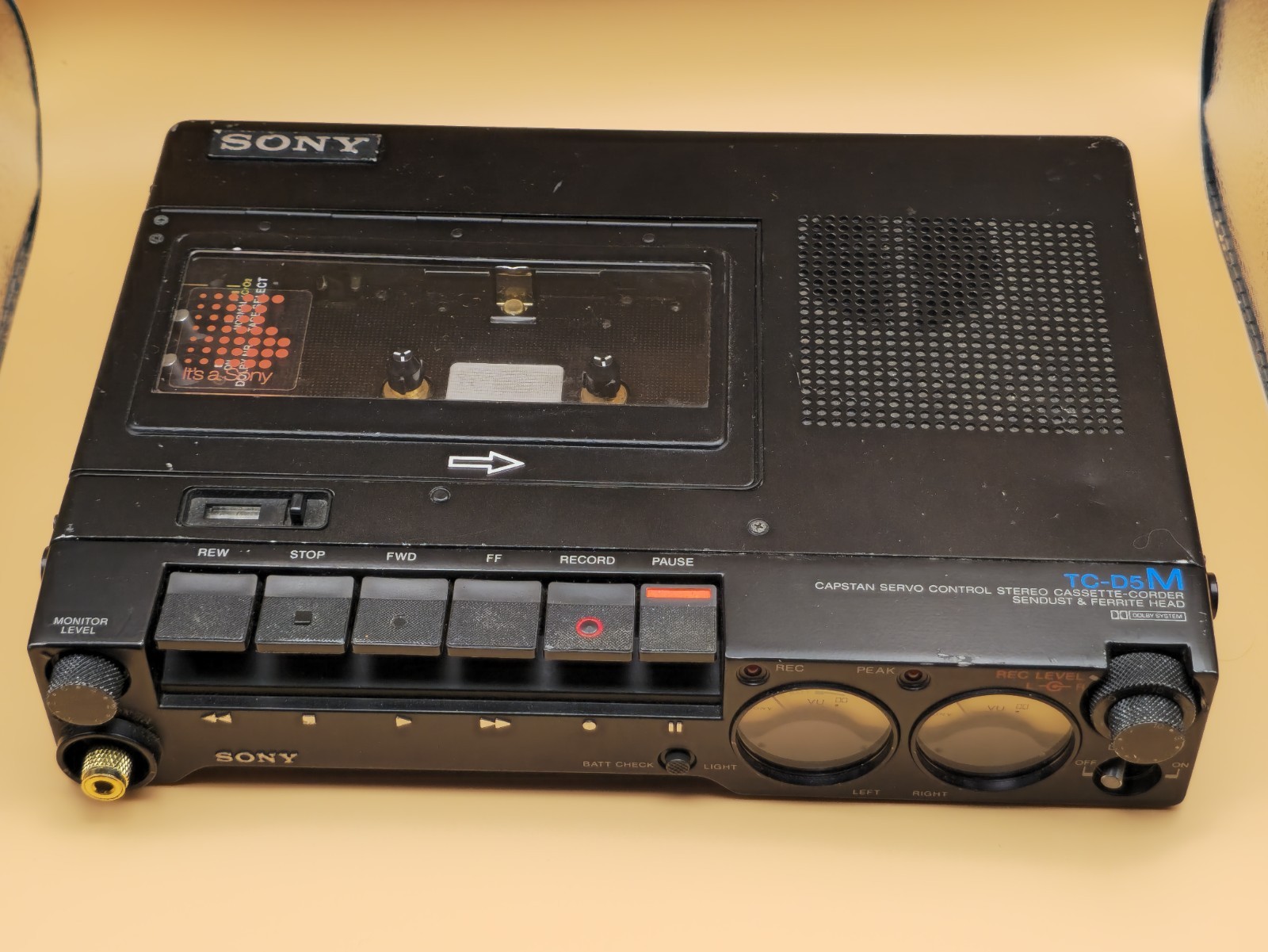
The Sony TC-D5M came out in 1980 as a portable cassette recorder for professionals who couldn't afford a failure in the field. It was marketed as the "Cassette Denske D5M" for metal tape use. It targeted broadcast journalists and location recordists who needed reliability, accurate monitoring, and compatibility with high-performance metal formulations. At ¥105,000, it was a serious investment, priced above consumer gear but under full studio rigs. Owners report it delivered: a rugged transport in a utilitarian metal case, built to survive daily use and record clean, detailed audio. Unlike flashier contemporaries, the D5M doesn't shout. It works.
The design centered on mechanical precision and electrical stability. The coreless motor, paired with an original disk drive capstan servo system, aimed for near-direct-drive performance from a compact, battery-powered unit. That wasn't marketing fluff. Measured wow and flutter of 0.06% wrms placed it among the most stable portable decks of its era. Add a frequency response out to 19 kHz on metal tape and a signal-to-noise ratio of 59 dB (Dolby off, peak level), and the D5M offered transparency that surprised even seasoned users. It wasn't warm or colored. It was faithful.
Specifications
| Manufacturer | Sony |
| Model | TC-D5M |
| Type | Portable Cassette Recorder |
| Year of Introduction | 1980 |
| Heads | Erase: 1, Recording/Playback: 1 (S&F head) |
| Motor | Frequency servo coreless motor using variable reluctance type FG |
| Signal-to-Noise Ratio | 59 dB (Dolby off, peak level, metal cassette) |
| Frequency Characteristic | 20 Hz ~ 19 kHz (Metal Cassette) |
| Wow and Flutter | 0.06%wrms |
| Distortion Factor | 1.0% (Metal Cassette) |
| Monitor Output | 200mW (EIAJ) |
| Power Sources | 100 VAC (via optional AC-61), Dry battery 3V (D cell x2), Car Battery (via optional ACC-120) |
| Battery Life | Approximately 5.5 hours (Eveready Alkali AM1), Approximately 2 hours (Sony Super SUM-1S) |
| Power Consumption | 12VA (50Hz), 11VA (60Hz) |
| External Dimensions | Width 237 x Height 48 x Depth 168 mm |
| Weight | 1.7 kg (including dry batteries) |
Key Features
Original Disk Drive Capstan Servo Mechanism
The TC-D5M's transport hinges on an "original disk drive capstan servo" system - a design Sony claimed gave direct-drive-like stability in a portable. It combines a frequency-servo-controlled coreless motor, a flywheel coupled directly to the motor shaft, and a low-power, high-torque layout. This keeps speed fluctuations down and accounts for the measured 0.06% wrms wow and flutter. Collectors note the system's resilience, though long-term reliability depends on maintenance. Dried belts and hardened idlers can undermine the precision this mechanism was built to deliver.
S&F Head Compatible with Metal Tape
The D5M has a single S&F (Standard & Ferric) head for both recording and playback. A 4-stage tape selector switch handles metal, chrome, and ferric tapes. The head is optimized for metal tape, in line with the unit's high-end positioning. It's not a multi-head design, but the S&F approach kept the unit compact and reduced head alignment complexity. Users report that head wear over time, especially on heavily used units, can degrade high-frequency response. That matters most when playing back metal tapes pushing to 19 kHz.
Dolby NR System and Sony Limiter
Dolby B and C noise reduction are onboard, essential for getting the most signal-to-noise ratio out of metal and chrome tapes. With Dolby off, the unit still reaches 59 dB on metal tape at peak level, a strong figure for the format. It also has the "Sony Limiter," designed to prevent overmodulation on sudden input peaks. It curbs distortion well, but some field recordists note it can compress transients too aggressively for music recording. It suits voice better, where consistency counts for more than dynamic range.
4-Stage Tape Selector with Single Switch
A single rotary switch selects between four tape types: normal, chrome, metal, and off (for playback only). This simplifies operation in fast-paced environments and removes the need for separate bias and EQ adjustments. It reflects Sony's focus on usability under pressure. Owners caution, though, that misalignment or switch contamination, both common in older units, can lead to incorrect bias and dull or distorted playback.
Peak Level Indicator
A front-panel peak level indicator helps prevent overmodulation, which is crucial when recording without real-time monitoring. The meter responds quickly and gives visual feedback on transient peaks. It isn't a VU meter, but it does the job in field conditions. Some users report dimming or failure in older units, often from aging LEDs or power regulation issues on the amplifier board.
Built-in Monitor Speaker and 200mW Output
The D5M has a built-in monitor speaker driven by a 200mW (EIAJ) amplifier, which is unusual for a professional portable deck. It's handy for quick checks, but the fidelity is modest, and serious users rely on headphones or external monitors. The speaker can degrade over time. Owners note distorted output or complete failure, often linked to capacitor aging on the amplifier board.
DC-DC Converter for Stable Bias Current
To keep recording performance consistent across varying battery voltages, Sony used a DC-DC converter with improved efficiency. This circuit stabilizes the high bias current needed for metal tape recording, which is key to low distortion (rated at 1.0% on metal tape). Failures here, particularly electrolytic capacitors, can lead to weak output or unstable recording levels, especially on batteries.
Microphone Attenuator and MPX Filter
The microphone attenuator lets the deck handle high-output sources without clipping, useful for loud events or line-level feeds. The MPX filter is meant to block FM stereo pilot tones during broadcast monitoring. It's a niche feature, but practical for journalists working near radio transmitters. Both are passive circuits, but potentiometer wear can cause scratchy operation or signal dropouts, a commonly reported issue in aging units.
Historical Context
Introduced in 1980, the TC-D5M was part of Sony's push to dominate the professional portable recorder market. It shared many features with the smaller TC-D6 and offered a more compact alternative without giving up core functionality. It was marketed specifically for metal tape use, and it arrived during a brief window when metal cassettes promised near-digital fidelity, before digital recorders made them obsolete. The D5M didn't revolutionize the format, but it refined it. Its performance and durability made it a staple in news gathering and field recording throughout the early 1980s.
Collectibility & Value
The TC-D5M holds a collectibility rating of 8/10, valued for its build quality and historical role. Current market value runs from $300 to $800, depending on condition and accessories such as the optional AC-61 adapter or LC-D5 carrying case (originally priced at ¥6,000). Working units in good condition typically sell around $500, and pristine examples bring up to $750. Units listed at $187.50 are often non-functional or missing key components.
Common issues include deteriorated belts, dried idler tires, and scratchy potentiometers, particularly the tape selector and input level controls. Some users report significant motor power loss on fresh batteries, often traced to aging capacitors in the DC-DC converter or power regulation circuits. Repair is feasible. Service manuals are available online, and replacement belts are sold as a set for the TC-D5M and TC-D5PRO. Owners have reported success replacing specific capacitors, such as the 10V 10µF tantalum on the amplifier board, to restore full function.
Market Value
┌──────────────────────────────────────────────────────────────────────────┐
│ SONY TC-D5M                                                     Nov 2026 │
├──────────────────────────────────────────────────────────────────────────┤
│ High      $900                                    Latest            $499 │
│ Median    $405                                    Trend                — │
│ Low       $25                                     Volume           ~7/mo │
├──────────────────────────────────────────────────────────────────────────┤
│   $900 ┤                                                  .              │
│        │                     .      .      .                      .   .. │
│        │          .                        .   .          .  .     ..    │
│   $514 ┤       .                          .                              │
│        │                 . . ..       .    .  .                         .│
│        │.     .            .        . .    ...    ..    .              . │
│        │    .    ...     .. .      .    .  .          .                  │
│     $0 ┤                     . .      .       .                          │
│        ├─────────────────────────────────────────────────────────────────│
│    vol │▁   ▁ ▁▁ ▁▃▁     ▃▁▃▁▆▁▁   ▁▃ ▄ ▁ ▁█▁▁▃▁  ▁▁  ▁ ▁ ▄  ▁    ▃▁▁ ▁▃▁│
│        └─────────────────────────────────────────────────────────────────│
│         2025-12                      2026-04                      2026-08│
└──────────────────────────────────────────────────────────────────────────┘
eBay completed sales. Excludes accessories, parts, and non-working units. Hover points for details.
eBay Listings
Recently sold on eBay: $144–$806 (median $405, based on 54 completed sales, past 12 months)


As an eBay Partner, we earn from qualifying purchases. This helps support our independent vintage technology research.
Related Models
- Sony TC PB5 (1970s)
- Sony ECR-500
- Sony TC-2150SD (1978)
- Sony TC-2200A (1972)
- Sony TC-2250SD (1974)
- Akai CS-M40R (1983)
- Akai GX-7 (1970)
- Akai GX-8 (1975)
- Akai GX-F44R (1979)
- Akai GX-F71 (1982)