Sony TC-C5 (1992)
A rare 5-cassette changer from Sony’s late analog era, blending lab-grade tape tech with futuristic automation — if you can find one that still spins.
Overview
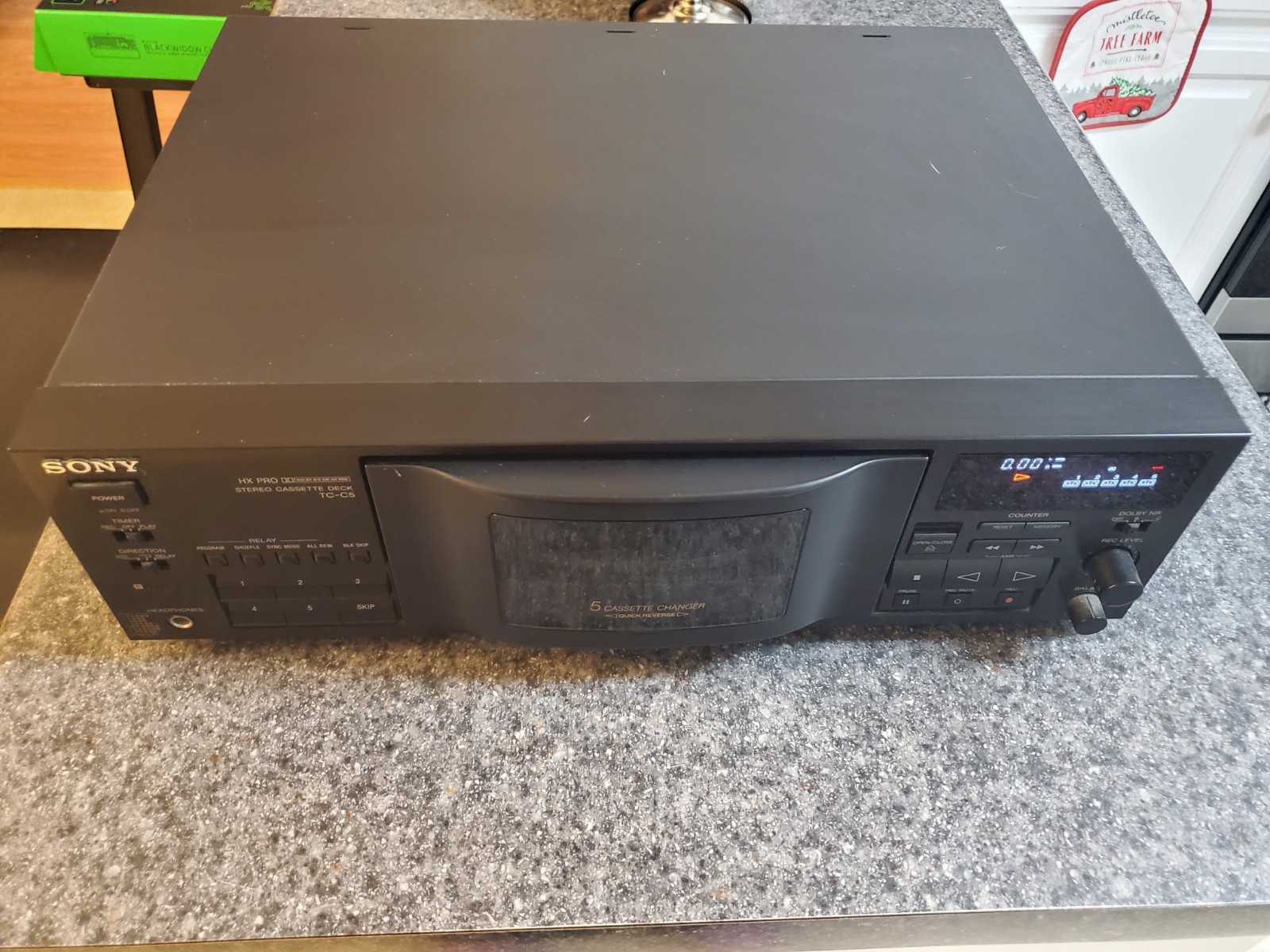
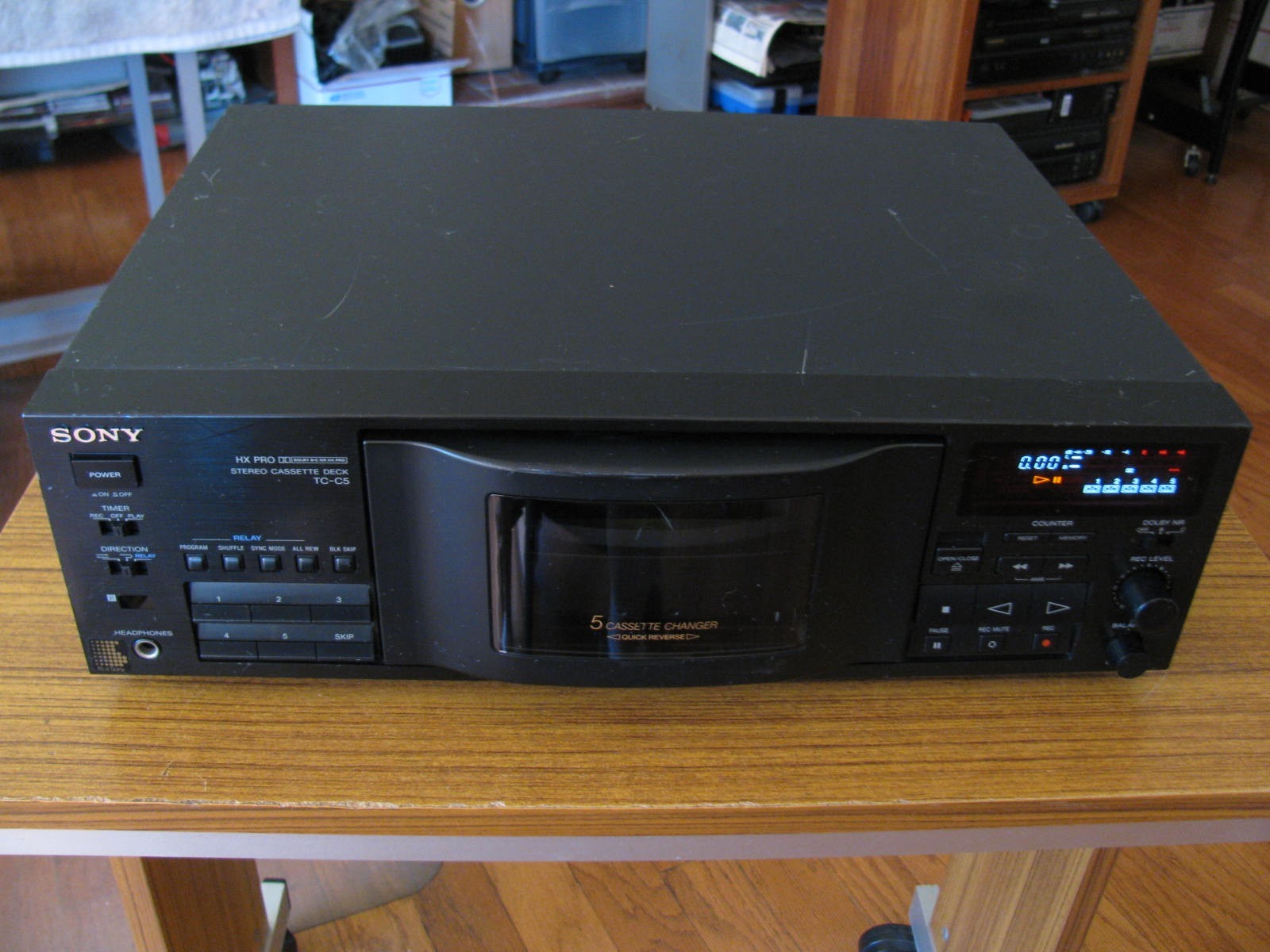
Forget dual decks — the Sony TC-C5 plays a different game entirely. Released in 1992, this isn’t just a cassette deck; it’s a five-tape carousel with a rotating drum that silently swaps cassettes like a robotic DJ. At a time when CDs were dominating and cassette decks were shrinking or vanishing, Sony doubled down on tape with something almost anachronistic: a high-end, fully automated changer aimed at the serious home listener. Priced at ¥53,000 at launch, it wasn’t cheap, and it wasn’t subtle — weighing in at 6.9 kg and stretching nearly half a meter wide, this thing commands space like a piece of lab equipment. It’s a machine built for people who wanted to stack tapes and walk away, whether for long recording sessions or uninterrupted playback. And while it lacks the warmth some associate with vintage analog gear, it delivers precision — cold, clean, and exacting.
Specifications
| Manufacturer | Sony |
| Year of Production | 1992 |
| External dimensions | 430 x 135 x 350 mm (w/h/d) |
| Weight | 6.9 kg |
| Power consumption | 18W |
| Power requirements | US, Canadian model : 120V AC, 60Hz; AEP, Germany model : 220—230V AC, 50/60Hz; UK model : 240V AC, 50/60Hz; E model : 120, 220, 240V AC, 50/60Hz |
| Tape Speed | 4.76 cm/s |
| Heads | Erasing head x 1 (ferrite head), Playback/Recording head x 1 (LA head) |
| Motors | Capstan motor x 1 (DC servo motor), Reel motor x 1 (DC motor), ASIST (mechanical drive) motor x 3 (DC motor) |
| Signal-to-noise ratio (Dolby NR OFF, Type IV/Sony METAL-SLT) | 59 dB |
| Signal-to-noise ratio (Dolby B, Type II/Sony UX-S) | 73 dB |
| Signal-to-noise ratio (Dolby C, Type II/Sony UX-S) | 78 dB |
| Frequency response (Dolby NR OFF, Type IV/Sony METAL-SLT) | 30 - 19,000 Hz (±3 dB, IEC) |
| Wow and flutter | 0.09% W. Peak (IEC), 0.06% WRMS (NAB) |
| Total harmonic distortion | 1% (with Sony METAL-SLT cassette) |
| Fast-winding time | Approx. 90 sec. (with Sony C-60 cassette) |
| Line inputs (phono jacks) Sensitivity | 77.5 mV |
| Line inputs (phono jacks) Input impedance | 47 k ohms |
| Line outputs (phono jacks) Rated output level | 0.3 V at a load impedance of 47 kohms |
| Line outputs (phono jacks) Load impedance | Over 10 k ohms |
| Headphones (stereo phone jack) Output level | 0.3 mW at a load impedance of 32 ohms |
| Attachment | Wireless Remote Control RM-J801 |
Key Features
Five-Tape Carousel with Rotating Drum
The TC-C5 isn’t just a deck — it’s a cassette robot. At its core is a rotating drum that holds five tapes and automatically swaps them, making it a cassette changer designed for the consumer market. This wasn’t for casual listening; it was for programming long sessions, archiving records, or setting up unattended recording marathons.
PC-OCC Wound Laser Amorphous Head
Sony didn’t cut corners on the playback side. The TC-C5 uses a laser-amorphous head wound with PC-OCC (Pure Copper Crystal Oriented Conductivity) wire — a material known for lower resistance and cleaner signal transfer. This isn’t just marketing fluff; it’s the kind of head technology usually reserved for top-tier decks, and it contributes to the tight frequency response and low distortion figures. Paired with AC bias and a dedicated erase head, it’s built for accuracy, not coloration.
Dolby HX Pro and Multi-Mode Noise Reduction
The deck supports Dolby B, C, and HX Pro — a rare combination that gives it flexibility across tape types. With Dolby C and Type II tape, the signal-to-noise ratio hits 78 dB, which is excellent for a consumer deck. HX Pro (Headroom Extension) further improves high-frequency headroom during recording, especially with metal tapes, allowing for cleaner transients without distortion. This isn’t just about reducing hiss — it’s about maximizing the dynamic range of the cassette medium itself.
CD Sync Recording and AMS
One of the more forward-thinking features is CD sync recording, which lets you trigger recording from a CD player — handy for making tape copies with precise start points. It also includes AMS (Automatic Music Sensor), which detects silence and can be used to auto-skip or segment recordings. Combined with the Auto Space REC MUTE function, it’s designed for clean, gap-free archiving. The FL linear electronic counter even displays time in minutes and seconds, synced to tape movement, so you can log recordings with precision.
Wireless Remote and User Interface
Control is handled via the included RM-J801 wireless remote, which was high-end for its time. The front panel includes a peak level meter with peak hold — critical for avoiding distortion during recording — and soft-touch controls that feed into a microcontroller-driven system. One known component, the relay slider switch (S971), toggles between single, dual, and relay play modes, using a clever resistor ladder setup to signal the microcontroller. While no widespread failure modes are documented beyond this switch, the complexity means that when something goes wrong, it’s rarely simple.
Collectibility & Value
The Sony TC-C5 is rare — so rare that one used unit recently listed for $1,295 on SpenCertified, described simply as "rare" and "used." That price isn’t typical of most vintage cassette decks, even high-end ones, suggesting either a niche collector market or extreme scarcity. One owner reports having used theirs for over 20 years with near-perfect function, which hints at durability when maintained. But with no widespread data on common failures beyond the relay switch circuitry, repairability is a gamble. Service manuals exist, but sourcing parts — especially for the carousel mechanism — could be a challenge. It’s not a beginner’s deck, but for someone deep into Sony’s late analog experiments, it’s a fascinating artifact: a last gasp of innovation in a dying format.
eBay Listings


As an eBay Partner, we earn from qualifying purchases. This helps support our independent vintage technology research.
Related Models
- Sony TC-2050SD (1978)
- Sony TC-2130A (1974)
- Sony TC-2220 (1972)
- Sony TC-FX6 (1982)
- Sony TC-K96R (1986)
- Aiwa AD-F990 (1993)
- Kenwood KX-3060 (1982)
- Stromberg-Carlson RS-404 (1975)
- Akai CS-F33R (1985)
- Akai DX-59 (1983)