Sony TC-2850SD (1973)
The machine that made portable stereo recording possible — heavy as a brick, built like a tank, and the first of its kind.
Overview
You can almost hear the tape spinning before you even press play — not because it's loud, but because the Sony TC-2850SD carries a kind of legend in its chassis. Released in 1973, this was the world’s first stereo portable compact cassette recorder, a title that might sound like marketing fluff until you realize just how much it changed the game. Before this, serious recording meant lugging around reel-to-reel monsters or settling for mono cassette portables that sounded like they were recorded through a wall. The TC-2850SD smashed that barrier. It wasn’t just another cassette deck with a handle — it was a portable professional stereo cassette recorder, built to standards that made broadcasters take notice. And they did. So much so that in Japan, any portable cassette machine started getting called a “Densuke,” after Sony’s earlier professional portables — a nickname that stuck to this one like glue.
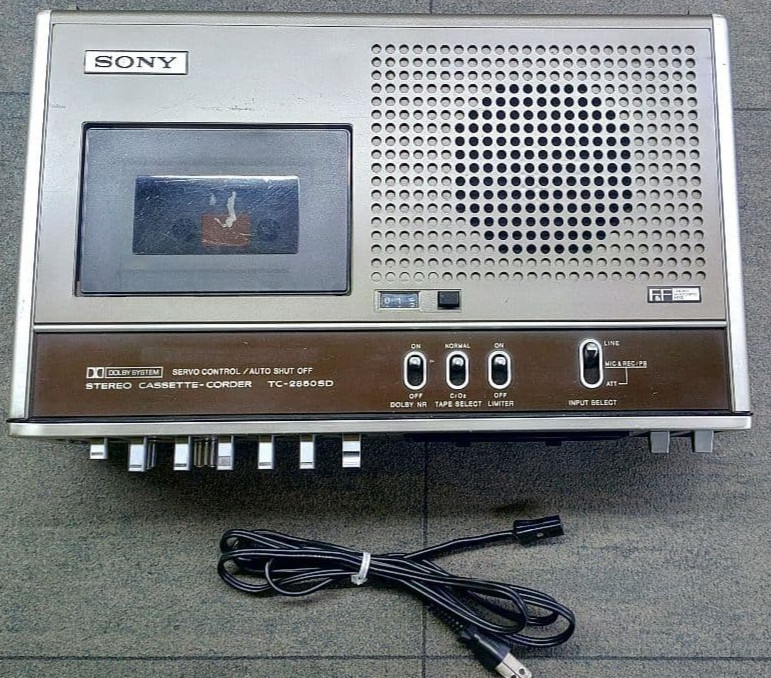
It’s hefty — 5.4kg, to be exact — but that weight tells a story of durability. The brown and silver metal case isn’t trying to be sleek; it’s trying to survive. This thing was made to go places, with a convenient strap for transport and a build quality that didn’t flinch at being tossed in a car trunk or carried into the field. It wasn’t just for engineers, either. Its combination of high quality and relative affordability sparked the 'Namaroku boom' — a wave of amateur field recording across Japan in the 1970s where people chased the sounds of trains, street markets, and nature with a new kind of sonic curiosity. The TC-2850SD was at the heart of that movement, a tool that democratized stereo recording in a way no one had managed before.
But let’s be clear: it wasn’t perfect. While it offered exceptional recording fidelity for its time and form factor, it had competition almost immediately. The Nakamichi 550, also released around 1973, was already being called superior in quality by users who had both. That’s not a knock on the Sony — it’s just that innovation moved fast. The TC-2850SD wasn’t trying to be the last word in fidelity; it was trying to be the first word in portability, and on that front, it delivered.
Specifications
| Manufacturer | Sony |
| Year of Production | 1973 |
| Product Type | Portable stereo cassette recorder |
| Frequency Characteristic | 30 Hz ~ 15 kHz (When Using Chromicassette) |
| External Dimensions | Width 378 x Height 108 x Depth 238 mm |
| Weight | 5.4kg |
| Power Source | Compatible with 100 VAC, dry batteries, rechargeable batteries, and car batteries |
| Heads | F & F head |
| Motor | DC servo motor used in professional machines |
| Transport | Belt driven single-capstan transport |
| Tape Counter | Analog 3 digit tape counter |
| Tape Type Selection | Support for normal and chrome tapes |
| Features | Peak limiter (Sony Limiter recording method), manual or automatic recording levels, VU meter lighting, stereo headphone monitor, 20 dB microphone attenuator, line/microphone selector switch, built-in amplifier and speaker for monitor, battery check |
Key Features
Professional-Grade Transport and Motor
Inside that rugged shell is a belt-driven single-capstan transport system — not the three-motor beasts that would come later, but still a serious design for 1973. What really sets it apart is the DC servo motor, the same type used in Sony’s professional reel-to-reel machines. That wasn’t just a spec sheet flex; it meant stable tape speed and consistent performance, even on battery power. Combined with the F & F (Ferrite & Ferrite) head, it delivered a level of fidelity that made it viable for broadcast use, not just hobbyists.
Sony Limiter: The Safety Net for Live Recording
One of the standout features is the Sony Limiter recording method — a peak limiter designed to prevent distortion during sudden loud inputs. In an era before digital clipping warnings and undo buttons, this was crucial. Whether you were recording a live speech, a street performance, or a train whistle, the limiter acted as a guardrail, keeping levels from peaking into distortion. It wasn’t a noise reduction system like Dolby, but it was just as important for field recording. And yes, despite one source claiming Dolby-B, the higher-authority specs confirm: there is no Dolby NR on this model. What you get is raw, unprocessed analog capture — with a little analog intelligence built in.
Power Flexibility That Meant Real Portability
The TC-2850SD didn’t just run on four C-cell batteries (though it did). It could also use rechargeable packs, AC power, or even a car battery — a rare level of versatility in 1973. That wasn’t just convenient; it was revolutionary. Being able to plug into a car battery meant you could record for hours in remote locations. The built-in stabilizing power supply and DC-DC converter ensured that voltage stayed steady, preventing speed fluctuations that could ruin a take. This wasn’t a toy with a battery check light — it was a tool with serious power management.
Controls and Monitoring: Built Like a Studio Machine
The switches don’t click — they toggle with a solid, mechanical heft that feels more like a broadcast console than a portable recorder. Everything from the line/microphone selector to the tape type switch is laid out with functional clarity. The L/R level meters are front and center, with VU meter lighting that makes them readable in low light. There’s a built-in amplifier and speaker for quick monitoring — not high fidelity, but enough to verify your recording is happening. And if you want real monitoring, there’s a stereo headphone output. Add in the 20 dB microphone attenuator for handling hot line-level signals, and you’ve got a machine that can handle more than just casual use.
Historical Context
The Sony TC-2850SD didn’t just enter the market — it created a category. As the world’s first stereo portable compact cassette recorder, it redefined what was possible in field recording. Before 1973, portable stereo was either nonexistent or prohibitively expensive. This machine changed that, offering a level of quality and portability that sparked the 'Namaroku boom' — a cultural wave in Japan where amateur recordists took to the streets, capturing everyday sounds with a newfound accessibility. It wasn’t just a gadget; it was a cultural catalyst.
Its nickname, “Cassette Densuke,” came from Sony’s line of professional portable tape recorders, and the name stuck because this thing earned it. Broadcasters began using it, and the term “Densuke” eventually became generic for any portable cassette recorder in Japan — a testament to its influence. But it wasn’t alone for long. The Nakamichi 550, released around the same time, was already being praised for superior quality, showing how quickly the field evolved. The TC-2850SD wasn’t the best for long — but it was the first, and that matters.
eBay Listings


As an eBay Partner, we earn from qualifying purchases. This helps support our independent vintage technology research.
Related Models
- Sony TC-2050SD (1978)
- Sony TC-2130A (1974)
- Sony TC-2220 (1972)
- Sony TC-FX6 (1982)
- Sony TC-K96R (1986)
- Aiwa AD-F990 (1993)
- Kenwood KX-3060 (1982)
- Stromberg-Carlson RS-404 (1975)
- Akai CS-F33R (1985)
- Akai DX-59 (1983)