Sony MZ-S1 (2002)
A "Sports" NetMD recorder that sold for $180 and treated a fragile disc format like something you could take to the gym.
Overview
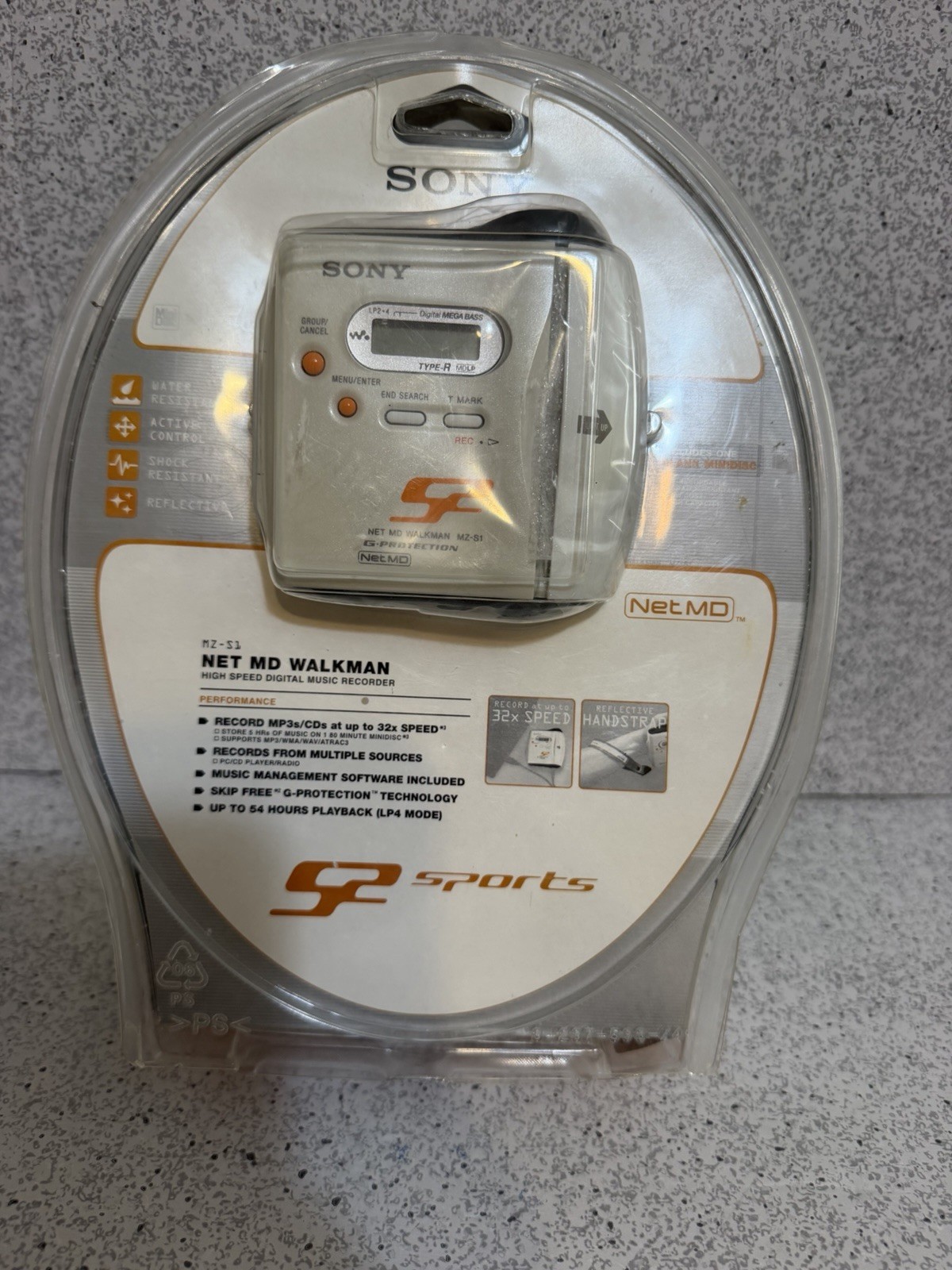
The MZ-S1 arrived in April 2002 with the "Sports" tag. Sony's own catalog listings call it a "'Sports' portable NetMD recorder." That is a strange thing to say about a MiniDisc deck, until you remember how hostile the format's early portables were to actual use. NetMD, the USB-tethered variant of the MiniDisc ecosystem, was the pitch: transfer from a PC, then leave the computer behind. The MZ-S1 was positioned as the version of that idea you could knock around.
At a US$180 list price it sat in the affordable middle of Sony's portable recorder range, not the flagship tier. Aftermarket listings still use names like "NetMD SONY Walkman MZ-S1 Sport," so the identity stuck in the used market for years. The "Sports" descriptor is the one thing two independent catalog sources agree on most consistently. This was a recorder for people who wanted to capture rehearsals and make playlists without treating the hardware like laboratory equipment. The fact sheet's own editorial framing calls out musicians recording rehearsals as a target use. That fits the feature set: on-device track editing, a line input for pulling audio off anything with an output, and a headphone jack with its own volume control.
A date note for anyone cataloguing these. The MiniDisc Wiki portable table carries an ambiguous "2005/04" entry, but two corroborating MDCP pages independently give an intro of 4/2002. The 2002 date is the one to trust. The wiki figure looks like a table-column artifact.
Key Features
ATRAC Compression with SP and LP Modes
The MZ-S1 used Sony's ATRAC (Adaptive Transform Acoustic Coding) compression, the codec in every MiniDisc machine. Recording modes included SP (Standard Play) and LP (Long Play), a straightforward trade between disc capacity and fidelity. The fact sheet doesn't pin down which ATRAC revision the S1 used, so treat any claim of a specific version number as unverified. The SP/LP mode structure is the documented part.
NetMD and PC Connectivity
The "NetMD" in the model's catalog description is the whole point of the S1's generation: a PC link for getting music onto discs, then a portable player that stands on its own. The detec.in marketplace listing gives the hardware platform as "PC." That is boilerplate-flavored and single-source, but it's consistent with the NetMD identity. Treat the "supported formats: MP3, WAV, WMA" line from that same listing with caution. It reads like marketplace spec-block filler rather than a Sony datasheet, and no second source corroborates it.
LCD Display and On-Device Editing
The front-panel LCD shows track numbers, remaining recording time, and battery life. The MZ-S1 also let users edit tracks directly on the device, so splitting, reordering, and titling didn't require a trip back to the computer. The fact sheet describes this for the rehearsal-room use case.
Line Input, Headphone Output, and Battery Power
Connectivity covers a line-in for direct recording from external sources and a headphone jack with volume control. Power came from an LR6 (size AA) alkaline battery (not supplied). Battery life figures are documented for an LR6 (SG) alkaline dry battery: recording of 9 hours (Normal), 13 hours (LP2), and 16 hours (LP4); playback of 40 hours (Normal), 49 hours (LP2), and 54 hours (LP4). Any other "X hours" claim floating around the web about this model is suspect, since some of it belongs to entirely different Sony products.
"Sports" Construction and the MT-MZN707-177 Mechanism
Sony described the construction as durable, and the service documentation shows real mechanical substance inside. The mechanism deck is designated MT-MZN707-177, with a sled motor listed as Motor Sled M602 and the optical pickup assembly as OP Service Assy LCX-5R. The main board carries a spread of ICs including the AK5354VT-E2, TA2131FL EL, SN761057ADBT, SC111258FCR2, XPC18A22AFCR2, and XPC18A32AFCR2. None of that tells you how it sounds. It does tell a technician what they're looking at when the lid comes off, and a playback-error repair is one of the few documented failure stories attached to this model.
Historical Context
The MZ-S1 launched in the early 2000s - April 2002 per two corroborating catalog sources - as part of Sony's broad portable recorder lineup, and it appears in the MiniDisc Wiki's portable equipment table as a recorder. It was marketed to audiophiles and casual listeners alike, with the pitch that it delivered high-quality sound in a portable package. The fact sheet also frames it as an ideal choice for musicians recording rehearsals and for consumers building custom playlists. At $180 it was priced to move units, which fits a "Sports" variant designed to survive being carried around.
eBay Listings


As an eBay Partner, we earn from qualifying purchases. This helps support our independent vintage technology research.