Sony MDS-JB920
A MiniDisc deck whose pitch control reaches down to −98.5% — a studio tool hiding in a consumer chassis.
Overview
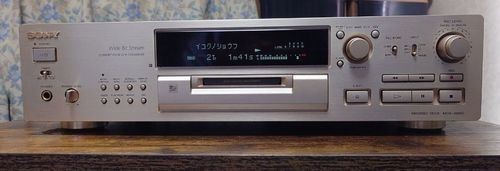
The MDS-JB920 is a Sony MiniDisc deck built around the ATRAC codec, and the spec sheet that ships with it reads less like a hi-fi component and more like a small studio machine. Contemporary coverage of MiniDisc recorders in the late 1990s, such as HiFi-Stereo (October 1998, p.62), framed the format among the broader wave of digital recorders then reaching consumers.
The frequency response is quoted at 5 to 20,000 Hz ±0.3 dB, the signal-to-noise ratio is given as over 100 dB during playback, and wow and flutter are listed as below measurable limit — which, for a disc-based digital format, is the point. What surprises collectors is how far Sony pushed the playback controls: the deck's fine pitch function moves playback speed in 0.1% increments across a range from −98.5% to +12.5%, adjustable through the setup menu. That is not a feature aimed at the living-room listener. That is a feature aimed at someone learning a part, transcribing a phrase, or matching a track to a performance.The system itself is standard first-generation MiniDisc architecture: a 780 nm semiconductor laser with continuous emission, a GaAlAs laser diode, constant linear velocity rotation between 400 and 900 rpm, Advanced Cross Interleave Reed Solomon Code error correction, 44.1 kHz sampling, and EFM modulation. The output is held to less than 44.6 µW measured at 200 mm from the objective lens with a 7 mm aperture — the kind of figure that only appears in a manual because a regulator demanded it, but it tells you the deck was documented to a level of precision most consumer gear never sees.
Connections are generous for the period. There are two square optical digital inputs (660 nm), one coaxial digital input on a phono jack rated 0.5 Vp-p ±20% into 75 ohms, and a line-level analog input on phono jacks with 47 kilohm impedance, 500 mVrms rated and 125 mVrms minimum. The digital input bit length is selectable between 24-bit, 20-bit, and 16-bit, defaulting to 20-bit — a menu setting rather than a fixed hardware path.
The deck's editing and playback conveniences are where the manual spends most of its pages. Setup menu 02 sets the track marking function, with a default of T.Mark LSyn; menu 03 sets the reference level for that automatic marking, adjustable from −72 to −0 dB and shipped at −50 dB. Menu 04 handles Auto Space and Auto Pause, menu 05 controls Smart Space and Auto Cut (on by default), menu 06 enables the peak hold on the level meters, menu 07 sets music-scan playback time between 6 and 20 seconds, and menus 08 and 09 set fade-in and fade-out durations from 1.0 to 15.0 seconds, both defaulting to 5.0. Menu 10 changes playback speed by automatic steps from −48 to +2, and menu 11 is the fine control described above. The two are linked: changing one value changes the other, so a user who dials in a fine offset and then touches the coarse pitch will find the fine setting has moved with it.
A few operational quirks are worth knowing before buying. The playback sound drops out momentarily whenever the fine control value is changed, and the fine setting returns to 0% whenever the deck is powered off or the disc is ejected. In other words, the pitch offset is a session setting, not a stored preference — a deliberate design choice, but one that will annoy anyone who wanted a permanent transpose.
The service documentation shows a machine built around a CXD2654R DSP and a system controller designated IC800, with the optical pickup block reporting focus OK, track jump detection, and spindle servo lock status back to the controller over a serial bus. The pickup assembly carries a temperature sensor and an automatic power control loop, and the service manual's alignment procedure walks a technician through read-power and write-power traverse adjustment with an oscilloscope on the BD board, saving each result to non-volatile memory. None of this is unusual for the era, but it does mean the MDS-JB920 is a deck that can be serviced properly by someone with the manual and a scope, rather than being a sealed black box.
Collectors should note that the fact sheet for this model is thin on market history — production years, original price, and current resale values are not documented here, and this page will not guess at them. What is documented is a well-specified MiniDisc deck with an unusually deep pitch-control implementation and a full complement of digital inputs, and that combination is the reason it turns up in studio-adjacent setups rather than only in living rooms.
eBay Listings



As an eBay Partner, we earn from qualifying purchases. This helps support our independent vintage technology research.