Sony CDP 502 ES (1987)
That first shimmering note from a CD back in the day? This player made it feel like magic—solid, detailed, and startlingly alive.
Overview
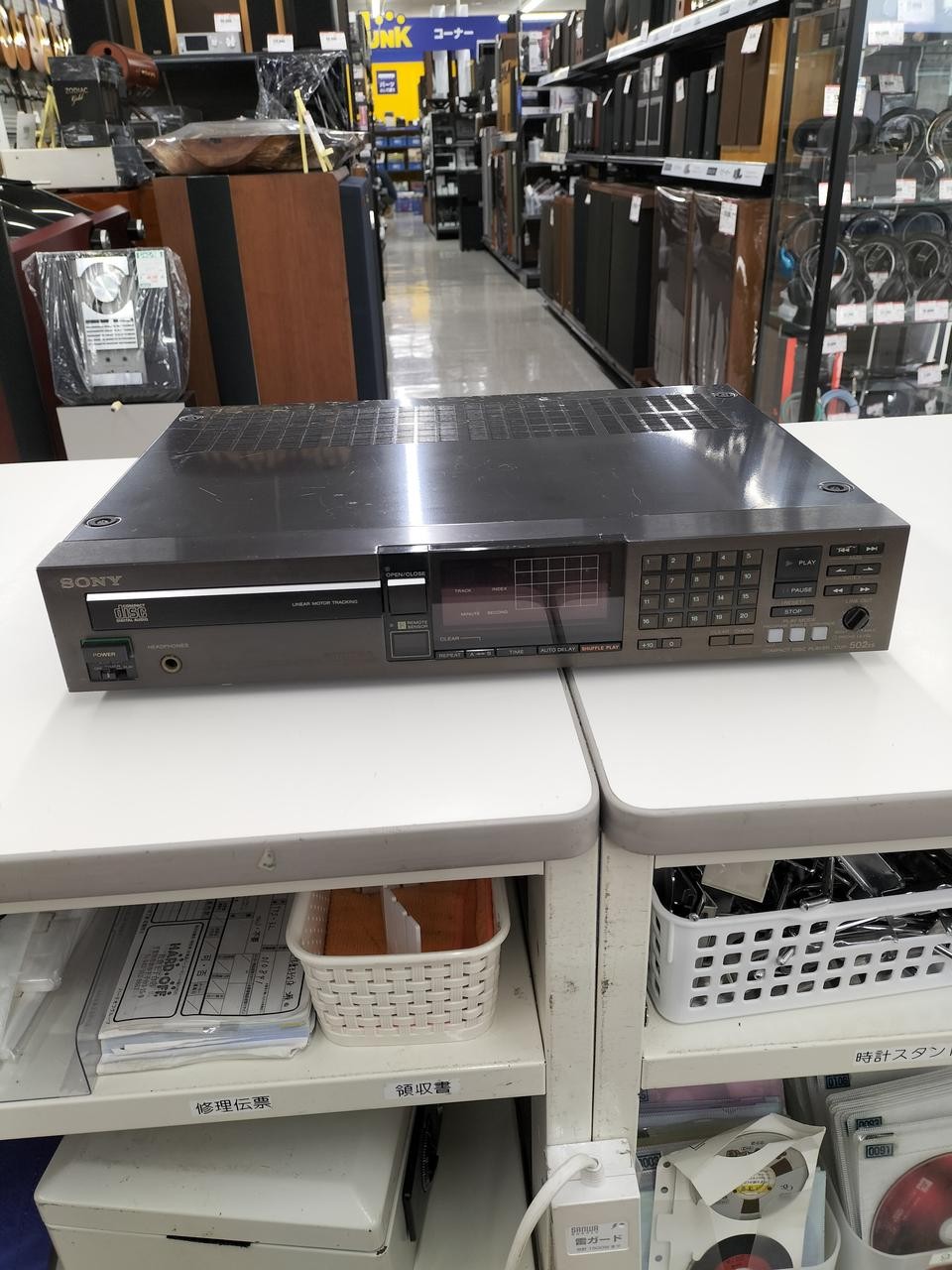
If you were lucky enough to buy a CD player new in 1987, there’s a good chance it was something like the Sony CDP 502 ES—an unassuming black box that quietly redefined what home audio could be. It wasn’t flashy, didn’t come with a remote (at least not always), and didn’t pretend to be a luxury item, but it delivered something far more important: transparency. Early CD players often sounded clinical or brittle, like they were trying too hard to prove how “digital” they were. The 502 ES didn’t do that. It let the music breathe, with a smooth top end, solid imaging, and a sense of authority that made you forget you were listening to ones and zeros. This was Sony’s ES (Elevated Standard) line doing what it did best—taking cutting-edge tech and making it musical.
Positioned just below the flagship CDP-552ES, the 502 ES shared much of its DNA: the same beefy power supply, discrete output stages, and that legendary KSS-120C laser pickup known for its longevity and tracking precision. It wasn’t just reliable—it was *fast*. Load times were snappy for the era, and disc recognition was nearly instantaneous. Owners still rave about how few discs it refused to read, even today. The transport was built like a tank, with a die-cast chassis and thoughtful isolation to minimize vibration. No plastic gears here—this was serious hardware, wrapped in a minimalist front panel with a fluorescent display that glowed a soft green, the kind you’d catch glimpses of in a dark room like a tiny lighthouse.
What made the 502 ES special wasn’t just its specs, but its timing. 1987 was the year CDs started to feel inevitable. LPs still ruled, but the future was optical, and Sony—having co-created the format—was leading the charge. The 502 ES was a gateway drug: affordable enough for serious enthusiasts but built to standards that rivaled much pricier gear. It didn’t try to be warm like vinyl or hyper-detailed like some later digital players. It just told the truth, with a neutrality that aged remarkably well.
Specifications
| Manufacturer | Sony |
| Production Years | 1987 |
| Model | CDP 502 ES |
| Series | ES (Elevated Standard) |
| Disc Compatibility | Compact Disc (CD) |
| Laser Pickup | KSS-120C |
| Frequency Response | 5Hz to 20kHz |
| Dynamic Range | 90dB |
| Total Harmonic Distortion | 0.005% |
| S/N Ratio | 105dB |
| Digital Output | Coaxial (RCA) |
| Analog Outputs | 2 x RCA (L/R) |
| Headphone Output | 1/4" stereo jack |
| Power Supply | AC 120V, 60Hz (North America) |
| Power Consumption | 14W |
| Dimensions | 430 x 107 x 288 mm (W x H x D) |
| Weight | 7.5 kg (16.5 lbs) |
| Remote Control | Optional (not included with all units) |
Key Features
Discrete Output Stage & ES Build Quality
Unlike many mid-tier CD players of the late '80s that cut corners with integrated circuits, the CDP 502 ES used a discrete output amplifier stage—a hallmark of Sony’s ES line. This meant cleaner signal paths, better channel separation, and a more dynamic presentation. It wasn’t just about fidelity on paper; you could hear it in the way strings didn’t glare, how kick drums had weight without bloat, and how vocals stayed anchored in space. The entire unit was built around a rigid, non-resonant chassis with a heavy steel base and internal shielding to protect sensitive analog circuits from digital noise. It felt like it could survive a move, a power surge, or a minor earthquake—because many of them did.
KSS-120C Laser Mechanism
The KSS-120C was Sony’s workhorse laser in the late '80s, and in the 502 ES, it was tuned for reliability and accuracy. Unlike cheaper mechanisms that skipped or struggled with warped discs, this one tracked with confidence. Service technicians still note that the KSS-120C is one of the more repairable and durable pickups of the era—belts and flex cables wear out, yes, but the core mechanism is robust. Owners report fewer “laser failures” than with many contemporaries, and when problems do arise, they’re often mechanical (like belt slippage) rather than electronic decay. That’s a big deal when you’re talking about 35+ year-old gear.
Fluorescent Display & User Interface
The 502 ES featured a bright, easy-to-read fluorescent display that showed track, time, and play status with clarity. No cryptic symbols or dim LEDs here—this was information you could read across a room. The buttons had a satisfying mechanical click, and the layout was intuitive: play, stop, skip, repeat, and program functions were all within reach. It didn’t have the flash of later players with graphic displays or infrared remotes as standard, but it didn’t need them. Everything worked, every time. And if you did have the optional remote, it added convenience without complicating the core experience.
Historical Context
The CDP 502 ES arrived at a pivotal moment. By 1987, the CD format had proven itself, but it was still shedding its “gimmick” reputation among audiophiles. Many listeners missed the warmth of vinyl, and early digital players often sounded harsh or lifeless. Sony’s ES series was a direct response: high-performance components that treated digital music with the same seriousness as their analog predecessors. The 502 ES sat in the sweet spot of the lineup—below the exotic CDP-552ES and CDP-303ES but above the basic CDP-302. It offered 90% of the flagship’s performance at a much more accessible price.
Competitors like Pioneer, Denon, and Marantz were also pushing quality CD players, but few matched Sony’s integration of mechanical reliability and sonic refinement at this price. The 502 ES wasn’t trying to beat the competition with specs—it did it with consistency. It was the kind of player you could buy, hook up, and forget about, knowing it would work flawlessly for years. That reliability, combined with its musicality, made it a favorite among early adopters and a staple in high-end systems of the late '80s.
Collectibility & Value
Today, the Sony CDP 502 ES is a quietly sought-after piece. It’s not as flashy as some of Sony’s later ES models, but it’s respected for its durability and sound. Units in working condition typically sell between $150 and $300, depending on completeness. A fully tested player with original box, remote, and manual—especially in “mint” condition—can fetch closer to £200 or more, as one UK listing noted. But condition is critical: these players are over 35 years old, and common issues include dried-up belts, worn flex cables, and failing electrolytic capacitors in the power supply.
The most frequent failure point is the drawer mechanism. If the belt slips or breaks, the tray won’t open or close properly. Some units get stuck in the “closed” position, requiring manual override from the bottom. While the KSS-120C laser is durable, it’s not immortal—eventually, the diode can weaken, leading to read errors. A full service—recapping, belt replacement, laser cleaning—can run $100–$150, so factor that into any purchase. Look for units with clean displays, responsive buttons, and confirmed playback. Avoid anything with a flickering display or sluggish tray—those are red flags.
Despite its age, the 502 ES holds up surprisingly well in modern systems. Its coaxial digital output lets it serve as a transport, and its analog stage remains competent. For vintage audio enthusiasts, it’s a solid entry point into ES-era Sony—less expensive than the 552 but more refined than the basic models. It’s not rare, but it’s not disposable either. Treat it right, and it’ll keep spinning discs for another 35 years.
eBay Listings



As an eBay Partner, we earn from qualifying purchases. This helps support our independent vintage technology research.
Related Models
- Akai CD-37
- Arcam Alpha 9 (1990s)