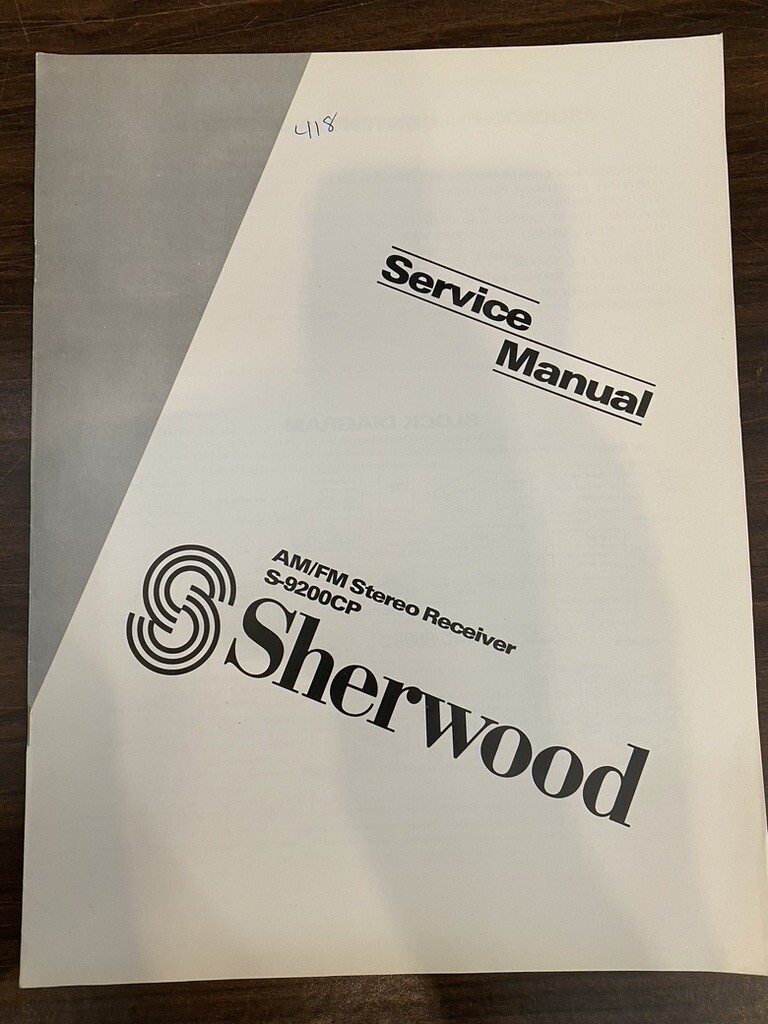
Sherwood S-9200CP: The Apex of Sherwood’s Cassette Engineering
In the early 1980s, the cassette deck evolved from a portable convenience into a serious high-fidelity audio format. At the forefront of this transformation stood brands like Nakamichi, Sony, and TEAC—but nestled among these giants was Sherwood, a brand often overlooked yet quietly delivering exceptional performance and engineering in its top-tier models. The Sherwood S-9200CP, introduced in 1982, stands as one of the company’s most accomplished cassette decks, representing the peak of Sherwood’s analog tape engineering. Though not as widely celebrated as some of its Japanese counterparts, the S-9200CP offers a compelling blend of precision mechanics, advanced noise reduction, and audiophile-grade circuitry that earns it a respected place in the vintage audio pantheon.
Technical Specifications
| Specification | Detail |
| Model | S-9200CP |
| Manufacturer | Sherwood Electronics |
| Year Introduced | 1982 |
| Type | 3-Head Stereo Cassette Deck |
| Tape Speed | 1⅞ ips (4.76 cm/s) |
| Heads | Separate Record, Playback, and Erase Heads |
| Motor System | Dual Direct-Drive Motors (Capstan & Reel) |
| Transport Mechanism | Full Manual (Touch-Logic) with Quartz Lock |
| Noise Reduction | Dolby B, Dolby C |
| Frequency Response | 30Hz – 18kHz (Type IV Metal) |
| Wow & Flutter | < 0.055% (WRMS) |
| Total Harmonic Distortion | < 1.5% (at 3% output) |
| Signal-to-Noise Ratio | 72 dB (Dolby C, Metal Tape) |
| Input/Output | RCA Line In/Out, 3.5mm Mic In |
| Power Requirement | 120V AC, 60Hz |
| Dimensions (W×H×D) | 430 × 140 × 330 mm (17 × 5.5 × 13 in) |
| Weight | 9.8 kg (21.6 lbs) |
Sound Characteristics and Performance
The Sherwood S-9200CP was engineered for high-fidelity tape reproduction, and it delivers with a sonic profile that balances warmth, clarity, and dynamic range. Thanks to its three-head configuration, the S-9200CP allows for true separate record and playback paths, meaning the machine can monitor playback in real time during recording—a feature previously reserved for professional decks.
Using Type IV metal tapes, the S-9200CP achieves a frequency response that rivals many reel-to-reel systems of the era, extending cleanly to 18 kHz with minimal roll-off. The inclusion of Dolby C noise reduction—still relatively new in 1982—significantly reduces tape hiss, especially on the high end, making it ideal for classical and acoustic recordings where silence between notes matters.
Listeners often describe the S-9200CP’s sound as detailed yet musical, with a slightly forward midrange that brings vocals and instruments to life. Bass response is tight and well-controlled, avoiding the flabbiness that plagued lesser decks. The dual direct-drive motors ensure stable tape tension and speed accuracy, contributing to a low wow and flutter performance that enhances the overall realism of the playback.
Notable Features and Innovations
The S-9200CP wasn’t just another cassette deck—it was a statement of engineering intent. Among its standout features:
- Quartz-Locked Transport: This ensures precise tape speed stability, critical for maintaining pitch accuracy and minimizing timing variations. Few consumer decks at the time offered quartz speed control, placing the S-9200CP in elite company.
- Manual Touch-Logic Transport: Unlike fully automatic decks that used microprocessors and solenoids, the S-9200CP featured a manual transport system with tactile, high-quality buttons. This design reduced mechanical complexity and improved long-term reliability.
- Three-Head Design with Azimuth Adjustment: The separate playback head allows for independent azimuth calibration, enabling users to fine-tune high-frequency response for optimal clarity. This level of user control was rare outside of professional gear.
- Dedicated Record Level Meters: Large, dual VU meters provide real-time monitoring of recording levels, helping users avoid distortion and under-modulation. The meters are backlit for visibility in low-light environments.
- Metal Tape Compatibility: The S-9200CP was optimized for Type IV metal tapes, which offered superior dynamic range and frequency response. It includes a dedicated metal tape selector that adjusts bias and equalization automatically.
- High-Quality Internal Wiring and Shielding: Sherwood used oxygen-free copper wiring and extensive shielding to minimize crosstalk and interference, a nod to audiophile-grade construction.
Common Issues and Maintenance
Like all vintage tape decks, the Sherwood S-9200CP requires periodic maintenance to perform at its best. Common issues include:
- Deteriorated Rubber Components: The pinch roller and capstan tire can harden or crack over time, leading to speed instability or tape slippage. These should be replaced every 10–15 years or as needed.
- Worn or Dirty Heads: Playback and record heads can accumulate oxide buildup, dulling the sound. Regular cleaning with isopropyl alcohol and demagnetization are essential.
- Capstan Bearing Dryness: Over decades, lubrication in the capstan shaft can dry out, causing increased friction and motor strain. A professional lubrication service can restore smooth operation.
- Sticky Mode Switches or Buttons: The manual transport buttons may become stiff due to dried lubricant or dust. Cleaning with contact cleaner and light lubrication can resolve this.
- Dolby Circuit Drift: Over time, the Dolby C circuitry may require calibration to maintain proper noise reduction performance. This is best handled by a technician with test tapes and alignment tools.
Despite these age-related concerns, the S-9200CP is known for its robust build quality. Its steel chassis, precision-machined transport, and high-grade components make it more durable than many of its contemporaries.
Current Market Value and Collectibility
The Sherwood S-9200CP remains a sleeper classic in the vintage audio world. While it doesn’t command the sky-high prices of a Nakamichi Dragon, it offers 90% of the performance at a fraction of the cost. In excellent working condition, the S-9200CP typically sells for $250–$400 on the secondary market, depending on location and included accessories.
Its collectibility is growing among cassette enthusiasts and analog purists who appreciate its manual operation, three-head design, and high-spec engineering. It’s particularly sought after by those building vintage home studios or restoring classic audio systems from the early '80s.
Because Sherwood didn’t produce the S-9200CP in large quantities, and many units were used heavily during the cassette boom, fully functional, well-maintained examples are becoming increasingly rare. This scarcity, combined with its solid performance, suggests that the S-9200CP may appreciate in value over time.
Conclusion and Legacy
The Sherwood S-9200CP is a testament to a time when American audio brands could compete with the best from Japan in terms of engineering and performance. While Sherwood may not have had the same marketing muscle as Sony or Technics, the S-9200CP proves that the company was capable of producing world-class cassette decks that satisfied even the most discerning audiophiles.
Today, the S-9200CP serves as a reminder of the golden age of analog tape, when cassettes were not just convenient but capable of delivering true high-fidelity sound. For collectors, restorers, or anyone looking to experience the warmth and texture of tape in a modern setup, the Sherwood S-9200CP is a worthy and underrated contender.
If you’re lucky enough to find one in good condition—or willing to restore one to its former glory—you’ll be rewarded with a machine that blends precision, musicality, and timeless design. In the world of vintage audio, the Sherwood S-9200CP is a quiet legend waiting to be rediscovered.
eBay Listings



As an eBay Partner, we earn from qualifying purchases. This helps support our independent vintage technology research.
Related Models
- Sherwood S-7500 (1979)
- Sherwood S-7210A (1979)
- Sherwood S-7250CP (1979)
- Sherwood S-7310 (1978)
- Sherwood S-8000IV (1979)
- Sony TC-2050SD (1978)
- Aiwa AD-F990 (1993)
- Kenwood KX-3060 (1982)
- Sony TC-2130A (1974)
- Sony TC-2220 (1972)