Sherwood S-7900A: The Enigmatic Shortwave Specialist of the Late 1970s
In the golden era of shortwave listening and international broadcasting, the late 1970s saw a surge in demand for high-performance communications receivers that could bring the world into listeners’ homes. While brands like Sony, Grundig, and National (Panasonic) dominated the consumer shortwave market, Sherwood—an American company better known for its mid-tier stereo receivers and amplifiers—stepped into this niche with the S-7900A, a communications receiver that remains something of a mystery to many vintage audio enthusiasts today.
The Sherwood S-7900A is not a stereo amplifier or a home theater component. It belongs to a different category altogether: the world of communications receivers. Designed for serious radio hobbyists, this unit was built to receive AM, SSB (single sideband), and CW (continuous wave) signals across multiple HF (high frequency) bands, making it a tool for monitoring amateur radio, maritime communications, international broadcasts, and even utility stations. Though Sherwood is not typically associated with high-end communications gear, the S-7900A represents a rare and intriguing departure from their usual product line.
Historical Context and Design Philosophy
Released in 1979, the S-7900A arrived at a time when global events—Cold War tensions, international diplomacy, and the rise of citizen diplomacy through ham radio—made shortwave listening both a pastime and a political act. Sherwood, aiming to capture a segment of the serious listener market, developed the S-7900A as a precision instrument rather than a casual radio.
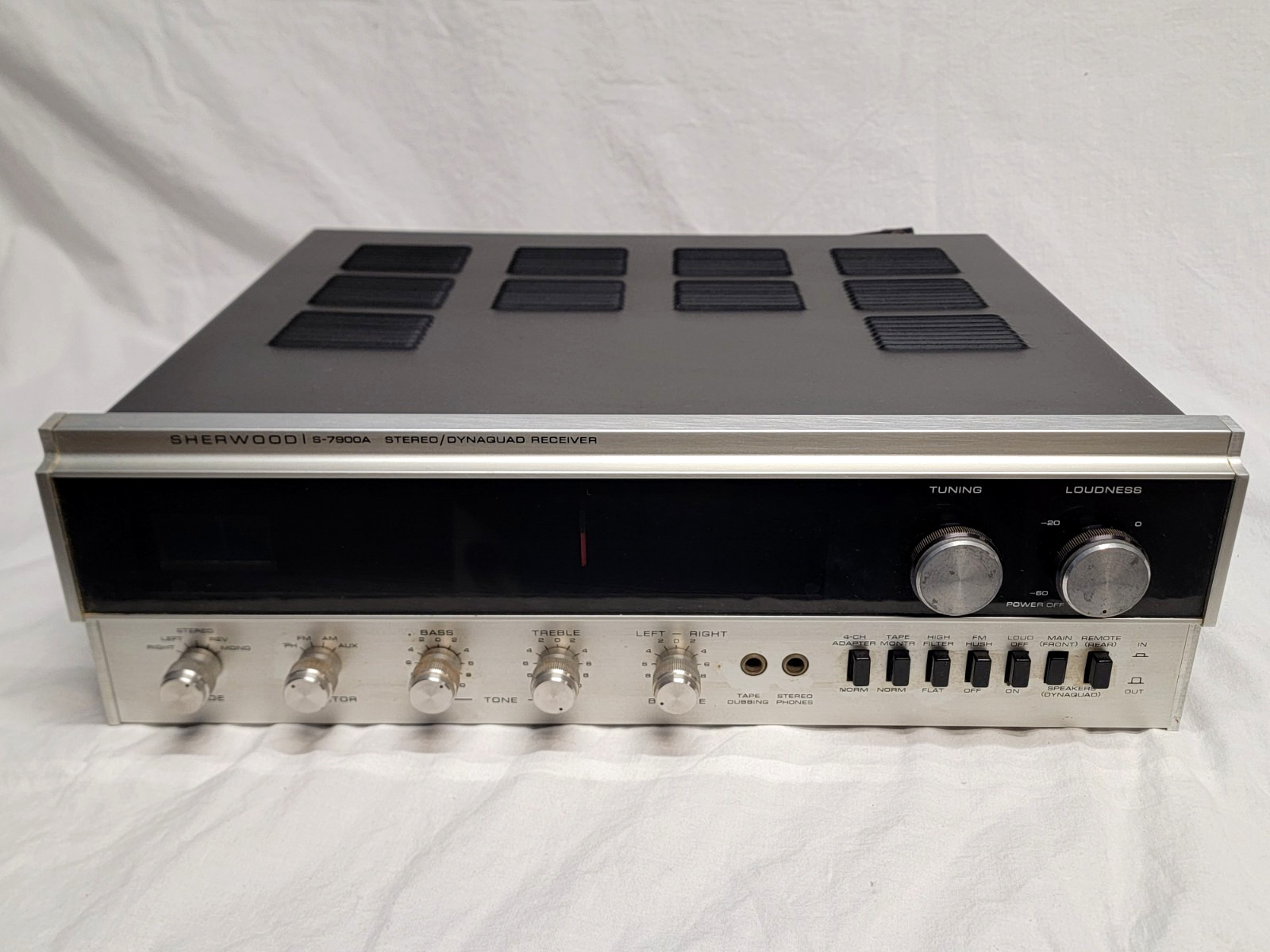
Unlike Sherwood’s more common stereo receivers of the era (like the popular RX series), the S-7900A lacks audio inputs, phono stages, or tone controls. Instead, it features a double-conversion superheterodyne architecture, a hallmark of quality communications receivers, which helps reduce interference and improve selectivity. Its front panel is dominated by a large analog dial, precision tuning knob, and a series of band and mode selectors—functional design over flash.
Though production numbers were likely low and marketing minimal, the S-7900A was positioned as a serious alternative to more established names like the Icom R-70, Drake R-4C, or even the Yaesu FRG-7. It was built during a transitional period when solid-state electronics were replacing tubes, yet before full digital synthesis became standard. As such, the S-7900A embodies the analog precision of its era with a clean, no-nonsense aesthetic.
Technical Specifications
| Feature | Specification |
| Model | Sherwood S-7900A |
| Year Introduced | 1979 |
| Type | Communications Receiver |
| Frequency Coverage | 1.8–30 MHz (HF bands) |
| Modes | AM, USB, LSB, CW |
| Tuning System | Analog dial with vernier scale, mechanical counter |
| Intermediate Frequencies | 1st IF: 9.0 MHz, 2nd IF: 455 kHz |
| Sensitivity | < 1 µV for 10 dB S/N (AM), < 0.5 µV (SSB/CW) |
| Selectivity | 6 dB bandwidth: ~2.4 kHz (AM), ~500 Hz (SSB/CW) |
| Audio Output | 1W into 8Ω (internal speaker), line-level output |
| Antenna Input | 50Ω coaxial, BNC connector |
| External Speaker | 8Ω terminal block |
| Power Supply | 120V AC, 60 Hz, ~25W |
| Dimensions | 17" W × 6" H × 14" D |
| Weight | 18 lbs |
Sound Characteristics and Performance
The S-7900A is not judged by the warmth of its audio circuitry or its stereo imaging—instead, its performance is measured in clarity, stability, and fidelity of received signals. The audio stage is clean and uncolored, designed to accurately reproduce the often weak and distorted signals picked up from across the globe.
In AM mode, the receiver delivers a full-bodied sound suitable for international broadcasters like BBC World Service or Radio Moscow. The SSB (single sideband) and CW modes, used primarily by amateur radio operators and maritime stations, are where the S-7900A truly shines. With a sharp product detector and well-tuned filters, it can pull intelligible voice and Morse code from signals that would be lost in the noise on lesser receivers.
The mechanical tuning system, while not as fast as modern digital synthesizers, offers a satisfying tactile experience. The large dial and vernier scale allow for precise frequency adjustments, and the mechanical counter helps users log frequencies accurately—a must for DXers (long-distance listeners).
Notable Features and Innovations
Despite its obscurity, the S-7900A includes several thoughtful features that reflect Sherwood’s attention to the needs of serious listeners:
- Dual Conversion Architecture: This reduces image interference and improves overall signal clarity, especially in crowded bands.
- Selectable IF Bandwidth: Though not as sophisticated as multi-filter systems in higher-end units, the S-7900A includes basic filtering optimized for AM and SSB/CW reception.
- Built-in Speaker and Headphone Jack: Uncommon in many communications receivers of the time, this makes the S-7900A more accessible for casual use.
- External Speaker and Antenna Terminals: Designed for expansion, allowing users to connect larger antennas or external audio systems.
- Sturdy Metal Chassis: Built for durability, with a heavy-duty enclosure that resists RF interference and mechanical vibration.
Common Issues and Maintenance
Due to its age and rarity, the Sherwood S-7900A can present challenges for collectors and restorers:
- Capacitor Aging: Electrolytic capacitors in the power supply and audio stages may have dried out, leading to hum or power failure. A full recap is often recommended.
- Dial Lamp Failure: The analog dial is backlit by a small incandescent bulb, which may need replacement with modern LED equivalents.
- Tuning Gear Wear: The mechanical tuning system can become stiff or noisy over time. Cleaning and lubrication of the tuning shaft and gears are essential.
- Antenna Connector Corrosion: BNC connectors are prone to oxidation, especially if used outdoors. Regular cleaning ensures optimal signal transfer.
- RF Amplifier Drift: Over decades, transistor characteristics can shift, causing tuning instability. Alignment by a technician familiar with HF receivers may be necessary.
Despite these issues, the S-7900A is generally well-regarded for its reliability, especially when compared to more complex digital units of the 1980s.
Current Market Value and Collectibility
The Sherwood S-7900A is rare—so rare that it rarely appears on major auction sites or collector forums. When it does surface, prices typically range from $150 to $300, depending on condition and completeness (original manual, power cord, etc.).
Its collectibility stems more from historical curiosity than performance superiority. While it doesn’t match the sensitivity or features of a Yaesu or Icom of the same era, it holds value as a piece of American radio history—a serious attempt by a mainstream audio brand to enter the niche world of communications receivers.
It appeals to:
- Shortwave DXers looking for vintage charm
- Sherwood brand collectors
- Cold War-era technology enthusiasts
- Restorers seeking a challenging but rewarding project
Conclusion and Legacy
The Sherwood S-7900A may never achieve the legendary status of the Sony ICF-2010 or the Drake R-4, but it occupies a unique space in the vintage audio and radio landscape. It represents a bold, if underappreciated, foray by Sherwood into high-performance communications technology.
For the right listener, the S-7900A is more than a receiver—it’s a time machine. Tuning across the HF bands, you might catch a fading broadcast from a distant country, a ham operator calling CQ, or a weather fax signal from a ship at sea. In an age of streaming and satellite radio, the S-7900A reminds us of a time when the airwaves were wild, unpredictable, and full of wonder.
If you’re lucky enough to find one in working condition—or are willing to restore it—you’re not just acquiring a piece of hardware. You’re joining a long tradition of global listeners who believe that the most powerful sound isn’t in a speaker—it’s in the silence between the signals, waiting to be heard.
eBay Listings

As an eBay Partner, we earn from qualifying purchases. This helps support our independent vintage technology research.
Related Models
- Sherwood RX-1010 (1978)
- Sherwood RX-2030R (1978)
- Sherwood RX-4010R (1978)
- Sherwood RX-4508 (1978)
- Sherwood RX-773 (1975)
- Pioneer QX-949A (1978)
- Pioneer SX-2000 (1978)
- Pioneer SX-2500 (1978)
- Marantz SR-2000 (1999–2001)
- Onkyo TX-1500MKII (1975)