Sanyo RD-W70: The Forgotten Innovator of the Cassette Era
In the golden age of analog audio, when cassette decks evolved from simple portable recorders into high-fidelity components, Sanyo quietly carved out a niche with technically advanced, forward-thinking designs. Among their most intriguing offerings was the Sanyo RD-W70, a cassette deck released in 1983 that stood apart from the competition with its unique engineering and ambitious feature set. Though not as widely recognized as contemporaries from Nakamichi, Sony, or TEAC, the RD-W70 represents a fascinating chapter in the evolution of cassette technology — a machine built for audiophiles who valued precision, innovation, and mechanical excellence.
A Glimpse into the Cassette Renaissance
By the early 1980s, the compact cassette had matured far beyond its origins as a dictation medium. With the advent of Dolby noise reduction, chromium dioxide tapes, and three-head transport systems, high-end decks began delivering sound quality that rivaled reel-to-reel recorders. Japanese manufacturers led the charge, and Sanyo — already known for its reliable consumer electronics — entered the high-fidelity arena with a series of ambitious cassette decks. The RD-W70 was one of their top-tier models, designed to compete in a crowded market dominated by giants.
What set the RD-W70 apart was not just its performance, but its dual capstan transport system — a rare and sophisticated mechanism that promised improved tape stability and reduced wow and flutter. This feature alone placed the RD-W70 in a small, elite group of decks that prioritized mechanical precision over cost-cutting.
Technical Specifications
| Feature | Specification |
| Model | RD-W70 |
| Manufacturer | Sanyo Electric Co., Ltd. |
| Year of Release | 1983 |
| Type | 3-Head, Dual Capstan Cassette Deck |
| Tape Heads | Separate Record, Playback, and Erase Heads |
| Motor Type | Direct Drive (Dual) |
| Wow and Flutter | < 0.055% (WRMS) |
| Frequency Response | 20Hz – 20kHz (with CrO₂ tape, Dolby C) |
| Signal-to-Noise Ratio | 72 dB (Dolby C On), 56 dB (Dolby C Off) |
| Total Harmonic Distortion | < 1.5% |
| Noise Reduction | Dolby B and Dolby C |
| Tape Types Supported | Type I (Ferric), Type II (CrO₂) |
| Auto Reverse | No |
| Inputs/Outputs | Line In, Line Out (RCA), Headphone Out (3.5mm) |
| Power Requirements | 120V AC, 60Hz (North American models) |
| Dimensions | 430 × 140 × 335 mm (W×H×D) |
| Weight | 9.8 kg (21.6 lbs) |
Sound Characteristics and Performance
The Sanyo RD-W70 was engineered for accuracy and transparency. Its three-head configuration — with independent record, playback, and erase heads — allowed for real-time monitoring during recording, a feature prized by home tapers and semi-professional users. The separate playback head ensured optimal alignment and minimized wear, contributing to long-term consistency.
Thanks to its dual capstan system, the RD-W70 achieved exceptional tape-to-head contact and speed stability. This translated into remarkably low wow and flutter — a specification that rivaled or even surpassed some Nakamichi models of the era. The result was a clean, dynamic sound with tight bass, clear mids, and extended highs, especially when using high-quality CrO₂ tapes with Dolby C noise reduction engaged.
Dolby C, introduced in the early '80s, offered superior high-frequency noise reduction compared to Dolby B, and the RD-W70 implemented it with precision. When properly calibrated, the deck could produce cassette copies that were nearly indistinguishable from the source — a remarkable achievement for consumer-grade equipment.
Notable Features and Innovations
The RD-W70 wasn’t just another cassette deck — it was a showcase of Sanyo’s engineering ambition:
- Dual Capstan Transport: One of the few consumer decks to use two capstans (one at each end of the tape path), ensuring even tension and minimizing tape wobble. This design reduced modulation noise and improved tracking.
- Three-Head System: Allowed for true monitoring during recording and optimized playback fidelity.
- Manual Tape Bias and EQ Adjustment: Advanced users could fine-tune recording levels for different tape types, maximizing performance with premium tapes.
- Fluorescent VU Meters: Large, easy-to-read meters provided accurate level monitoring, adding to the deck’s professional aesthetic.
- Direct Drive Motors: Reduced mechanical noise and improved speed accuracy over traditional belt-driven systems.
Despite lacking auto-reverse — a feature becoming common by 1983 — the RD-W70 focused on quality over convenience. It was built for users who valued performance and were willing to manually flip tapes for optimal sound.
Common Issues and Maintenance
Like all high-end analog gear from the 1980s, the Sanyo RD-W70 requires careful maintenance to perform at its best. Common issues include:
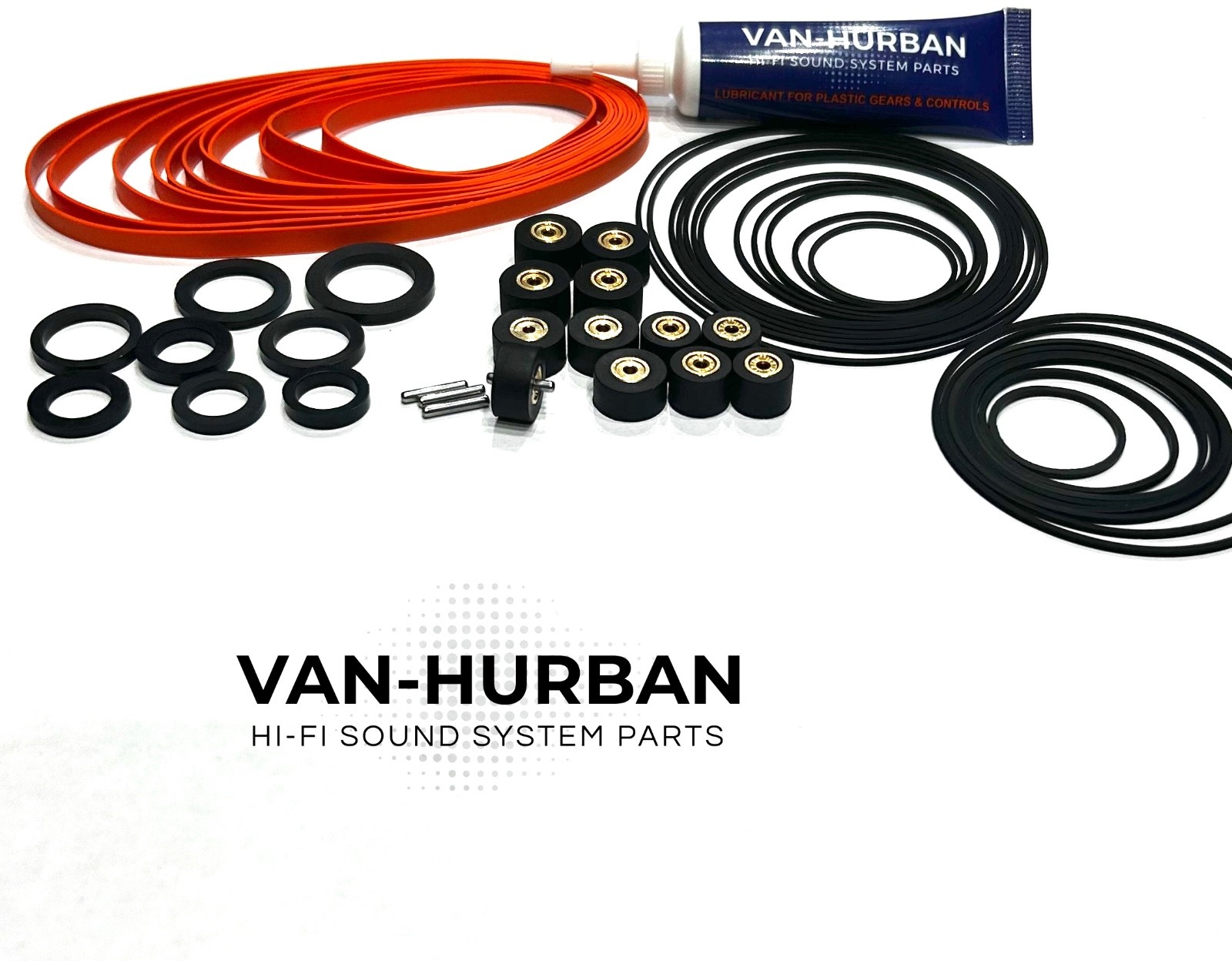
- Deterioration of Rubber Components: The pinch rollers and any internal belts (if present in ancillary mechanisms) can harden or crack over time. Replacement with modern equivalents is essential.
- Head Alignment Drift: Due to mechanical stress or age, the heads may fall out of alignment, leading to poor stereo imaging or high-frequency loss. Professional demagnetization and alignment are recommended.
- Capstan Bearing Dryness: The dual capstan system relies on precision bearings, which can dry out and cause speed instability. Lubrication by a technician is often needed.
- Dolby Circuit Drift: Over decades, capacitors and resistors in the Dolby circuitry can degrade, causing improper noise reduction or dull sound. Recapping may be necessary.
Regular cleaning with isopropyl alcohol and demagnetization every few dozen hours of use will keep the RD-W70 sounding its best. Finding replacement parts can be challenging due to its rarity, but the deck shares some components with other Sanyo models of the era.
Current Market Value and Collectibility
The Sanyo RD-W70 remains a rare find in the vintage audio market. Unlike more famous decks, it never achieved widespread popularity, which means surviving units in good condition are scarce. However, among cassette enthusiasts and analog collectors, interest is growing.
As of 2024, a fully functional and well-maintained RD-W70 typically sells for $300–$500, depending on condition, included accessories, and provenance. Units with original packaging and manuals command a premium. Given its technical sophistication and unique dual capstan design, the RD-W70 is increasingly seen as a sleeper classic — a hidden gem from a time when innovation in cassette technology peaked.
It’s not yet a mainstream collector’s item like a Nakamichi Dragon, but its rarity, build quality, and performance suggest it could appreciate in value as interest in high-end analog tape grows.
Conclusion and Legacy
The Sanyo RD-W70 is a testament to a brief but brilliant era when cassette decks were pushed to their technical limits. While overshadowed by more famous brands, the RD-W70 stands as one of Sanyo’s most accomplished audio products — a machine that combined precision engineering with audiophile-grade performance.
It may not have won the marketing wars, but in terms of mechanical innovation and sound quality, the RD-W70 holds its own against the best of its time. For the vintage audio enthusiast, restoring an RD-W70 is more than a repair project — it’s a rediscovery of a forgotten masterpiece.
In an age where analog revival meets digital convenience, the Sanyo RD-W70 reminds us that the pursuit of high fidelity wasn’t just about big names — it was about bold ideas, meticulous craftsmanship, and the belief that even a cassette could be a work of art.
eBay Listings


As an eBay Partner, we earn from qualifying purchases. This helps support our independent vintage technology research.
Related Models
- Sanyo DCX-233L (1978)
- Sanyo DCX-3400 (1979)
- Sanyo RD-S40 (1985)
- Sanyo RD-W40 (1982)
- Sanyo RD-W50 (1983)
- Sony TC-2050SD (1978)
- Aiwa AD-F990 (1993)
- Kenwood KX-3060 (1982)
- Sony TC-2130A (1974)
- Sony TC-2220 (1972)