Sanyo RD-W685: The Forgotten Innovator in Cassette Fidelity
In the late 1970s, as the cassette format evolved from a medium for voice recording into a serious contender for high-fidelity music playback, Japanese electronics manufacturers raced to refine tape deck technology. Amid giants like Sony, Panasonic, and TEAC, Sanyo carved out a niche with thoughtfully engineered, feature-rich cassette decks that offered excellent performance at accessible price points. One such model, the Sanyo RD-W685, stands as a quiet testament to this era—a compact yet sophisticated auto-reverse cassette deck that combined convenience with surprisingly robust audio engineering.
Though not as widely celebrated as some of its contemporaries, the RD-W685 has developed a cult following among vintage audio enthusiasts who appreciate its elegant design, mechanical reliability, and clean sonic signature. Released around 1979, the RD-W685 arrived at a pivotal moment when cassette decks began incorporating features once reserved for reel-to-reel systems—Dolby B noise reduction, dual-capstan transport, and precision tape head alignment—all in increasingly compact enclosures.
Technical Specifications
The Sanyo RD-W685 was designed to deliver high-quality playback and recording in a space-efficient form factor, making it ideal for integration into compact stereo systems or as a standalone component in a bedroom or portable setup.
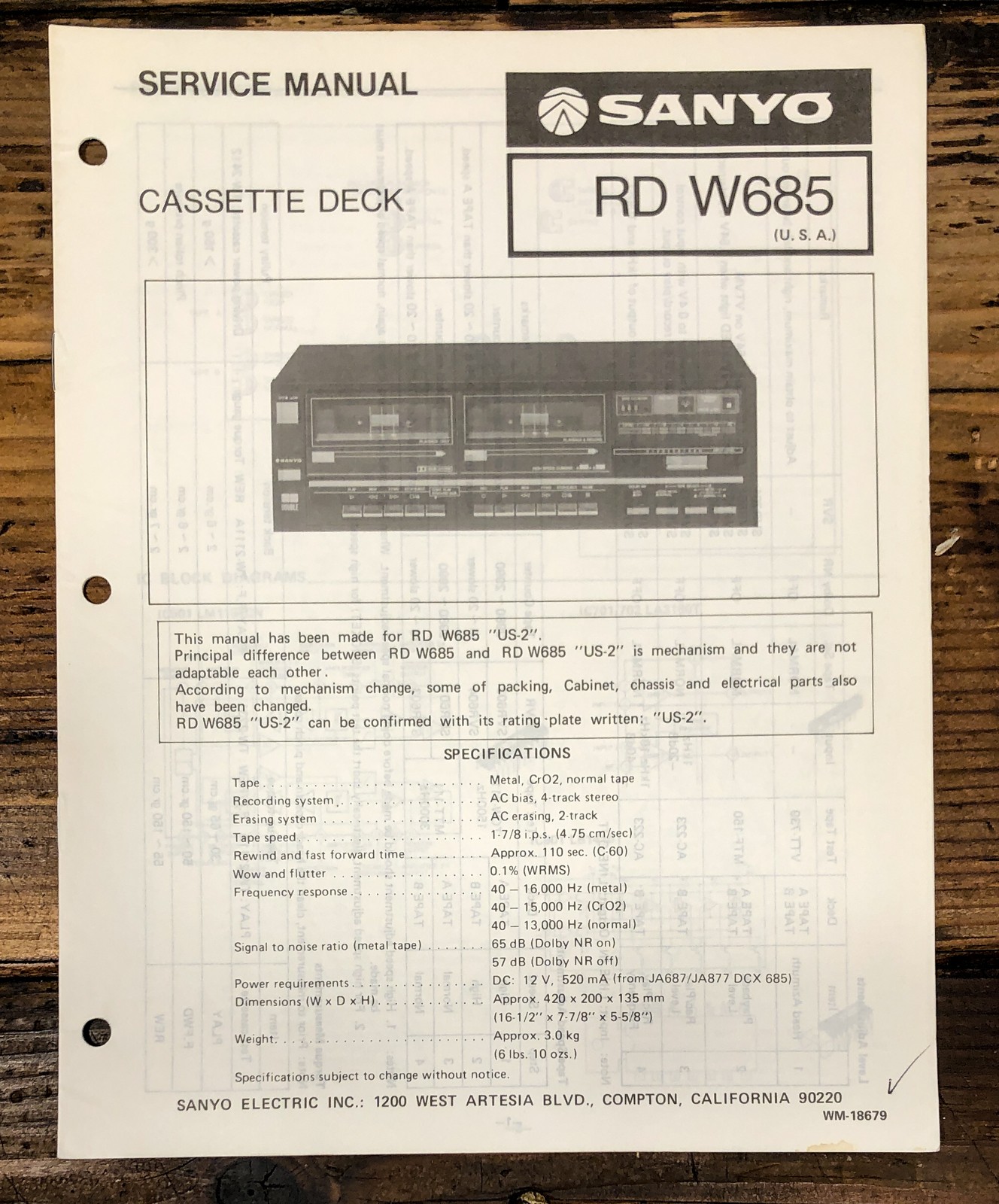
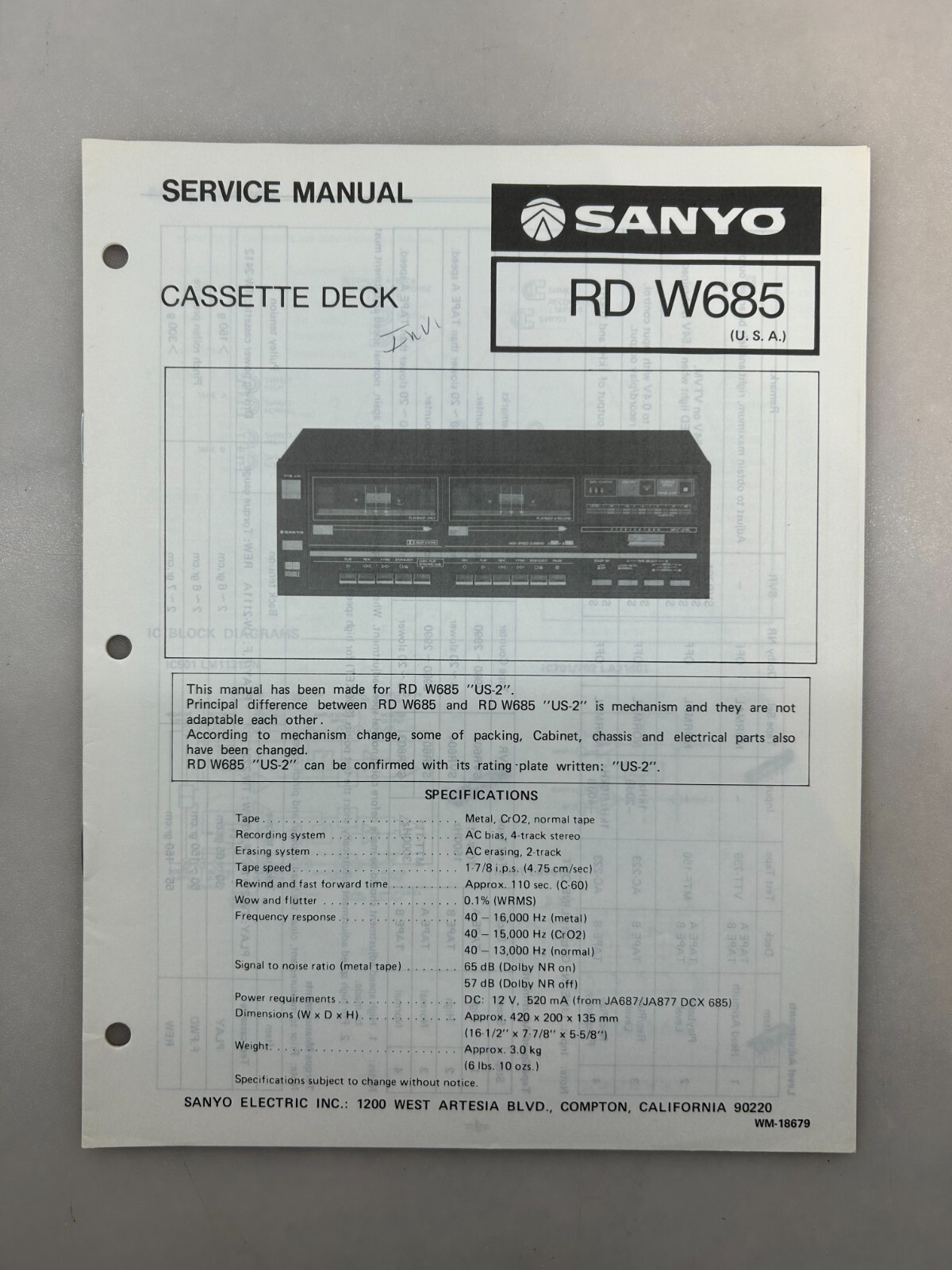
| Specification | Detail |
| Model | RD-W685 |
| Manufacturer | Sanyo Electric Co., Ltd. |
| Year of Release | 1979 |
| Type | 3-Head, Auto-Reverse Cassette Deck |
| Tape Speed | 1⅞ ips (4.76 cm/s) |
| Heads | Separate Record, Playback, and Erase Heads |
| Motor | Dual Direct-Drive Motors |
| Transport System | Dual Capstan, Auto-Reverse |
| Noise Reduction | Dolby B |
| Frequency Response | 40Hz – 15kHz (at 1% THD) |
| Wow and Flutter | < 0.08% (weighted) |
| Signal-to-Noise Ratio | 60 dB (Dolby B on) |
| Input Level | 250 mV (for 0 dB output) |
| Output Level | 0.35 V (at 0 dB) |
| Input Impedance | 47 kΩ |
| Output Impedance | 10 kΩ |
| Power Requirements | 120V AC, 60Hz, 15W |
| Dimensions (W×H×D) | 430 × 135 × 305 mm (17 × 5.3 × 12 inches) |
| Weight | 5.8 kg (12.8 lbs) |
| Finish | Black textured vinyl with silver faceplate |
Sound Characteristics and Performance
Despite its modest footprint and mid-tier positioning, the RD-W685 delivers a listening experience that belies its price point. The use of a 3-head configuration—with separate record, playback, and erase heads—ensures accurate monitoring during recording and consistent playback fidelity. Unlike many single-head auto-reverse decks that rely on tape flipping via head movement, the RD-W685’s fixed heads and tape inversion mechanism preserve head alignment and reduce mechanical wear.
The dual capstan drive system contributes to excellent speed stability, minimizing wow and flutter to levels comparable with higher-end models of the era. This results in a tight, well-controlled bass response and clear midrange articulation—ideal for jazz, classical, and vocal recordings.
With Dolby B noise reduction, tape hiss is effectively suppressed, particularly in the upper frequencies, giving recordings a cleaner, more polished sound. When Dolby is engaged, the signal-to-noise ratio reaches a respectable 60 dB, allowing for enjoyable listening even on pre-recorded tapes or home dubs.
The frequency response of 40Hz–15kHz is solid for a consumer-grade cassette deck of the late '70s, capturing most of the audible spectrum with minimal roll-off. While not quite matching the extension of premium Nakamichi or Revox decks, the RD-W685 holds its own in real-world listening scenarios, especially when paired with high-quality Type II (chrome) tapes and properly calibrated.
Notable Features and Innovations
The Sanyo RD-W685 was packed with user-friendly features that reflected Sanyo’s focus on practical innovation:
- True Auto-Reverse Playback and Recording: Unlike half-auto systems, the RD-W685 allows uninterrupted playback and recording on both sides of the tape without manual intervention.
- Dual Capstan Transport: Enhances tape-to-head contact and reduces speed variation, contributing to improved fidelity.
- Dolby B Noise Reduction: Standard on most high-quality decks by this time, but its inclusion here underscores Sanyo’s commitment to audio quality.
- Direct-View Recording Level Meters: Integrated VU meters provide real-time feedback for optimal recording levels, helping prevent distortion.
- Logic-Controlled Operation: Utilizes electronic logic for smooth, reliable tape transport control—reducing mechanical complexity and wear.
- Compact, Stackable Design: Designed to fit neatly into component stereo systems, with a sleek faceplate and intuitive button layout.
Common Issues and Maintenance
As with any vintage cassette deck, the Sanyo RD-W685 benefits from periodic maintenance to restore peak performance:
- Rubber Components Deterioration: The capstan tires and pinch rollers are prone to hardening or cracking after decades of use. Replacement with fresh rubber parts is essential for proper tape tension and speed accuracy.
- Head Alignment Drift: Over time, the tape heads may become misaligned, especially if the deck was used frequently. A professional demagnetization and alignment service can restore clarity and stereo imaging.
- Mechanical Sticking: The auto-reverse mechanism, while robust, can accumulate dust or dried lubricant. Cleaning and relubrication of gears and rails will ensure smooth operation.
- Capacitor Aging: Internal electrolytic capacitors may leak or lose capacitance, potentially affecting power delivery and audio circuitry. A recap by a qualified technician is recommended for long-term reliability.
Regular cleaning of the tape path with isopropyl alcohol and a lint-free swab will help maintain performance and prevent debris buildup.
Current Market Value and Collectibility
The Sanyo RD-W685 remains a relatively obscure model in the vintage audio marketplace, which has both advantages and drawbacks for collectors. On one hand, it is rarely counterfeited and typically sells at modest prices—usually between $75 and $150 in working condition. Fully serviced units with replaced belts and aligned heads may command slightly higher prices, especially if paired with original packaging or documentation.
Its collectibility is growing among enthusiasts who appreciate under-the-radar Japanese engineering and compact hi-fi systems. While it may never reach the status of a Nakamichi Dragon, the RD-W685 offers a compelling blend of functionality, sound quality, and nostalgic charm.
It’s particularly sought after by users building retro bedroom stereos, integrating vintage cassette decks into modern setups, or preserving analog recordings with authentic period equipment.
Conclusion and Legacy
The Sanyo RD-W685 may not have made headlines in its day, but it exemplifies the quiet excellence of second-tier Japanese audio brands during the golden age of home hi-fi. It delivers reliable auto-reverse functionality, solid build quality, and a warm, balanced sound that continues to satisfy analog lovers today.
More than just a relic, the RD-W685 is a functional piece of audio history—a bridge between convenience and fidelity at a time when cassette tapes were becoming a legitimate medium for music lovers. For those willing to restore and appreciate it, the Sanyo RD-W685 offers a rewarding listening experience and a tangible connection to the evolving story of analog sound.
If you stumble upon one in a thrift store or online marketplace, don’t overlook it. With a little care, the RD-W685 can still spin tapes with the best of them—proving that sometimes, the most unassuming gear holds the most pleasant surprises.
eBay Listings


As an eBay Partner, we earn from qualifying purchases. This helps support our independent vintage technology research.
Related Models
- Sanyo DCX-233L (1978)
- Sanyo DCX-3400 (1979)
- Sanyo RD-S40 (1985)
- Sanyo RD-W40 (1982)
- Sanyo RD-W50 (1983)
- Sony TC-2050SD (1978)
- Aiwa AD-F990 (1993)
- Kenwood KX-3060 (1982)
- Sony TC-2130A (1974)
- Sony TC-2220 (1972)