Sanyo 2050 (1975)
The Sanyo 2050 is a vintage stereo receiver from the mid-1970s that exemplifies the wave of affordable, high-quality audio equipment emerging from Japan during that era. Though not as widely celebrated today as contemporaries from brands like Pioneer, Kenwood, or Sony, the Sanyo 2050 holds a quiet distinction among collectors and enthusiasts of vintage audio gear. It represents a transitional period in home audio technology, bridging the gap between tube-based designs and the solid-state revolution, while offering a balance of functionality, performance, and value.
Manufactured in 1975, the Sanyo 2050 was marketed as a mid-tier receiver aimed at consumers seeking reliable performance without the premium price tag. It was part of Sanyo's broader push into the North American and European markets, where the company was establishing a reputation for durable, well-engineered electronics. While Sanyo is perhaps better known today for consumer appliances and batteries, in the 1970s the brand produced a full line of audio and video equipment that competed directly with more established names in the hi-fi world.
Design and Build Quality
The Sanyo 2050 features a classic brushed aluminum faceplate with a minimalist control layout, typical of mid-1970s Japanese design. The front panel includes a large analog VU meter flanked by rotary knobs for volume, tone controls, balance, and input selection. The meter not only serves a functional purpose—displaying output levels—but also adds a visual flair that many vintage audio enthusiasts appreciate. The overall build quality is solid, with a heavy chassis that suggests attention to durability and vibration damping.
The receiver measures approximately 440 mm (width) × 150 mm (height) × 360 mm (depth) and weighs around 11 kg (24 lbs), which was standard for receivers of its class. Its weight is due in part to the large power transformer and substantial heat sinks required for stable solid-state amplification. The rear panel includes a full complement of inputs and outputs for the time: AM/FM tuner, phono (MM), tape in/out, auxiliary, and a preamp output. It also features a speaker A/B selector, allowing users to switch between two sets of speakers—a feature that was considered advanced at the time.
Audio Performance
The Sanyo 2050 delivers 45 watts per channel into 8 ohms, with a total harmonic distortion (THD) of less than 0.8%. While these specifications may seem modest by modern standards, they were more than sufficient for driving the efficient speakers of the 1970s. The amplifier section uses discrete transistor circuitry, avoiding integrated circuits in favor of a more traditional, serviceable design. This contributes to the unit’s warm, slightly rich sound signature that many listeners associate with vintage gear.
Frequency response is rated from 20 Hz to 20 kHz, ±1.5 dB, which indicates a relatively flat response across the audible spectrum. The signal-to-noise ratio is approximately 72 dB, which is acceptable for a receiver of this class, though not exceptional. The tone controls offer ±12 dB adjustment at 100 Hz and 10 kHz, allowing for significant shaping of the sound to suit room acoustics or personal preference.
The built-in AM/FM tuner is one of the more capable aspects of the 2050. It features a digital frequency display (a novelty at the time), using red LED numerals to show the tuned frequency. The tuner section includes stereo separation of up to 40 dB and a signal strength meter, helping users optimize antenna placement. Reception quality is generally good, especially in urban areas with strong broadcast signals, though it lacks the sensitivity of higher-end tuners from the same period.
Technical Specifications
- Power Output: 45W RMS per channel (8Ω, 20Hz–20kHz, 0.8% THD)
- Total Harmonic Distortion: < 0.8%
- Frequency Response: 20 Hz – 20 kHz (±1.5 dB)
- Input Sensitivity:
- Phono (MM): 3.5 mV
- Line: 150 mV
- Signal-to-Noise Ratio: 72 dB (IHF-A weighted)
- Tone Controls: Bass ±12 dB at 100 Hz, Treble ±12 dB at 10 kHz
- Tuner:
- FM: 87.5–108 MHz, 10.7 MHz IF
- AM: 530–1600 kHz, 455 kHz IF
- Stereo Separation: >40 dB
- Inputs: Phono (RCA), Tape In, Aux, Tuner
- Outputs: Tape Out, Preamp Out, Speaker A/B
- Speaker Impedance: 8Ω minimum
- Power Consumption: 320W
- Dimensions: 440 × 150 × 360 mm
- Weight: 11 kg (24 lbs)
Legacy and Collectibility
Today, the Sanyo 2050 is not considered a rare or highly sought-after collector’s item, but it has gained a modest following among vintage audio hobbyists. Its appeal lies in its reliability, classic aesthetics, and the warm, analog sound it produces. Unlike some receivers from the era that suffer from capacitor failure or brittle wiring, many Sanyo 2050 units remain in working condition, thanks to the use of robust components and conservative engineering.
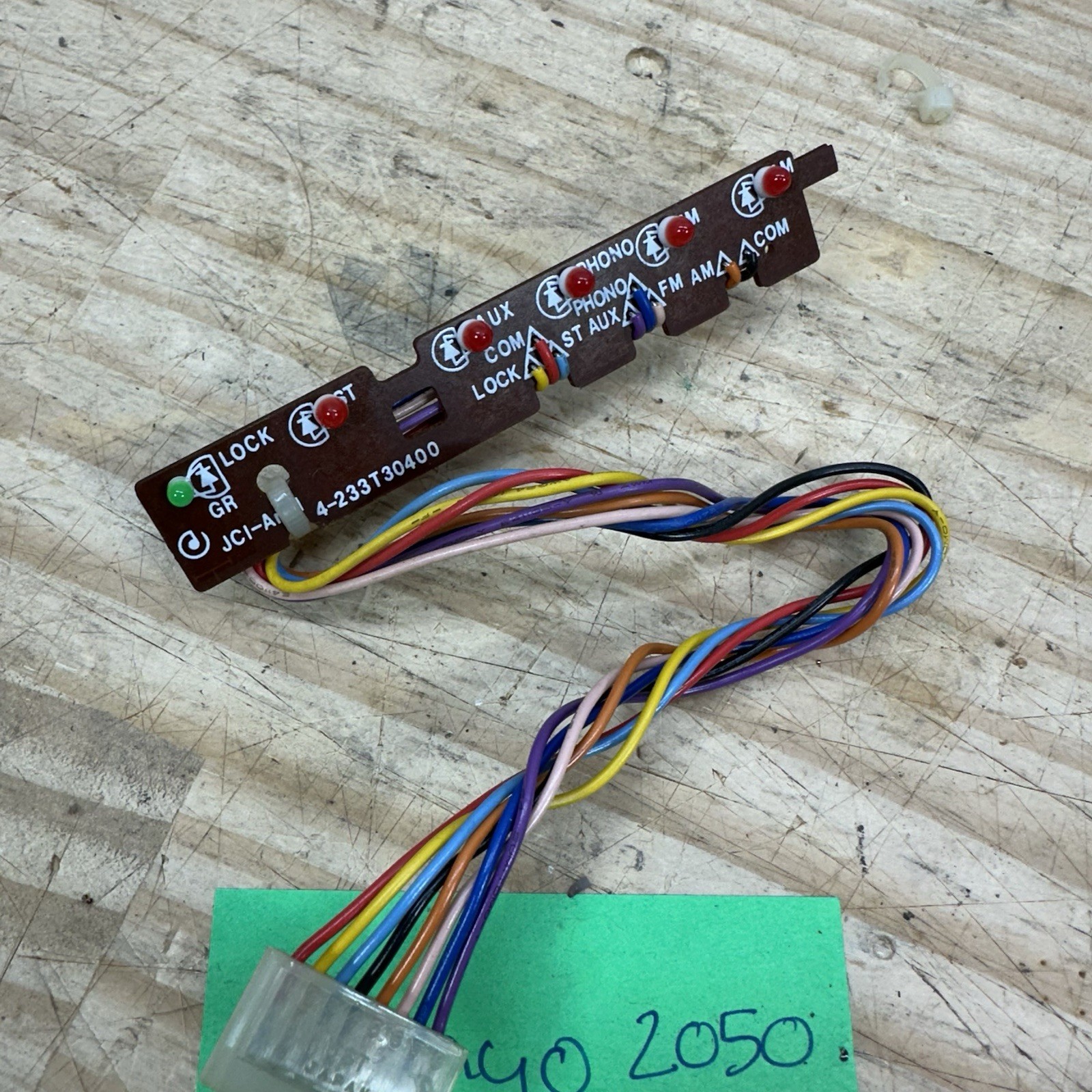
Restoration of the Sanyo 2050 typically involves recapping—replacing the electrolytic capacitors in the power supply and audio circuits—as these degrade over time. The LED display, while charming, can be problematic; early LED modules sometimes fail or dim significantly after decades of use. Replacement modules or modern LED equivalents are available from specialty audio restoration suppliers.
One of the challenges in evaluating the Sanyo 2050 is the lack of extensive documentation and service manuals compared to more prominent brands. However, enthusiast forums and online communities have begun compiling schematics and repair guides, making it easier to maintain and restore these units.
Conclusion
The Sanyo 2050 may not have achieved the legendary status of a Marantz 2270 or a Pioneer SX-1980, but it stands as a competent and well-built receiver from a pivotal moment in audio history. It reflects the democratization of high-fidelity sound, bringing solid performance and modern features to a broader audience. For the vintage audio enthusiast, the 2050 offers a rewarding listening experience, a piece of 1970s design, and a connection to the era when Japanese electronics began to dominate the global market.
Whether used as a daily driver in a retro setup or restored as a nostalgic centerpiece, the Sanyo 2050 deserves recognition for its craftsmanship and enduring functionality. It may not be a superstar, but it’s a dependable workhorse that continues to deliver music with character and charm.
eBay Listings



As an eBay Partner, we earn from qualifying purchases. This helps support our independent vintage technology research.
Related Models
- Sanyo 2033 (1974)
- Pioneer QX-949A (1978)
- Pioneer SX-2000 (1978)
- Pioneer SX-2500 (1978)
- Marantz SR-2000 (1999–2001)
- Onkyo TX-1500MKII (1975)
- Pioneer QX-646 (1978)
- Pioneer SX-1900 (1978)
- Pioneer SX-201 (1978)
- Pioneer SX-251R (1976)