Sansui SR-737 (1978–1980)
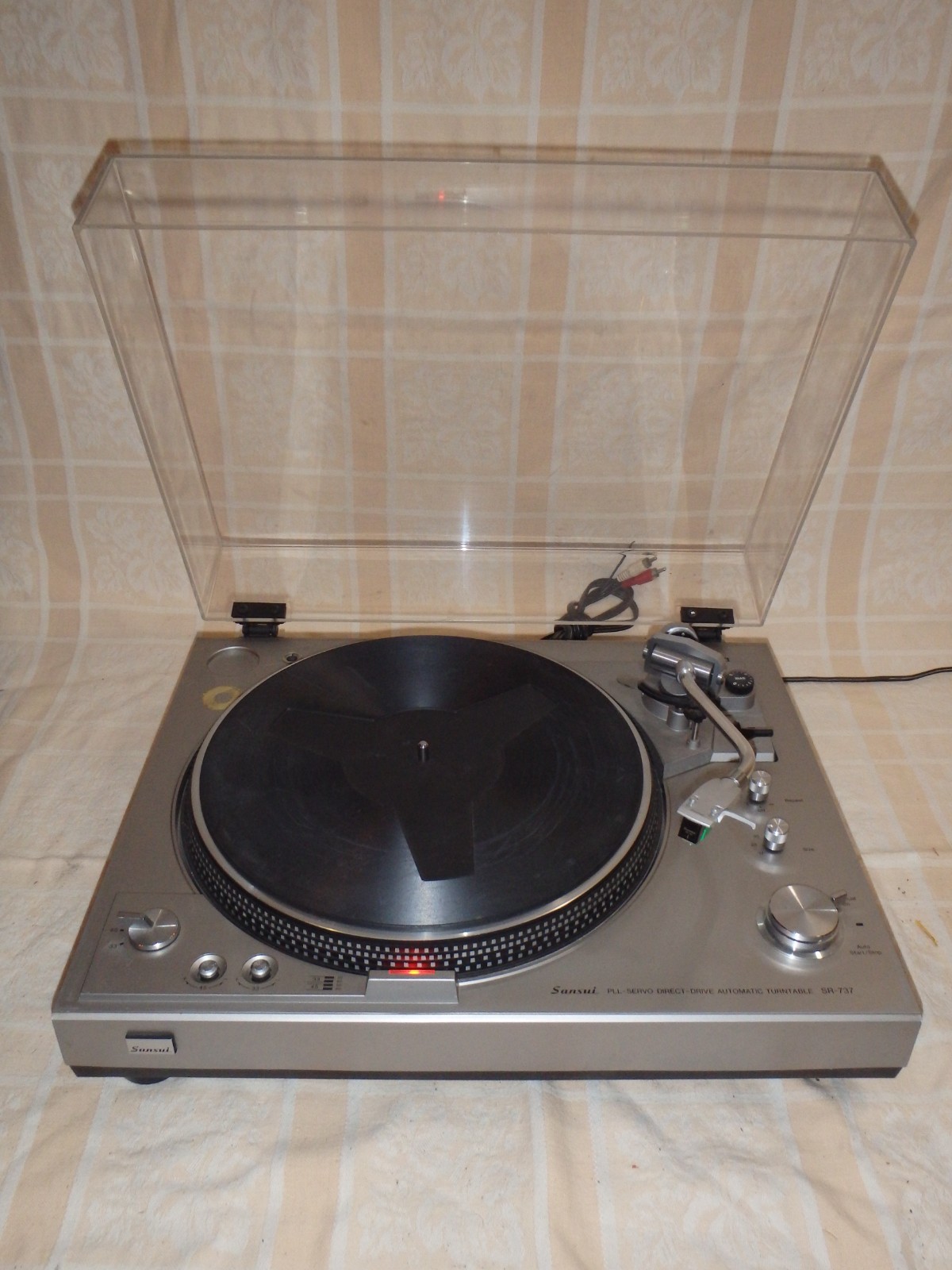
At 12.5kg, it sits solid on the shelf—not quite a tank, but built with a heft that promises more than plastic gimmickry.
Overview
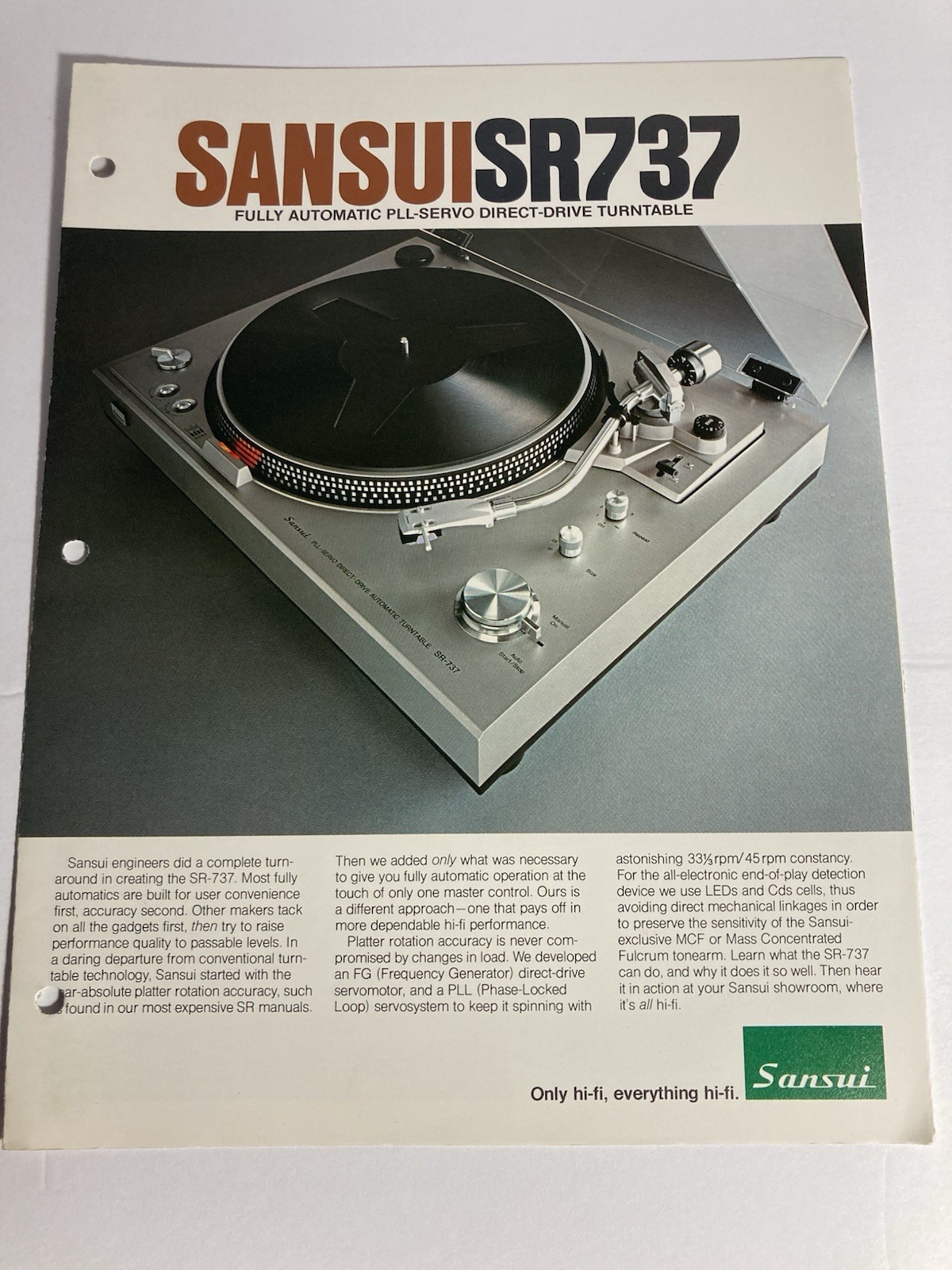
The Sansui SR-737 isn’t one of those forgotten entry-level turntables that got lost in the late-’70s direct-drive stampede. It’s a deliberate piece of engineering from a company that, for a brief stretch, aimed to stand shoulder-to-shoulder with Technics and Thorens. Made in Japan and introduced in 1978, the SR-737 rides the wave of Sansui’s push into high-performance turntable design—following their 1967 debut in the format and arriving just before the SR-838, a model some owners consider its more robust successor. This is a fully automatic, PLL-servo direct-drive turntable, meaning it starts, plays, and shuts down with the press of a button, while a phase-locked loop system keeps speed locked in tight. At first glance, it looks like a machine built to impress: a grey/silver finish, clean lines, and a satisfyingly dense aluminum die-cast platter weighing in at 3.2kg. But beneath that polished surface lies a machine with quirks—some charming, some frustrating.
Owners report it sounds excellent when working properly, with one calling it a “vintage Sansui gem” and another praising its build and sonic performance. Yet, the automatic mechanisms—especially the hydraulic tonearm lift—are frequent points of failure. Stories circulate of arms that won’t lower, motors that spin backward at startup, or platters that hesitate before finding correct rotation. Speed stability at 33 rpm has also been questioned by at least one user, though 45 rpm reportedly performs flawlessly. The pitch control slider, offering ±4% adjustment, is another known weak spot, almost universally said to benefit from a cleaning with contact rejuvenator like Deoxit. Despite these issues, the SR-737 carries a reputation for solid internal construction: a two-layer chassis with a rigid die-cast aluminum top plate over a heavy steel bottom plate, designed specifically to dampen resonance. The tonearm is a static-balanced S-shaped pipe type, 230mm in effective length, with an original azimuth-adjustable Sansui headshell. It was supplied with the SC-43 moving magnet cartridge and SN-43 stylus—a complete, if modest, package out of the box.
Specifications
| Manufacturer | Sansui Electric Co., Ltd. |
| Model | SR-737 |
| Product type | Direct Drive Automatic Turntable |
| Production years | 1978–1980 |
| Made in | Japan |
| Drive type | Direct Drive |
| Drive system | PLL-Servo Direct-Drive |
| Features | PLL (Phase-Locked Loop), Automatic features |
| Tonearm lift type | Hydraulic tone arm lift |
| Headshell | Original azimuth adjustable Sansui headshell |
| Speed settings | 33 rpm and 45 rpm |
| Speed change | Electronic |
| Pitch control | ±4% |
| Wow & Flutter | 0.03% WRMS |
| Rumble | -78dB (DIN B) |
| Platter weight | 3.2kg |
| Motor type | 4-pole synchronous |
| Tonearm type | Static-balanced S-shaped pipe arm |
| Effective tonearm length | 230mm |
| Overhang | 15mm |
| Tracking error angle | Within 2° per 60mm record radius |
| Applicable cartridge weight | 4-10g |
| Stylus pressure range | 0-3g, direct reading |
| Anti-skating range | 0-3g |
| Power requirements | AC 120V, 60Hz |
| Power consumption | 9W |
| Dimensions (W x H x D) | 470 x 170 x 390mm |
| Weight | 12.5kg |
| Original cartridge | Sansui SC-43 (SC43) phono cartridge |
| Original stylus | Sansui SN-43 (SN43) needle stylus |
Key Features
3.2kg Heavy Aluminum Die-Cast Platter
Mass matters in turntables, and the SR-737 doesn’t skimp. Its 3.2kg platter isn’t just for show—it provides substantial rotational inertia, helping maintain stable speed between motor pulses. Combined with the 4-pole synchronous motor and PLL servo control, this platter delivers a measured wow and flutter of just 0.03% WRMS, a figure competitive with high-end decks of its era. The weight also contributes to the unit’s overall stability, reducing sensitivity to external vibration. It spins on a precision spindle, and while some users report initial direction-finding hiccups, once settled, it maintains consistent rotation.
Two-Layer Construction Chassis with Die-Cast Aluminum Top Plate
The chassis isn’t just a shell—it’s a structural element designed to fight resonance. The SR-737 uses a two-layer construction: a rigid die-cast aluminum top plate bonded to a heavy steel bottom plate. This sandwich approach adds mass and damping, preventing unwanted vibrations from reaching the stylus. Unlike some contemporary turntables with fully suspended subchassis, the SR-737 relies on this rigid, layered platform—mounted on compliant feet—to isolate the platter and tonearm assembly. The result is a stable, inert foundation that supports the precision mechanics above.
Static-Balanced S-Shaped Pipe Tonearm with Azimuth-Adjustable Headshell
The tonearm is a static-balanced S-shaped pipe design, 230mm in effective length, offering a tracking error angle within 2° across a 60mm record radius. It’s mounted on a large metal cast housing that integrates bias compensation and the hydraulic lift mechanism. The original headshell is azimuth-adjustable—a rare and welcome feature at this level—allowing users to fine-tune stylus alignment for optimal channel balance. The arm supports cartridges weighing between 4g and 10g, and tracking force is set via a direct-reading dial from 0 to 3g, with anti-skating similarly adjustable in the same range.
PLL-Servo Direct-Drive System with Electronic Speed Change
The SR-737 uses a PLL (Phase-Locked Loop) servo-controlled direct-drive system, a technology Sansui adopted to compete with the precision of Technics’ SP-10 and later SL-1200 series. This system constantly monitors platter speed via a sensor ring and adjusts motor output in real time, ensuring exceptional speed accuracy. Speed change between 33 and 45 rpm is electronic—no belt shifting or manual pulley swaps. The motor itself is a 4-pole synchronous type, directly coupled to the platter, eliminating belt wear and slippage. However, at least one owner reports instability at 33 rpm, suggesting that while the design is sound, aging components may compromise performance over time.
Historical Context
Sansui entered the turntable market in 1967, but it wasn’t until the late 1970s that the brand made a serious push into high-fidelity direct-drive designs. The SR-737, released in 1978, arrived during a period of intense innovation in turntable engineering, when Japanese manufacturers were rapidly advancing servo-controlled direct-drive technology. It was priced at approximately 58,000 yen in Japan at launch—a respectable sum, placing it in the upper tier of Sansui’s offerings. While not as widely celebrated as the Technics SL-1200, the SR-737 represented Sansui’s commitment to precision, joining other models like the SR-929 and SR-838 in challenging European and Japanese high-end standards.
Collectibility & Value
The SR-737 trades today in the $100–$160 range, with working units commanding higher prices—$150 when paired with a Yamaha A-40 amplifier, $160 as a standalone asking price. Parts-only or repair units appear around $100. Despite its age, a service manual is available for download, which helps DIY repairs. Common issues include malfunctioning automatic functions—such as the turntable failing to shut off or the hydraulic tonearm lift sticking in the raised position—and plastic levers dislodging from cam grooves. The pitch control slider is notorious for needing cleaning, and some users recommend a full recap of the electronics as a preventative measure. A full conversion to manual operation is possible by removing the automation components, though owners are warned not to disassemble the large cast housing containing the bias spring—a job that, if botched, can be nearly impossible to fix. Wiring to the tonearm is also fragile and must be handled with care during servicing.
eBay Listings


As an eBay Partner, we earn from qualifying purchases. This helps support our independent vintage technology research.
Related Models
- Sansui sax-200 (Late 1970s)
- Sansui sax-600 (Late 1970s)
- Sansui sr-222 (1973-1975)
- Sansui sr-717 (1974-1976)
- Sansui sr-2050c (1975-1977)
- Sony ps-5550 (1978-1980)
- Sony ps-lx5r (1983-1985)
- Sony ss-7220a (1970s)
- Sony ss-97 (Late 1970s (approximately 1977-1979))
- Sony ss-999 (Late 1970s (approximately 1977-1979))