Sansui SR-4040 (1968–1971)
It hums to life with a quiet authority—no flash, no fuss—just a turntable built to disappear so your records can speak.
Overview
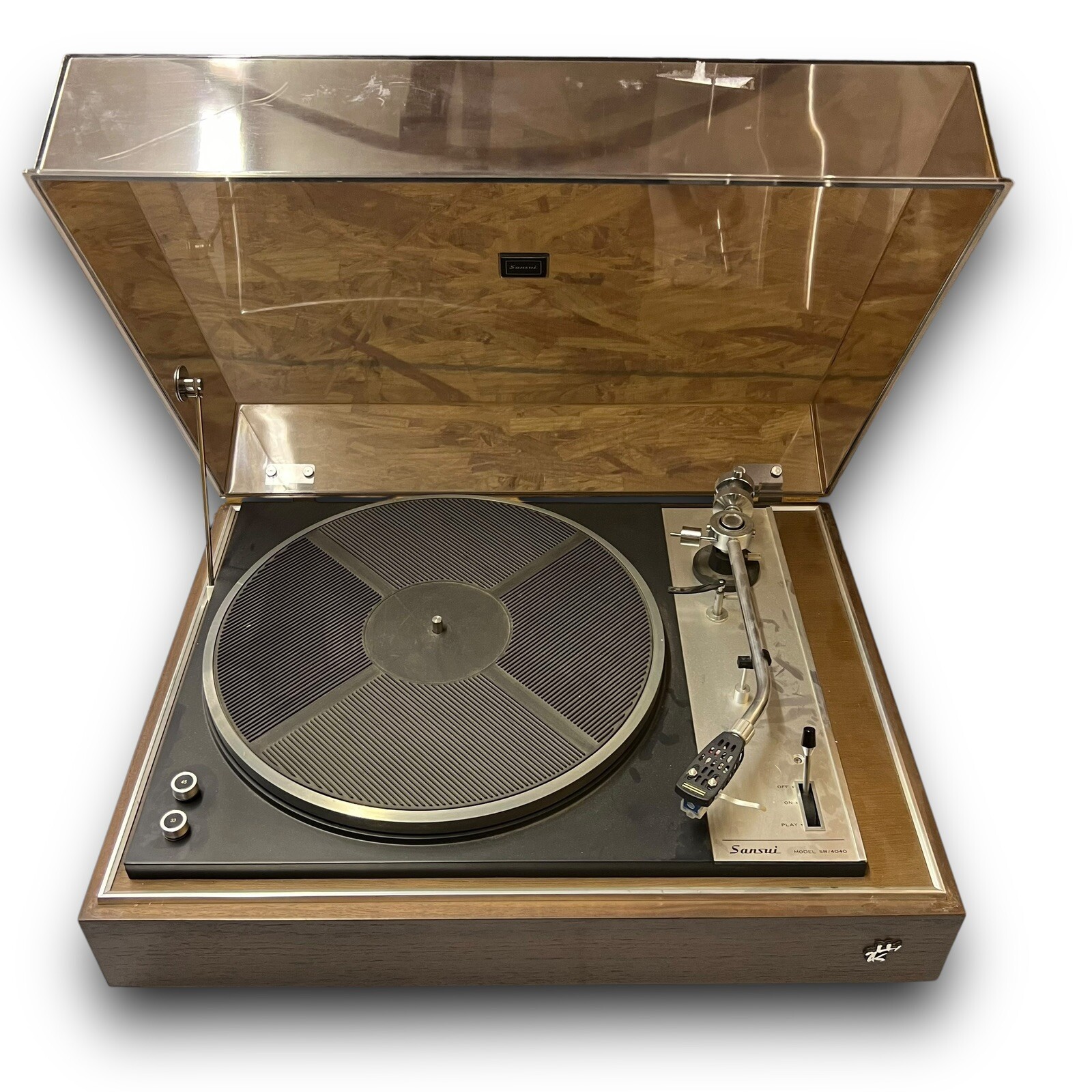
The Sansui SR-4040 isn’t the kind of turntable that shouts for attention. It doesn’t have a gimbaled arm like a Technics SP-10, nor the polished chrome of a Linn LP12. But if you’ve ever pulled one from a forgotten corner of an estate sale or seen it tucked under a stack of vintage receivers, you know it carries a quiet confidence. Released in June 1968 and manufactured through 1971, this was Sansui’s answer to the growing demand for high-fidelity belt-drive systems that could deliver stable, low-vibration playback without breaking the bank—though at ¥44,000 (or roughly 800 DM at the time), it wasn’t exactly an entry-level machine. It sat in that sweet spot where engineering ambition met real-world usability, aimed at serious listeners who wanted performance without theatrics.
What sets the SR-4040 apart isn’t just its double platter system—though that’s part of it—but how every detail, from the micron-precise polyurethane belt to the 110 mm stainless steel spindle, seems chosen to eliminate variables. This wasn’t a turntable designed to look good in a catalog; it was built to rotate at 33 1/3 and 45 rpm with a constancy that borders on obsessive. The specs claim “not more than 0.08%” wow and flutter, a number that still raises eyebrows today, and while we can’t verify every claim without lab gear, owners report a stillness in the groove that feels rare even among its peers. It’s not flashy, but it’s *present*—like a well-tuned engine that doesn’t roar but simply goes.
And then there’s the tonearm. A static-balanced, low-mass tubular design that Sansui called a “non-resonant pipe arm,” it’s simple in appearance but loaded with thoughtful touches: a lateral balancer to align the center of gravity precisely over the fulcrum, a feather-touch lifter cam that delays engagement to avoid record damage, and a headshell so light—just 7 grams including wiring—it borders on delicate. Paired with the stock Sansui PC-4 cartridge, a high-compliance moving coil with a built-in voltage boosting transformer, the system leans into MC territory without demanding a separate step-up transformer from the start. Whether that’s a blessing or a limitation depends on who you ask. Some owners praise the clarity and balance; others note that finding replacements or upgrades can be tricky, especially since most MC cartridges of that era didn’t offer replaceable styli—a fact one user bluntly pointed out: if the PC-4 is dead, it’s likely gone for good.
Still, the consensus among those who’ve lived with it is clear: this is a well-built, no-nonsense turntable. Forum users describe it as “very well built and sounds great,” and one simply says, “I love my SR-4040.” That’s not hyperbole—it’s the quiet endorsement of someone who’s spun records on it for years. It may not have the pedigree of a Thorens or the cult status of a Technics, but in its time, it offered a level of performance that made comparisons with far more expensive models not just possible, but favorable. As one user put it, for the price difference between this and a Marantz 6350Q, you could already be ahead with a better cartridge on the Sansui.
Specifications
| Manufacturer | Sansui Electric Co., Ltd. |
| Product type | Stereo record player / Turntable |
| Production years | 1968 - 1971 |
| Type | 2-speed, double turntable, belt drive system |
| Drive system | belt-drive |
| Turntable | 31 cm, 2.5 kg, zinc alloy die-cast; 20 cm, 0.5 kg, Aluminum Alloy Die-cast (Total 3 kg) |
| Motor | Condenser actuated four pole synchronous motor |
| Rated speed | 33 1/3, 45 rpm |
| Rotation switching system | Belt changing mechanism by push button |
| Wow and flutter | Not more than 0.08% |
| Rumble | -70dB (DIN B) |
| Signal-to-noise ratio | 46 dB or more |
| Tonearm | Static balanced non-resonant pipe arm |
| Tracking error | ± 1 φ ° |
| Needle pressure | 0g ~ 2.5g (read directly in 0.5g steps) |
| Cartridge | MC Type (Built-in Voltage Boosting Transformer) |
| Frequency characteristic | 15 Hz to 22 kHz |
| Output balance | Within 1.0 dB |
| Crosstalk | 30 dB or More (1 kHz) |
| Output voltage | 4 mv (1 khz, 50mm/sec) |
| Standard load resistance | 50k Ω |
| Standard needle pressure | 1.5g ~ 2g |
| Needle tip compliance | 18x10 -6 cm/dyne |
| Needle tip | 0.5 mil, Round Diamond Needle |
| Power supply voltage | 100 VAC, 50Hz/60Hz |
| Power consumption | 15VA |
| External dimensions | Width 512x Height 186x Depth 388 mm |
| Weight | 12kg |
Key Features
The Double Platter System: Mass Without the Bulk
Sansui took a different path with the SR-4040: a two-piece platter combining a 31 cm outer ring made of zinc alloy die-cast and a 20 cm inner disc of aluminum alloy. Together, they total 3 kg of rotating mass, but the design spreads the weight strategically. The inner platter isn’t just decorative—it’s the actual drive surface, where the belt makes contact, maximizing the flywheel effect while keeping the overall assembly balanced. This isn’t just clever engineering; it’s a quiet rebellion against the trend of ever-heavier turntables. The result? A system that resists speed fluctuations without becoming a back-breaking slab of metal.
Belt Drive Done Right
Sansui didn’t just slap a belt on a motor and call it a day. The SR-4040 uses a high-precision polyurethane belt finished on a grinder to ensure thickness uniformity in the micron range—yes, microns. That kind of attention to belt consistency was rare at the time and speaks to Sansui’s commitment to minimizing speed variation. Even the switching mechanism is thoughtful: a push-button system changes speeds by shifting the belt position, and when the power is off, the mechanism locks to prevent the belt from sitting under tension and deforming over time. It’s a small detail, but one that reflects a deeper philosophy: this turntable was designed to be left on, ready to play, without degrading in storage.
Motor and Spindle: The Heart of Stability
At the core is a 4-pole synchronous capacitor-start motor, designed to maintain constant speed regardless of voltage or load changes. Paired with a 110 mm stainless steel center spindle and a bearing interface laminated with gunmetal and fully wrapped for precision fit, the drive system aims for mechanical silence. The spindle isn’t just long for show—it contributes to vertical stability, reducing wobble and ensuring the platter spins true. Combined with the belt drive and double platter, it creates a system where rumble is rated at -70dB (DIN B), a figure that suggests near-inaudible mechanical noise even on quiet passages.
The Arm: Lightweight, Balanced, and Smart
The tonearm is where the SR-4040 reveals its sophistication. A static-balanced, low-mass tubular design, it minimizes moving mass for better tracking and reduced record wear. But Sansui didn’t stop there. The lateral balancer allows users to align the center of gravity of the cartridge and counterweight so that the fulcrum bears the load perfectly—no cantilever tilt, no uneven pressure. It’s a feature usually found on far more expensive arms, and its inclusion here suggests Sansui was targeting a discerning audience. The feather-touch lifter, linked to the power switch via a delay cam, ensures the stylus lifts smoothly without jerking, a small luxury that protects both record and stylus.
Build and Isolation: Walnut, Acrylic, and Springs
The case is walnut—solid, warm, and unpretentious—with a removable acrylic dust cover that lets you watch the platter spin without touching anything. But beneath the wood, there’s engineering: an audio insulator system using coil springs and rubber cushions to decouple the turntable from its base, reducing howling and external vibration. The mat is no afterthought either—a special rubber sheet with anti-static properties and a soft edge to prevent scratching. Even the spare headshell is over-engineered: a 7g lightweight unit made from a special alloy with a downward-bent edge for rigidity, compatible with European-standard connectors so it can be used on other arms. This is a turntable that thinks ahead.
Collectibility & Value
The Sansui SR-4040 trades in a quiet, niche market—no eBay feeding frenzies, no Instagram hype. Prices reflect that. As of mid-2024, one was listed on ADVERTS.ie for €800; another surfaced on Reverb seven months ago at $948.29 plus shipping. Polish listings on OLX have ranged from PLN 5,200 to as high as PLN 9,999 in 2020, while a Czech listing asked CZK 25,000. Yet, in stark contrast, a Craigslist ad in Kansas City once asked just $130—proof that condition, location, and awareness play huge roles. These discrepancies suggest the SR-4040 isn’t yet a “hot” collectible, but rather a find for those who know what they’re looking at.
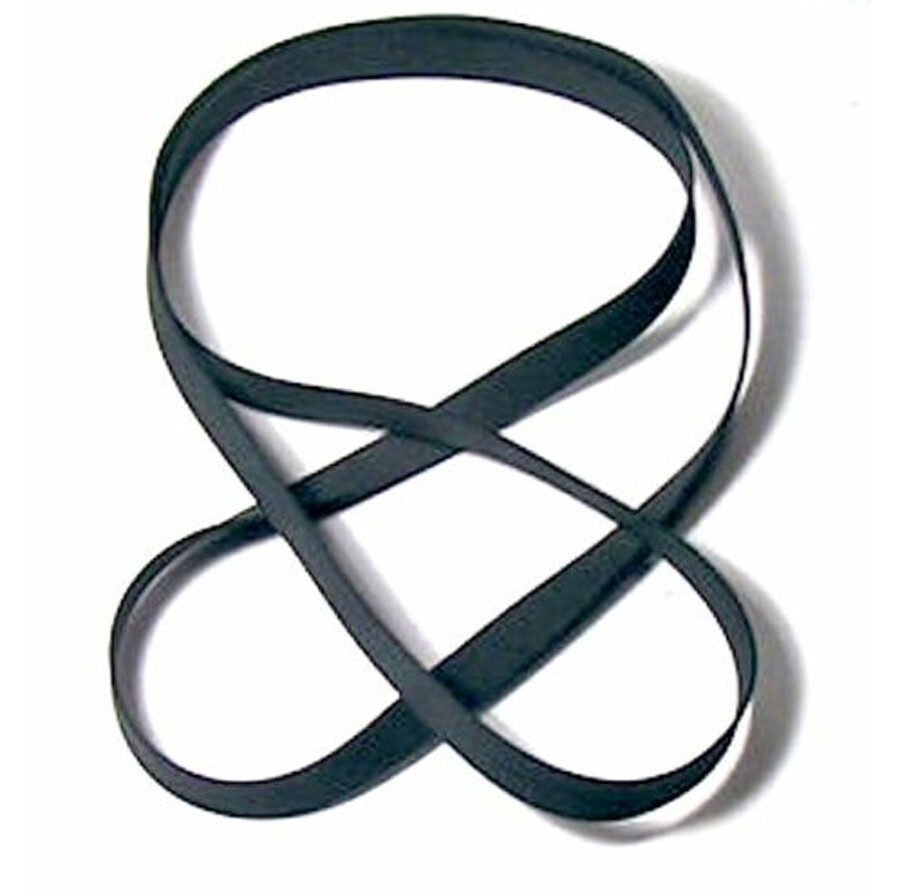
Maintenance is straightforward in theory: a replacement belt for the SR-4040 (shared with the SR-3060 and SR-4050) costs around $9 and is still available. But the real challenge lies in the cartridge. The built-in Sansui PC-4 is a high-compliance MC unit, and as one owner noted, “the vast majority of MC carts do not have replaceable styli.” If it’s worn, replacement is likely the only option—and sourcing a working original or a compatible substitute isn’t easy. Forum users have reported difficulty finding information or parts, with one saying, “There is little to no info on this TT on the web. I am looking for a cartridge but the going is slow.” That lack of documentation could be a dealbreaker for some, but for others, it’s just part of the hunt.
Still, those who own one tend to praise it. “It’s very well built and sounds great,” one user says. Another simply states, “I love my SR-4040.” That kind of quiet loyalty—no exaggeration, no sales pitch—might be the best endorsement this turntable will ever get.
eBay Listings


As an eBay Partner, we earn from qualifying purchases. This helps support our independent vintage technology research.
Related Models
- Sansui sax-200 (Late 1970s)
- Sansui sax-600 (Late 1970s)
- Sansui sr-222 (1973-1975)
- Sansui sr-717 (1974-1976)
- Sansui sr-2050c (1975-1977)
- Sony ps-5550 (1978-1980)
- Sony ps-lx5r (1983-1985)
- Sony ss-7220a (1970s)
- Sony ss-97 (Late 1970s (approximately 1977-1979))
- Sony ss-999 (Late 1970s (approximately 1977-1979))