Sansui SR-4040 (1968–1971)
That hush when the stylus hits the groove—this one doesn’t just play records, it unfurls them.
Overview
Let’s clear the air first: if you’re hunting for a Sansui SR-404, you’re likely chasing a typo. Every spec sheet, every listing, every whisper in the vintage forums points to the **Sansui SR-4040**—a turntable that slipped out in June 1968 and quietly punched above its weight. Sansui Electric Co., Ltd., still fresh off their first turntable release the year before, weren’t just dipping a toe into the analog pool—they were diving in with a design that felt more lab-born than factory-floor stamped. At 12kg, it’s no lightweight, but that mass isn’t just for show. It’s a carefully balanced system where weight meets strategy, especially with that two-piece platter setup. Originally priced at ¥44,000 (roughly 800 DM, if you were shopping in Germany), it wasn’t cheap, but it wasn’t trying to be a budget player either. This was a machine built for people who wanted something between a workhorse and a statement.
And what a looker—walnut case, acrylic dust cover that lifts like theater curtains, and a build that suggests more engineering than ornamentation. The specs alone tell a story of precision: wow and flutter under 0.08%, frequency response stretching from 15 Hz to 22 kHz, and a signal-to-noise ratio of 46 dB or more. That’s not just competitive for 1968—it holds up today. But what really sets the SR-4040 apart is how it marries high compliance with low mass. The tonearm is a static-balanced non-resonant pipe deal, riding on a high-precision miniature bearing, and the whole thing floats on an audio insulator with coil springs and rubber cushions to kill vibrations before they ruin your groove. It’s over-engineered in the best way—like a Swiss watch for vinyl lovers.
Still, owning one now isn’t just about nostalgia. It’s about wrestling with legacy. That beautiful MC cartridge? It’s a blessing and a curse. Output is a healthy 4 mV, thanks to a built-in voltage boosting transformer, but if the stylus dies, you’re likely replacing the whole cartridge—most MCs from that era don’t have user-replaceable tips. And good luck finding a spare. One Vinyl Engine forum user admitted buying an SR-4040 with no cartridge and hitting a wall: “There is little to no info on this TT on the web.” That’s the reality. This isn’t a Technics SL-1200 with endless aftermarket support. It’s a rare bird, and keeping it singing means being part archaeologist, part tinkerer.
Specifications
| Manufacturer | Sansui Electric Co., Ltd. |
| Product type | 2-Speed Belt-Drive Turntable |
| Production years | 1968–1971 |
| Method | 2-speed, belt drive system |
| Turntable | 31 cm, 2.5 kg, zinc alloy die-cast; 20 cm, 0.5 kg, Aluminum Alloy Die-cast (Total 3 kg) |
| Motor | Condenser actuated four pole synchronous motor |
| Rated speed | 33 1/3, 45 rpm |
| Rotation switching system | Belt changing mechanism by push button |
| Wow and flutter | Not more than 0.08% |
| PU Arm | Static balanced non-resonant pipe arm |
| Tracking error | ± 1 φ ° |
| Needle pressure | 0g ~ 2.5g (read directly in 0.5g steps) |
| Cartridge | MC Type (Built-in Voltage Boosting Transformer) |
| Frequency characteristic | 15 Hz to 22 kHz |
| Output balance | Within 1.0 dB |
| Crosstalk | 30 dB or More (1 kHz) |
| Output voltage | 4 mv (1 khz, 50mm/sec) |
| Standard load resistance | 50k Ω |
| Needle tip compliance | 18x10 -6 cm/dyne |
| Needle tip | 0.5 mil, Round Diamond Needle |
| Power supply voltage | 100 VAC, 50Hz/60Hz |
| Power consumption | 15VA (15 W) |
| External dimensions | Width 512x Height 186x Depth 388 mm |
| Weight | 12kg |
Key Features
The Double Platter Dance
Most turntables add mass with a single heavy platter. Sansui went sideways with a two-piece system: a 2.5 kg zinc die-cast outer disc and a 0.5 kg aluminum inner disc, the latter doubling as the belt-driven pulley. Total rotational mass is 3 kg, which helps stabilize speed, but the real trick is weight distribution. By splitting the platter, Sansui managed high inertia without making the whole unit crush your shelf. The belt? A high-precision ground polyurethane loop, designed to grip without slipping or stretching. And switching speeds isn’t a motor tweak—it’s a physical belt shift, activated by a push-button mechanism that moves the belt between steps on the inner platter. It’s mechanical, deliberate, and satisfying in a way electronic speed switches rarely are.
Feather Touch, Delayed Action
The arm lift isn’t just a lever—it’s a cam-driven, interlocking system with a “delay operation” design. You nudge the start button, and the platter begins to spin. A moment later, the tonearm lifts and glides forward. It’s not just about looking cool (though it does); it’s about minimizing shock to the stylus and record. The same goes for lift-off: the arm returns, waits a beat, then the platter stops. That tiny pause keeps the stylus from skating across the label. It’s the kind of detail that makes you realize someone spent real time thinking about the ritual of playback, not just the specs.
Cartridge Quirks and Headshell Lightness
The built-in MC cartridge is high-compliance (18x10⁻⁶ cm/dyne), which means it tracks well but demands a stable setup. And while the 0.5 mil round diamond tip is durable for its era, the lack of replaceable styli is a known headache. As one Reddit user put it: “if it's a moving coil then it is most likely that it will need to be replaced entirely.” That’s a costly reality. But Sansui did give you options: a spare headshell, made of special light alloy with reinforcement ribs, weighs just 7g including wiring. It’s built for European standard connectors, so swapping isn’t impossible—just not plug-and-play. And yes, there’s a lateral balancer to fine-tune the arm’s center of gravity, because Sansui knew that even a fraction of a millimeter off could color the sound.
Isolation That Means Business
Inside that walnut case, the turntable doesn’t sit directly on the chassis. It’s mounted on an audio insulator system—coil springs and rubber cushions—designed to decouple the platter from cabinet vibrations. Even the bearing spindle is laminated with gunmetal and fully wrapped for smooth rotation. The 110 mm stainless steel center spindle isn’t just long for show; it adds vertical stability. And the platter mat? A special rubber sheet with anti-static edges, so your records don’t cling or crackle. This isn’t just isolation—it’s overkill in the best possible way.
Historical Context
Sansui launched its first turntable in 1967, and by June 1968, they’d already dropped the SR-4040—a bold move for a newcomer. At the time, the high-end table game was ruled by Thorens and Technics, both of which were refining direct-drive and ultra-precision belt systems. Sansui didn’t go direct-drive; instead, they doubled down on belt-drive refinement, calling it “the world’s most advanced” in their materials. Whether that was marketing or measurable truth, the SR-4040 landed alongside other respected models like the SR-838 and SR-929, suggesting Sansui was serious about competing at the top tier. The company wasn’t just making components—they were building ecosystems, claiming the SR-4040 could deliver “playback quality beyond the capabilities of any turntable you've ever heard” when paired with their amps and speakers. That kind of confidence didn’t come from nowhere.
Collectibility & Value
Today, the SR-4040 trades in a wide, wild range. You’ll see units listed for €800 on Irish classifieds, $948 on Reverb, or even PLN 9,999 on Polish marketplaces—though whether they sell is another story. Many listings are “for parts” or “untested,” with sellers admitting the unit hasn’t been powered in decades. The biggest red flag? That MC cartridge. If it’s dead, replacement isn’t cheap, and sourcing a compatible one takes legwork. One forum owner lamented the lack of online info, making upgrades or repairs a guessing game. Still, when a fully functional SR-4040 shows up—walnut gleaming, acrylic cover intact, belt fresh—it commands attention. Replacement belts for the SR-3060, SR-4040, and SR-4050 are available for around $9, so maintenance isn’t impossible. But this isn’t a plug-and-play vintage turntable. It’s a project for someone who loves the challenge as much as the sound.
eBay Listings
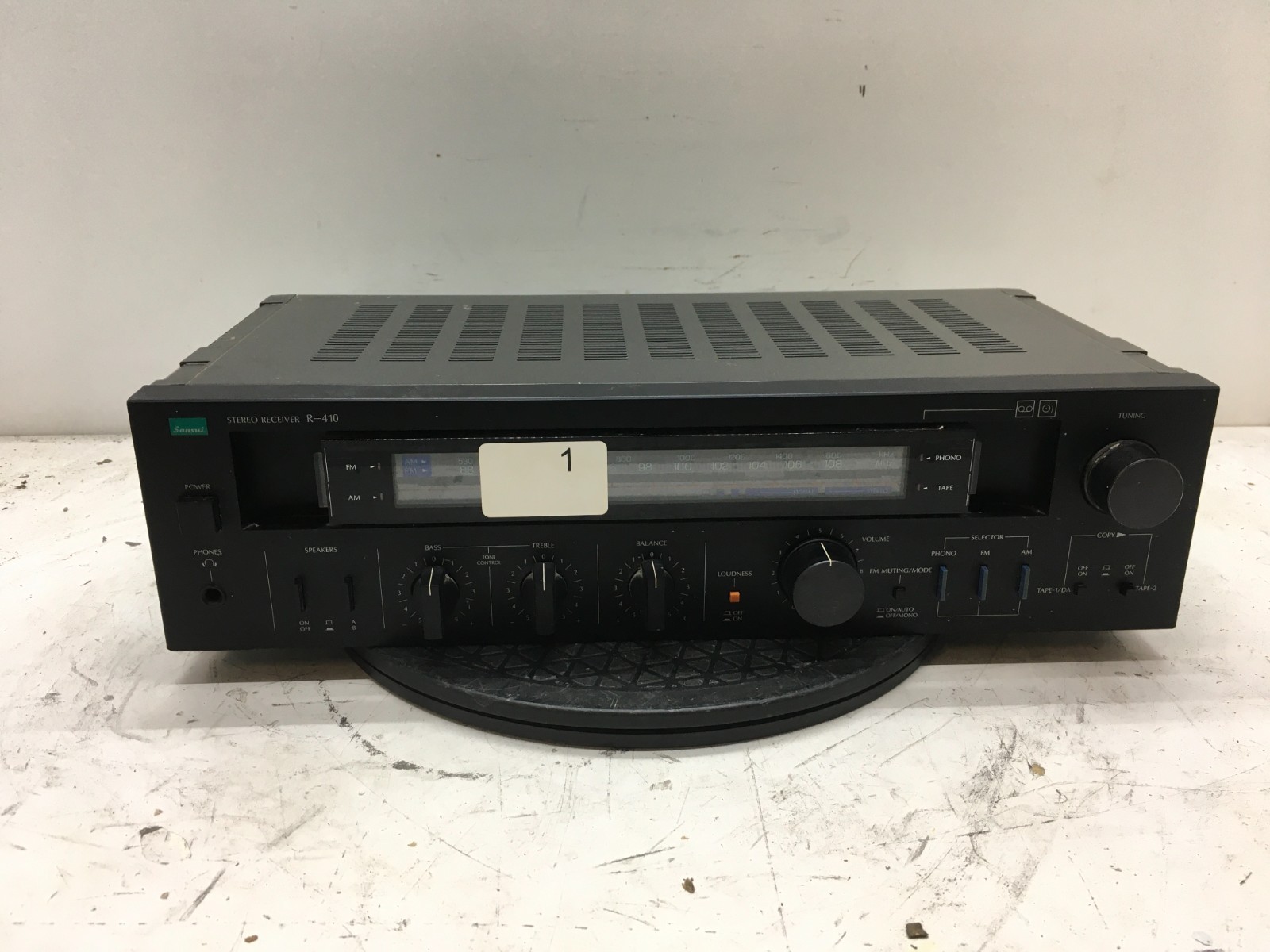
As an eBay Partner, we earn from qualifying purchases. This helps support our independent vintage technology research.
Related Models
- Sansui sax-200 (Late 1970s)
- Sansui sax-600 (Late 1970s)
- Sansui sr-222 (1973-1975)
- Sansui sr-717 (1974-1976)
- Sansui sr-2050c (1975-1977)
- Sony ps-5550 (1978-1980)
- Sony ps-lx5r (1983-1985)
- Sony ss-7220a (1970s)
- Sony ss-97 (Late 1970s (approximately 1977-1979))
- Sony ss-999 (Late 1970s (approximately 1977-1979))