Sansui SP-X8700 (1980)
Big, bold, and unapologetically flashy — these floor-scratchers were built to turn heads and shake walls.
Overview
Let’s clear the air right up front: there’s no such thing as a “Sansui SP-X8” in the official books. Every spec sheet, museum listing, and surviving manual points to the SP-X8700 — a hulking, six-driver floorstander from 1980 that looks like it rolled off the set of a 1970s karaoke bar designed by a sci-fi set decorator. If you’re chasing this model, you’re chasing the SP-X8700. The “SP-X8” tag seems to be a shorthand that’s grown in forums, maybe for convenience, maybe out of confusion — but the real deal is the X8700, and it’s a beast.
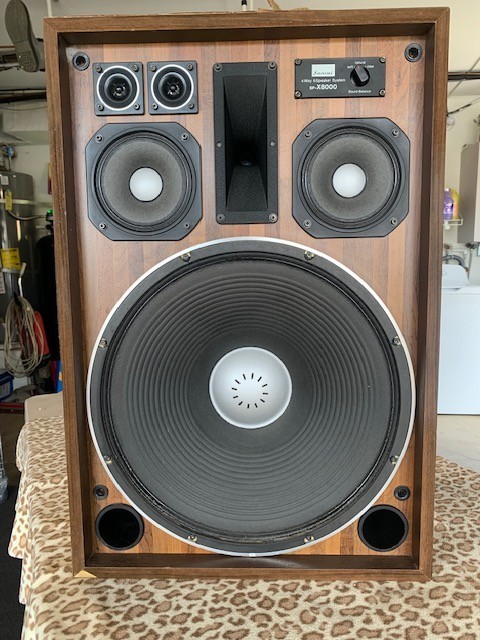
At first glance, it’s hard to tell if this speaker was engineered to reproduce music or to dominate a room visually. Standing over two feet tall in a wooden case with a dramatic horn tweeter and three little cone super tweeters stacked like a sonic crown, it’s a statement piece. And while Sansui didn’t leave behind a detailed technical manifesto on why they built it, the specs suggest ambition: a 4-way system with six separate drivers, including a massive 432mm (that’s 17-inch) bass cone — rare even for its time. This wasn’t some modest bookshelf upgrade; this was Sansui throwing every driver they had into a single cabinet and saying, “Let it roar.”
Owners are split — passionately — on what that roar actually sounds like. One swears they’re “unbelievable” and still “sound incredible” even after replacing crossover components. Another says they “perform flawlessly” and “sound amazing” right out of the box. But then there’s the other camp: calling them “low end speakers from the Kabuki era,” criticizing “hollow bass,” “unintelligible highs,” and muddled mids. One Reddit user bluntly claims a $100 Amazon bookshelf pair would outperform them. Yet another calls them “extremely efficient” — a trait that matters if you’re running vintage tube gear or lower-powered amps.
And that’s the thing: these aren’t subtle speakers. They’re loud, flashy, and built for presence. Whether that presence is sonic or visual depends on who you ask. Some see them as “classic top of the line Sansui speakers,” a crown jewel of the brand’s late-era output. Others see them as overbuilt, under-engineered relics — “very kobuki,” as one user put it, meaning flashy but shallow. Even their efficiency is a double-edged sword: great for driving with low-wattage amps, but if the crossover or drivers are degraded, that efficiency just means you hear the flaws louder.
They’re not small, either. At 470 x 688 x 270 mm, they’re nearly 28 inches tall and weigh 19.3kg (42.5 lbs) each — solid, dense, and likely to leave a mark if you’re not careful. One seller noted a “small red mark on the top from a candle,” which they thought “could be rubbed out.” That’s the kind of detail that sticks with you: these aren’t museum pieces sealed in glass. They lived in living rooms, near coffee tables, next to lamps — and sometimes, apparently, candles.
Specifications
| Manufacturer | Sansui Electric Co., Ltd.; Tokyo |
| Type | 4-way, 6-driver loudspeaker system |
| Configuration | 4-way, 6-driver |
| Power Handling | 220W |
| Impedance | 8Ω |
| Bass driver | 1 x 432mm cone |
| Midrange driver | 1 x 165mm cone |
| Tweeter | 1 x 171x59mm horn (T-149C) |
| Super Tweeter | 3 x 49mm cone (T-167) |
| Dimensions (WHD) | 470 x 688 x 270 mm / 18.5 x 27.1 x 10.6 inch |
| Weight | 19.3kg / 42.5 lb |
| Material | Wooden case |
Collectibility & Value
The Sansui SP-X8700 trades in a wide, wild range — from bargain-bin curiosity to audiophile oddity. In 2011, pairs were moving for $150 to $225 on Craigslist and eBay. Today? The market’s all over the map. One pair was listed for $399.99 on US Audio Mart. A single unit once carried a Buy It Now price of $116 on eBay; a pair went for $1,450. In Poland, a listing hit PLN 5,000 — roughly $1,200 at current exchange. That kind of spread tells you everything: there’s no consensus on value, only passion.
Condition matters — but so does belief. These speakers often need work, and one owner admitted they bought theirs from a shop that “recapped the crossovers,” a common but non-trivial repair. Without original service manuals or documented failure rates, that kind of maintenance is a roll of the dice. You might get a pair that “perform flawlessly,” or you might inherit a set with fatigued super tweeters and a fried horn. And since there’s no official sensitivity rating, frequency response, or crossover design info available, diagnosing issues is more art than science.
Are they collectible? Not in the way a Quad ESL or a JBL L100 is. There’s no official lineage, no known siblings, no marketing lore. They’re remembered — sometimes fondly, sometimes not — but not canonized. If you buy them, it’s because you love the look, you’ve heard a pair that sang, or you’re betting on a restoration. Just don’t expect broad agreement that you’ve made a wise move. As one forum user put it: “More current speaker designs would be a better purchase than spending $225 on these.” But then again, someone else paid six times that. Go figure.
eBay Listings



As an eBay Partner, we earn from qualifying purchases. This helps support our independent vintage technology research.
Related Models
- Sansui sax-200 (Late 1970s)
- Sansui sax-600 (Late 1970s)
- Sansui sr-222 (1973-1975)
- Sansui sr-717 (1974-1976)
- Sansui sr-2050c (1975-1977)
- Sony ps-5550 (1978-1980)
- Sony ps-lx5r (1983-1985)
- Sony ss-7220a (1970s)
- Sony ss-97 (Late 1970s (approximately 1977-1979))
- Sony ss-999 (Late 1970s (approximately 1977-1979))