Sansui SE-9 (1981–1983)
The equalizer that listens to your room and fixes it—while making you stare at its dancing sliders in disbelief.
Overview
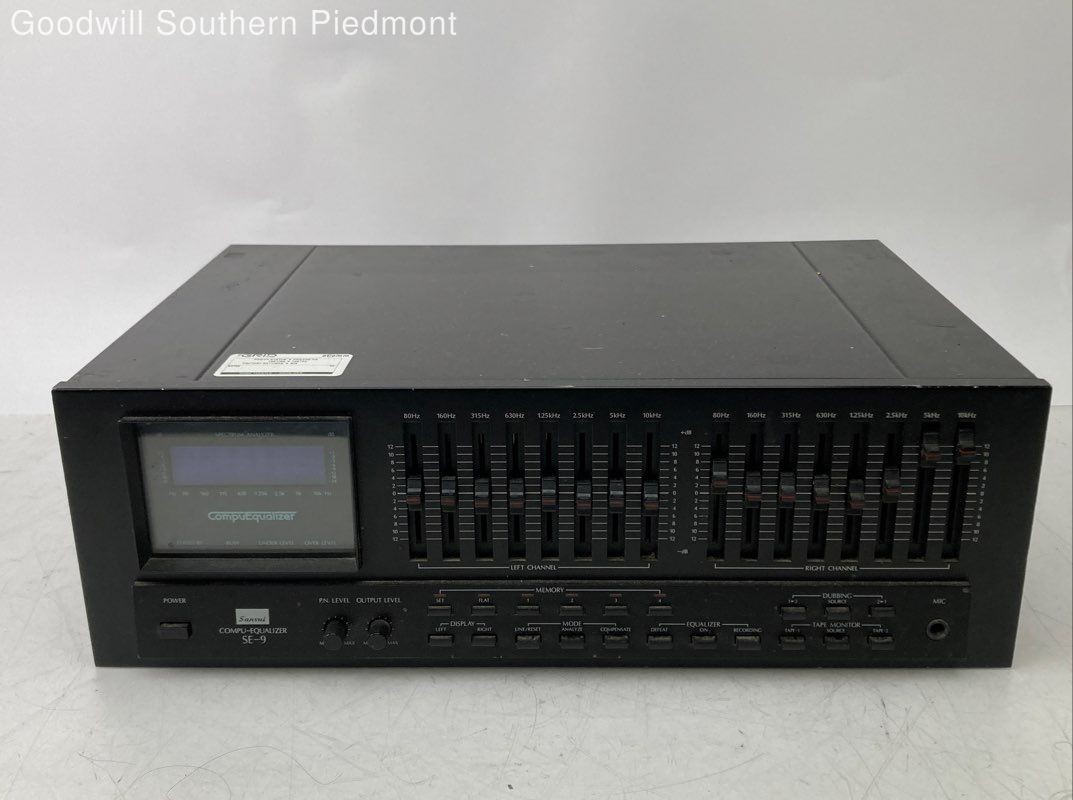
You press a button, and suddenly the thing starts talking to your speakers. A soft pink noise hums out—left channel, then right—while the SE-9’s tiny brain crunches the acoustics of your living room. Then, like magic, the sliders start moving. Not by hand. On their own. A quiet whir of motors and strings pulls each fader into place, adjusting bass and treble to cancel out the room’s flaws. It’s not sci-fi. It’s 1981, and Sansui just dropped the SE-9: a graphic equalizer with a microcomputer, a spectrum analyzer, and a flair for the dramatic.
This wasn’t just another box of knobs and circuits. The Sansui SE-9—often called the “Compu-Equalizer”—was built to do one job no other consumer unit could do reliably: automatically flatten your room’s frequency response. It came with a calibrated electret condenser microphone, a built-in pink noise generator, and a 4-bit microcomputer running Sansui’s proprietary program. You’d place the mic in your listening position, hit “Analyse,” and let the machine take over. In about 30 seconds, it measured the room, calculated corrections, and drove all 16 sliders (8 per channel) into their ideal positions using a motorized string-and-pulley system. That last bit? It’s as analog as it sounds—delicate, intricate, and mesmerizing to watch.
And when it wasn’t auto-calibrating, it worked like a high-end manual equalizer. Flat response in the neutral position, 8 bands from 80 Hz to 10 kHz, ±12 dB of cut or boost, and a frequency range stretching from 10 Hz to 100 kHz—way beyond what most ears can hear. The signal path used semiconductor inductors (IC-based), ditching bulky coils for cleaner, more stable performance. It had a defeat switch to bypass the circuit entirely, two user memory slots, four factory-programmed sound menus, and even dubbing capability between two tape decks. For its time, it was a full-featured hub in a high-end stereo chain.
Weighing in at 6.6 kg and clad in either silver or black, the SE-9 had the heft and presence of a serious piece of gear. It wasn’t subtle. It was meant to be seen, operated, and admired—especially when those sliders started moving on their own. Owners report it sounds “very very good,” with one Tapeheads.net user calling it “one of the coolest hifi stuff ever made.” A Reddit user flat-out declared it “the best equalizer I have ever owned.” That kind of devotion doesn’t come from specs alone. It comes from the experience.
Specifications
| Manufacturer | Sansui Electric Co., Ltd. |
| Production years | 1981 - 1983 |
| Original price | ¥79,800 (around 1981) |
| Variable range | ±12 dB, left / right independent |
| Center frequencies | 80 Hz, 160 Hz, 315 Hz, 630 Hz, 1.25 kHz, 2.5 kHz, 5 kHz, 10 kHz |
| Input Sensitivity / Impedance | Input : 1V/30k Ω, Tape1, 2 : 1V/30k Ω, Mic : 4mV/47k Ω |
| Output Level / Impedance | Tape Rec1, 2 : 1V/50 Ω, Pink Noise Level : 500mV/600 Ω, Rated output : 1V/47k Ω |
| Total harmonic distortion | 0.008% (Rated Output) |
| Frequency response | 10 Hz ~ 100 kHz +0 -1dB (Flat Position) |
| Signal-to-noise ratio (IHF) | 110dB |
| Gain | 0 dB (flat position) |
| Power consumption | 30W |
| External dimensions | 430 (W) x 148 (H) x 311 (D) mm |
| Weight | 6.6kg |
| Accessory microphone type | Electret condenser type |
| Accessory microphone sensitivity | -65dB |
| Accessory microphone impedance | 600 Ω |
| Input voltage | 100 / 120 / 220 / 240 V |
| Input frequency | 50 / 60 Hz |
| Finish | silver, black |
Key Features
Microcomputer-Driven Room Correction
The SE-9 wasn’t just an equalizer—it was a self-contained acoustic correction system. At its heart was a 4-bit microcomputer running Sansui’s original software. In “Analyse” mode, it triggered a built-in pink noise generator, which sent signals through the left and right speakers in alternating 0.5-second bursts. The included electret condenser microphone captured the response, and the 8-band spectrum analyzer converted the data into level information for each frequency band. The microcomputer then calculated the necessary adjustments and sent commands to the motorized fader system. The whole process took about 30 seconds and resulted in a room-tailored EQ curve with no guesswork.
Motorized String-and-Pulley Fader System
Few vintage components are as hypnotic to watch as the SE-9 in action. Sixteen 60mm slide faders—8 per channel—are moved not by gears or direct drives, but by a network of strings and pulleys connected to small motors. This system was praised in user comments for its precision and quiet operation. One HiFi Engine user called it “awesome in its design and how well it works.” But it’s also delicate. Over time, dust, wear, or dried lubricant can cause sliders to stick or become unresponsive. Owners note that keeping the unit clean and dust-free is critical. And yes—it’s as satisfying as it sounds when all the sliders snap back to flat with a single button press.
Semiconductor Inductor Circuit
Sansui eliminated traditional coils by using IC-based semiconductor inductor circuits. This design choice reduced size, heat, and potential magnetic interference while maintaining a wide frequency response and low distortion (just 0.008% at rated output). It also contributed to the unit’s impressive 110dB signal-to-noise ratio (IHF). The result was a cleaner, more stable signal path—especially important when you’re boosting or cutting across eight bands.
Memory and Sound Menus
The SE-9 offered two user memory stages, allowing owners to store and recall custom EQ curves. It also came with four pre-programmed sound menus—professionally tuned response curves for different listening preferences or content types. These weren’t gimmicks; they were part of Sansui’s push to make high-fidelity tuning accessible. Whether you wanted to flatten your room, enhance vocals, or simulate a concert hall, the SE-9 could recall it with one touch.
Defeat Mode and Connectivity
A dedicated Defeat button bypassed the entire equalizer circuit, sending the signal straight through with no coloration. This was essential for A/B comparisons and ensuring the unit didn’t degrade the signal when not in use. Connectivity included RCA inputs and outputs for main input, two tape loops (with dubbing between Tape1 and Tape2), and a dedicated mic input for the calibration microphone. The ability to daisy-chain tape decks made it a central hub in a complex analog setup.
Collectibility & Value
The Sansui SE-9 is described as a top-of-the-line vintage Sansui equalizer, and the market reflects that. Listed prices vary widely: $475 on eBay, $550 at The Turntable Store, and as high as $1,780 at TechnoGold Audio & Vintage—though these are asking prices, not confirmed sales. A Reddit user reported seeing one offered for $120, suggesting condition plays a huge role. Units listed as “technical: 5/10, cosmetic: 5/10” are often marketed for parts or repair, indicating that fully functional examples are rarer.
Common issues include distorted sound, unresponsive sliders, connectivity errors, dead bulbs on the front panel, and faded paint or markings. The original microphone has a 600 Ω impedance, and using a replacement with different specs—like a 200 Ω mic—could damage the unit. It’s also unclear whether the SE-9 provides phantom power, so using modern mics like the Behringer ECM-8000 (which require +15V to +48V) is risky without verification.
Maintenance largely revolves around cleaning the sliders and keeping the device dust-free. Service manuals with schematics are available, which helps with repairs, but there’s no detailed public data on common electronic failures like capacitor degradation or motor wear. Given the complexity of the fader drive system, any restoration should be approached with care.
eBay Listings



As an eBay Partner, we earn from qualifying purchases. This helps support our independent vintage technology research.
Related Models
- Sansui sax-200 (Late 1970s)
- Sansui sax-600 (Late 1970s)
- Sansui sr-222 (1973-1975)
- Sansui sr-717 (1974-1976)
- Sansui sr-2050c (1975-1977)
- Sony ps-5550 (1978-1980)
- Sony ps-lx5r (1983-1985)
- Sony ss-7220a (1970s)
- Sony ss-97 (Late 1970s (approximately 1977-1979))
- Sony ss-999 (Late 1970s (approximately 1977-1979))