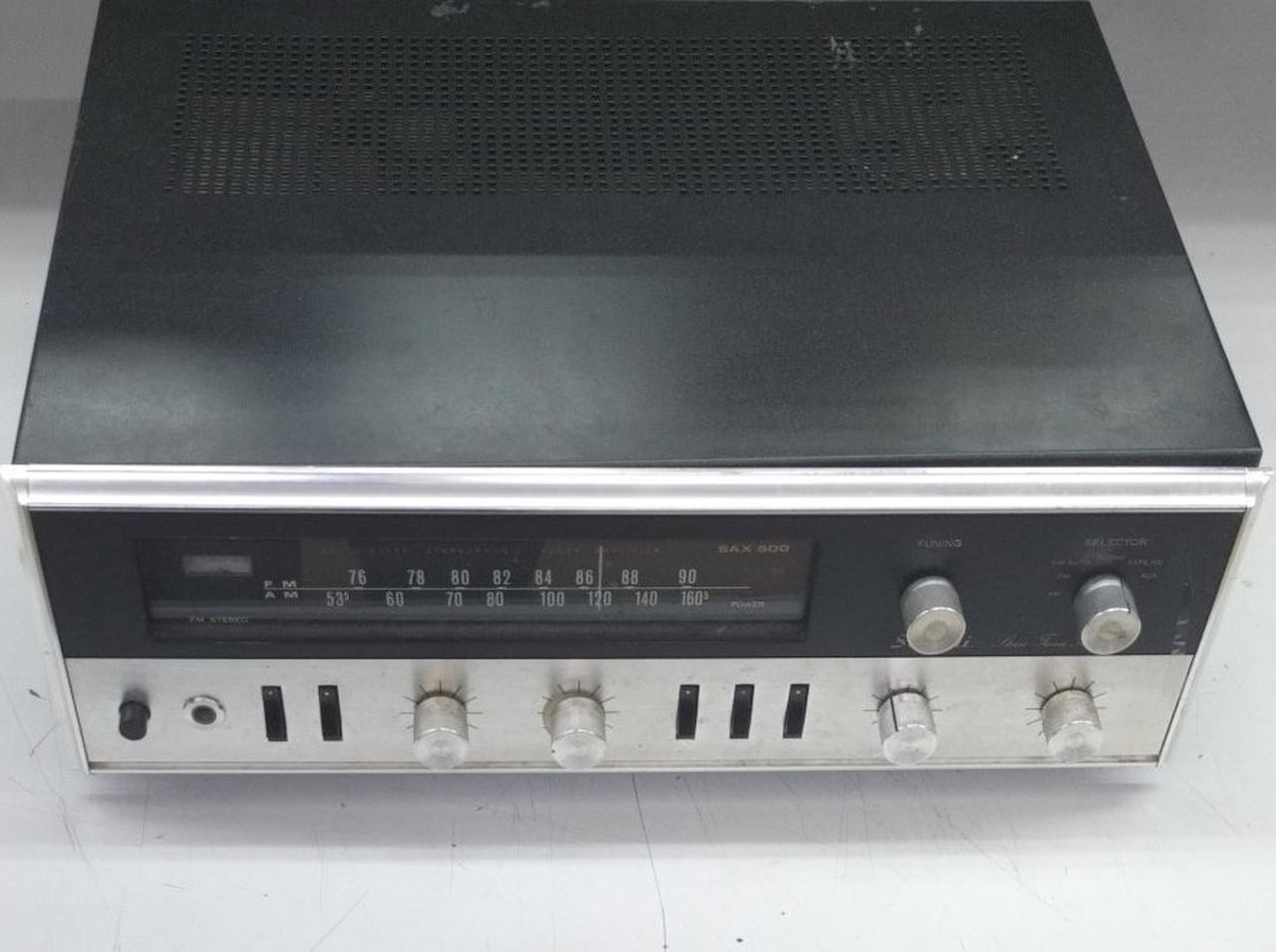
Sansui SAX-600 (Early 1960s)
A handwired tube beast from Japan’s golden era of hi-fi, built when Sansui was chasing sonic perfection with vacuum-powered ambition.
Overview
You can almost smell it—the warm hum of glowing glass, the faint ozone of a chassis pushing serious voltage through hand-soldered joints. The Sansui SAX-600 isn’t just old gear; it’s a relic from the moment Japanese audio engineering started turning heads worldwide. Built in Japan during the early 1960s, this tube stereo receiver—also described as a vacuum amplifier and power amplifier—was part of an “impressive group of products” that signaled Sansui’s arrival on the global hi-fi stage. At a time when many Western companies still dominated audiophile circles, Sansui was quietly assembling something special: gear designed not just to compete, but to redefine what solid, high-fidelity sound could be. Their goal? Simple, if audacious: “to produce the world class stereo amplifiers and receivers.” The SAX-600 was one of the machines meant to carry that torch.
It’s not a sleek minimalist statement like later solid-state designs. This is audio as machinery—dense, complex, alive. And while we don’t have hard numbers on power output, frequency response, or physical dimensions (those specs remain lost to time, or at least to the archives we’ve scoured), we do know what’s inside: a forest of vacuum tubes, each playing its role in shaping the signal path. Based on one verified unit, the tube complement includes NEC 6AR8s (four of them), NEC 6BA6s (two), NEC 6BN8s (two), Hitachi 6AQ6s (four), National 12AX7s (three), plus a National 6BE8, National 6BL8, National 6AQ8 (two), and one unmarked 12AX7 whose origin remains a mystery. That’s 20 tubes by count—some dual-purpose, some stage-specific—suggesting a design that prioritized gain, tone shaping, and perhaps AM/FM broadcast tuning alongside serious audio amplification.
This wasn’t a stripped-down amp for the budget buyer. The sheer number of tubes implies a fully-featured receiver with multiple stages: preamp, driver, power amp, and likely integrated tuner sections. The use of both 12AX7s (a classic dual-triode favored in preamp stages) and beam power tetrodes like the 6AQ6 and 6BL8 points to a serious architecture—one that balanced high voltage gain with robust output delivery. Whether it delivered the legendary “Sansui warmth” we associate with their later transistor gear is unknown, but owners of similar vintage tube models often describe a lush midrange and forgiving top end, the kind of sound that makes even worn vinyl feel luxurious.
Key Features
Vacuum Tube Architecture
The heart of the SAX-600 is its all-tube design, a hallmark of early 1960s high-fidelity equipment. Unlike later solid-state receivers that prized efficiency and compactness, the SAX-600 embraced the thermal and electrical demands of vacuum tubes to shape its sonic character. One verified unit contains a detailed tube lineup: four NEC 6AR8s, two NEC 6BA6s, two NEC 6BN8s, four Hitachi 6AQ6s, three National 12AX7s, and individual tubes including a National 6BE8, National 6BL8, two National 6AQ8s, and an unbranded 12AX7. This extensive array suggests a complex signal chain, likely incorporating separate stages for phono preamplification, audio voltage gain, FM detection, and power amplification. The presence of multiple 12AX7 variants—a staple in high-gain preamp circuits—hints at a design optimized for rich tonal detail, while the 6AQ6 and 6BL8 types, often used in output stages, may have contributed to its drive capability.
Historical Context
The SAX-600 emerged during a formative period for Japanese audio manufacturing. In the early 1960s, Sansui was not yet the household name it would become in the 1970s, but it was already building an “impressive group of products” aimed squarely at the high-fidelity market. This was a time when stereo broadcasting was gaining traction, LPs were replacing 78s, and consumers were beginning to treat home audio as an experience rather than just a convenience. Sansui’s stated goal during this era was “to produce the world class stereo amplifiers and receivers,” and the SAX-600 appears to have been one of the early embodiments of that ambition. While it arrived before the company’s more famous transistorized receivers, it laid groundwork in engineering discipline and circuit design that would later define their reputation.
eBay Listings

As an eBay Partner, we earn from qualifying purchases. This helps support our independent vintage technology research.
Related Models
- Sansui sax-200 (Late 1970s)
- Sansui sr-222 (1973-1975)
- Sansui sr-717 (1974-1976)
- Sansui sr-2050c (1975-1977)
- Sansui sr-232 (1975-1977)
- Sony ps-5550 (1978-1980)
- Sony ps-lx5r (1983-1985)
- Sony ss-7220a (1970s)
- Sony ss-97 (Late 1970s (approximately 1977-1979))
- Sony ss-999 (Late 1970s (approximately 1977-1979))