Sansui sax-200 (1964)
That warm, glowing hum as the colorful tuning scale rises—this 1964 tube-powered AM/FM multi-stereo amplifier is a time capsule of early high-fidelity ambition.
Overview
The Sansui sax-200 isn’t just another vintage receiver—it’s a statement piece from a moment when stereo was still magic, and Japanese manufacturers were proving they could build gear that rivaled anything from the West. Released in 1964, the sax-200 was one of the first in Sansui’s SAX series, arriving at a time when the company was laser-focused on crafting world-class stereo amplifiers and receivers. It’s not flashy by modern standards, but under the hood, it’s a meticulously engineered hybrid of tube warmth and emerging transistor tech, built to deliver a full, rich sound across AM, FM, and your favorite vinyl.
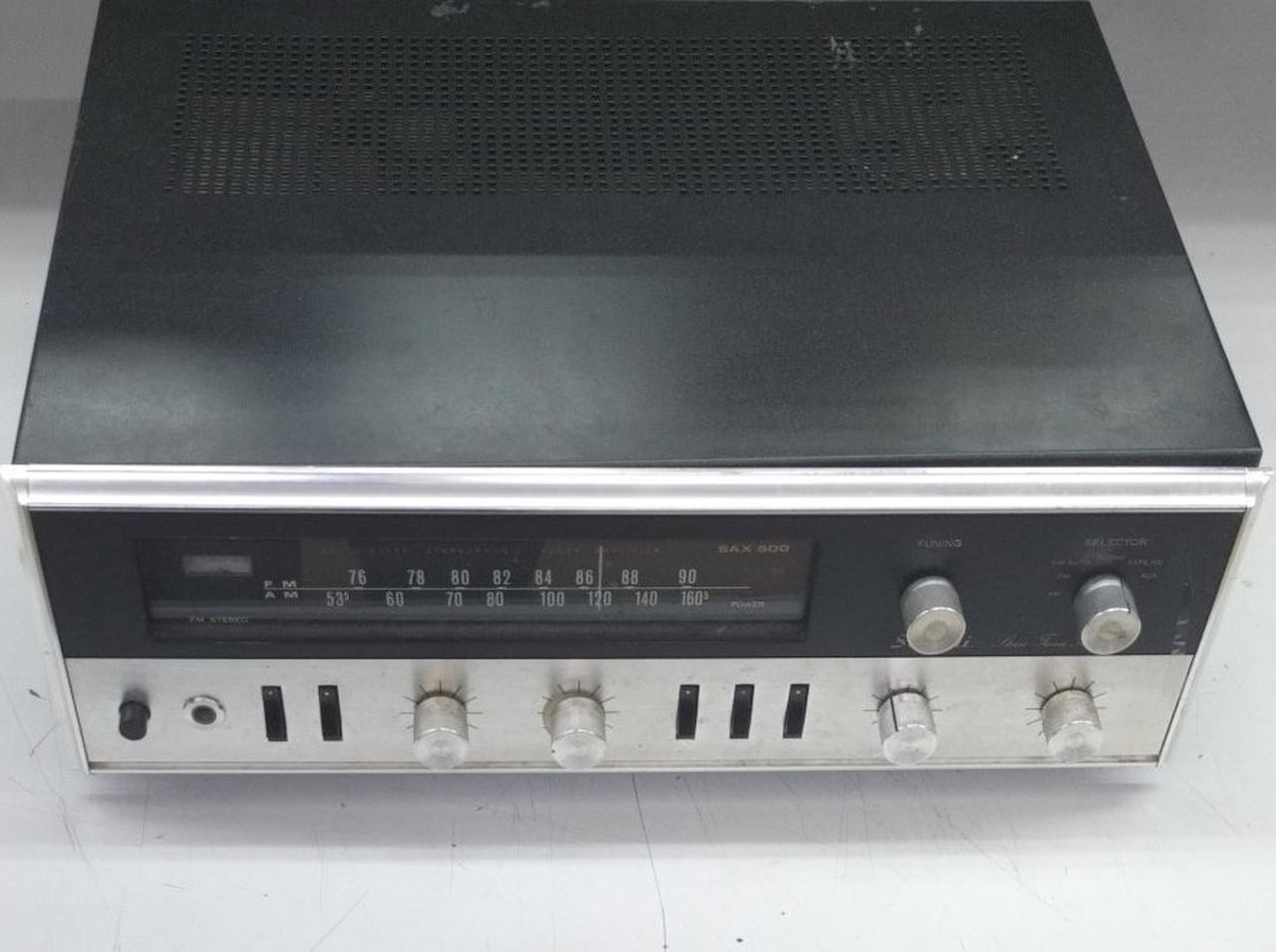
Priced at ¥44,700 at launch—a serious investment back then—the sax-200 packed a lot of innovation into its 13.3kg chassis. It’s a true multi-stereo amplifier, meaning it integrates a high-performance FM multiplex stereo tuner, preamp, and power amp in one unit, all wrapped in a design that feels both industrial and inviting. The front panel layout is dense but logical, with dedicated switches for every function, from source selection to filter options, and that unforgettable rising colorful scale that lifts into view when you power it on. It’s the kind of detail that makes you feel like you’re operating a piece of audio machinery, not just turning on a box.
And make no mistake—this is a machine. With 15 vacuum tubes, including four 6BM8s in a push-pull configuration for the output stage, it leans heavily on tube-based amplification for that lush, harmonically rich sound Sansui would become known for. But it’s not purely analog nostalgia: the unit also uses four 2SB-381 transistors in the head amplifier section, a nod to the transitional era where solid-state components were beginning to complement, not replace, tubes. The power stage employs voltage negative feedback (V-NFB) of more than 16 dB, which helps lower internal impedance and tighten up control over speakers—something that mattered even in 1964.
It’s also surprisingly flexible. The output impedance supports 8 Ω, 16 Ω, and 32 Ω loads, making it compatible with a wide range of vintage speakers. The preamp section offers generous gain across inputs, with phono (MAG) sensitivity at just 1.1 mV, ideal for magnetic cartridges of the era. And the inclusion of special terminals for condenser and tweeter suggests Sansui expected owners to build or fine-tune their speaker systems, not just plug in off-the-shelf boxes.
Specifications
| Manufacturer | SANSUI |
| Product type | AM/FM multi-stereo amplifier |
| Production years | Released in 1964 |
| Original price | ¥ 44,700 (released in 1964) |
| Music power | 23W+23W |
| Maximum power output | 16W+16W |
| Frequency characteristic | 20 Hz ~ 80 kHz -2dB or less (8 Ω load) |
| Distortion factor | 1% or Less (at Output 13W) |
| Output impedance | 8 Ω, 16 Ω, 32 Ω |
| Preamplifier Gain (output 12W, 1 kHz) | Phono MAG : 79 dB, 1.1 mV; Phono X-TAL : 51 dB, 40 mV; Tape (MIC) : 84 dB, 0.8 mV; AUX : 46 dB, 70 mV |
| Signal-to-noise ratio | Tape : 55 dB or more |
| Tone control | CR Type 50 Hz, + 13 dB to -15dB; 10 kHz, + 10 dB to -14dB |
| Equalizer | NF Type Phono:RIAA Tape:NAP |
| FM Tuner Receiving frequency | 76 MHz to 90 MHz |
| FM Tuner Bandwidth | 200kHz(-3dB) |
| FM Tuner Electrical fidelity | 30 Hz to 15 kHz ± 2 dB or less |
| FM Tuner Sensitivity | 3.5 μ V (S/N 30 db) |
| FM Multiplex Method | Switching system |
| FM Multiplex Frequency characteristic | 50 Hz to 15 kHz ± 2 dB |
| FM Multiplex Channel separation | 35 dB (1 V, 1 kHz) |
| FM Multiplex Distortion factor | 1% or Less (0.3 V Input, 1 kHz) |
| AM Tuner Receiving frequency | 535 kHz to 1605 kHz |
| AM Tuner Bandwidth | 6kHz -3dB |
| AM Tuner Sensitivity | 50 μ V or More (S/N 20 dB) |
| Accessory circuits | Loudness control, Scratch filter, Rumble filter, AFC, Tape monitor, FM stereo indicator |
| Semiconductors used | Vacuum Tubes (15 pcs) 6AQ8 : 3 pcs 6BE6 : 1 6BA6 : 3 6BM8 : 4 pieces 6BL8 : 1 6DA5 : 1 Piece 12AT7 : 1 12AU7 : 1 Piece; Germanium Diode OA-91 : 9; Silicon Diode SE-0,5B : 2 pcs; Selenium Rectifier TC-0,2P : 1 Piece; Transistor 2SB-381 : 4; Burr Cap 1S-352 : 1 Piece |
| Power supply voltage | 100 VAC, 50Hz/60Hz |
| Power consumption | 120VA |
| External dimensions | Width 436x Height 147x Depth 343 mm |
| Weight | 13.3kg |
Key Features
Tube Power with a Transistor Assist
At the heart of the sax-200 is a push-pull configuration using the 6BM8, a high-efficiency composite tube that combines a triode and pentode in one envelope. Four of these tubes are deployed in the output stage, delivering 23W of music power per channel—respectable for 1964. The design benefits from more than 16 dB of voltage negative feedback (V-NFB), which reduces internal impedance to about 1/8 of what it would be otherwise. That means tighter bass and better speaker control, even with the era’s less efficient drivers.
FM Multi-Stereo with Switching Matrix
The sax-200 was built for the future—even if that future was just arriving. It includes an FM multi-stereo circuit using a switching matrix method, which was one of the early approaches to decoding stereo broadcasts. The FM tuner covers 76–90 MHz, tailored for the Japanese FM band, and offers solid specs: 3.5 μV sensitivity (S/N 30 dB), 200kHz bandwidth, and 35 dB channel separation. The stereo indicator on the front panel lets you know when a stereo signal is locked in, a small but satisfying confirmation that you’re hearing the full spatial image.
Smart Input Flexibility
With dedicated inputs for phono (MAG and X-TAL), tape, mic, and AUX, the sax-200 was designed as a hub for a full analog setup. The preamp gain is substantial—84 dB for tape/mic input—so it can drive even low-output sources. The inclusion of NAP equalization for tape (in addition to RIAA for phono) shows Sansui’s attention to the nuances of tape playback, which was still a primary recording medium for enthusiasts.
Filters and Loudness for Real-World Listening
The accessory circuits are thoughtful: a loudness control to boost bass at low volumes, scratch and rumble filters to clean up vinyl playback, and AFC (Automatic Frequency Control) to stabilize AM reception. These weren’t just gimmicks—they were solutions to actual listening problems of the time. The scratch filter likely targeted surface noise from worn records, while the rumble filter helped with turntable-induced low-frequency noise.
That Rising Scale—Pure Theater
One of the most charming details? The colorful tuning scale that physically rises when you turn on the power. It’s not just functional—it’s theatrical. It signals that something important is happening, that this machine is coming to life. In an age of silent, instant-on electronics, that little mechanical flourish creates a ritual around listening.
Special Terminals for Tweeter and Condenser
The back panel includes special terminals labeled for condenser and tweeter—suggesting the sax-200 was meant to be part of a custom speaker system. This wasn’t just an amp for bookshelf speakers; it was for builders and tinkerers who wanted to optimize their sound. Whether used for passive crossovers or external electrostatic panels, these terminals show Sansui expected sophisticated users.
Historical Context
The sax-200 was part of an ambitious push by Sansui in the early 1960s to establish itself as a leader in high-fidelity audio. Alongside the sax-100, it was among the first models in the SAX series, which would evolve into a respected line of integrated amplifiers. Released in 1964, it arrived when stereo broadcasting was still new, FM was expanding, and consumers were beginning to demand more from their home audio. The inclusion of FM multiplex stereo decoding placed the sax-200 at the forefront of that shift, offering a complete, self-contained stereo experience in a single chassis.
Collectibility & Value
Today, the Sansui sax-200 trades in the $500–$650 range, with listings on Reverb and HifiShark reflecting strong interest from collectors who appreciate its combination of tube warmth, tuner performance, and historical significance. Units described as "fully restored" and "fully functional" command the higher end of that range, but caution is warranted: one owner reported receiving a unit that produced no sound until a fuse in the power supply was replaced. Another issue noted is persistent hissing on the FM band with no tuning response—symptoms that could point to aging capacitors, failing tubes, or selenium rectifier degradation.
The selenium rectifier (TC-0,2P) is a known weak point in vintage gear of this era and should be inspected or replaced during restoration. A service manual is available, which helps with troubleshooting and repair. Given the high tube count and mixed semiconductor technology, a full recapping and bias check are strongly recommended before extended use. There’s also at least one report of a user getting shocked when probing speaker terminals—so safety should be a priority when working inside the chassis.
eBay Listings
As an eBay Partner, we earn from qualifying purchases. This helps support our independent vintage technology research.
Related Models
- Sansui sax-600 (Late 1970s)
- Sansui sr-222 (1973-1975)
- Sansui sr-717 (1974-1976)
- Sansui sr-2050c (1975-1977)
- Sansui sr-232 (1975-1977)
- Sony ps-5550 (1978-1980)
- Sony ps-lx5r (1983-1985)
- Sony ss-7220a (1970s)
- Sony ss-97 (Late 1970s (approximately 1977-1979))
- Sony ss-999 (Late 1970s (approximately 1977-1979))