Sansui D-770R (1982–1984)
Flip the tape? Who has time for that—this thing reverses in under a second and keeps your mixtape magic alive.
Overview
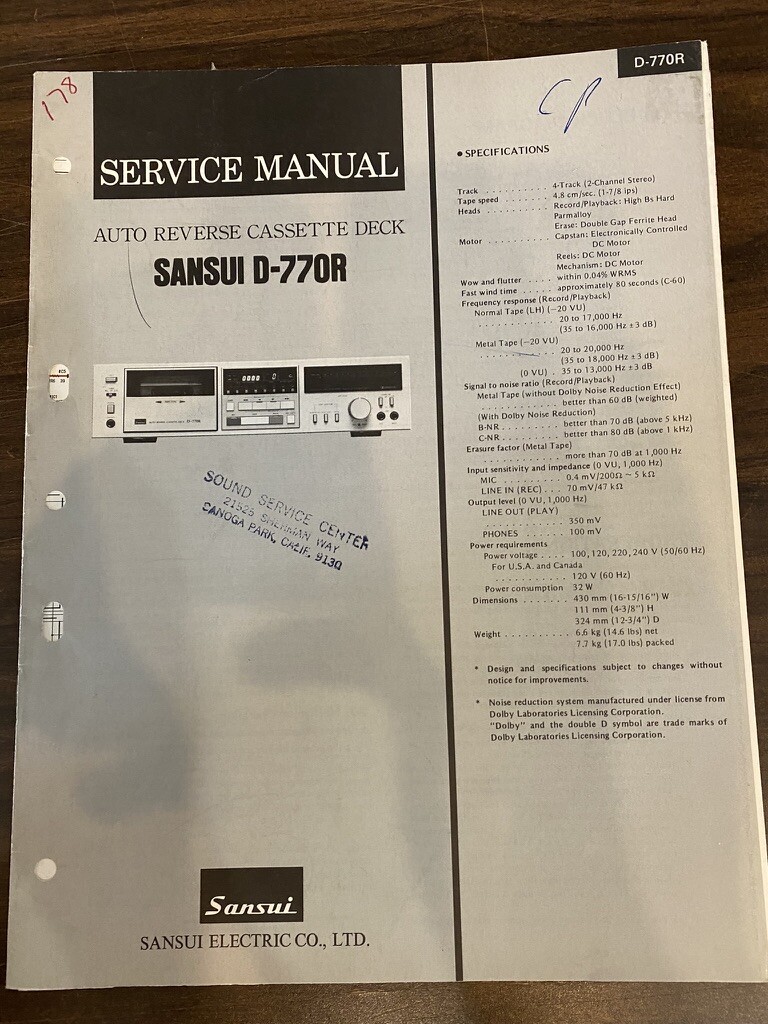
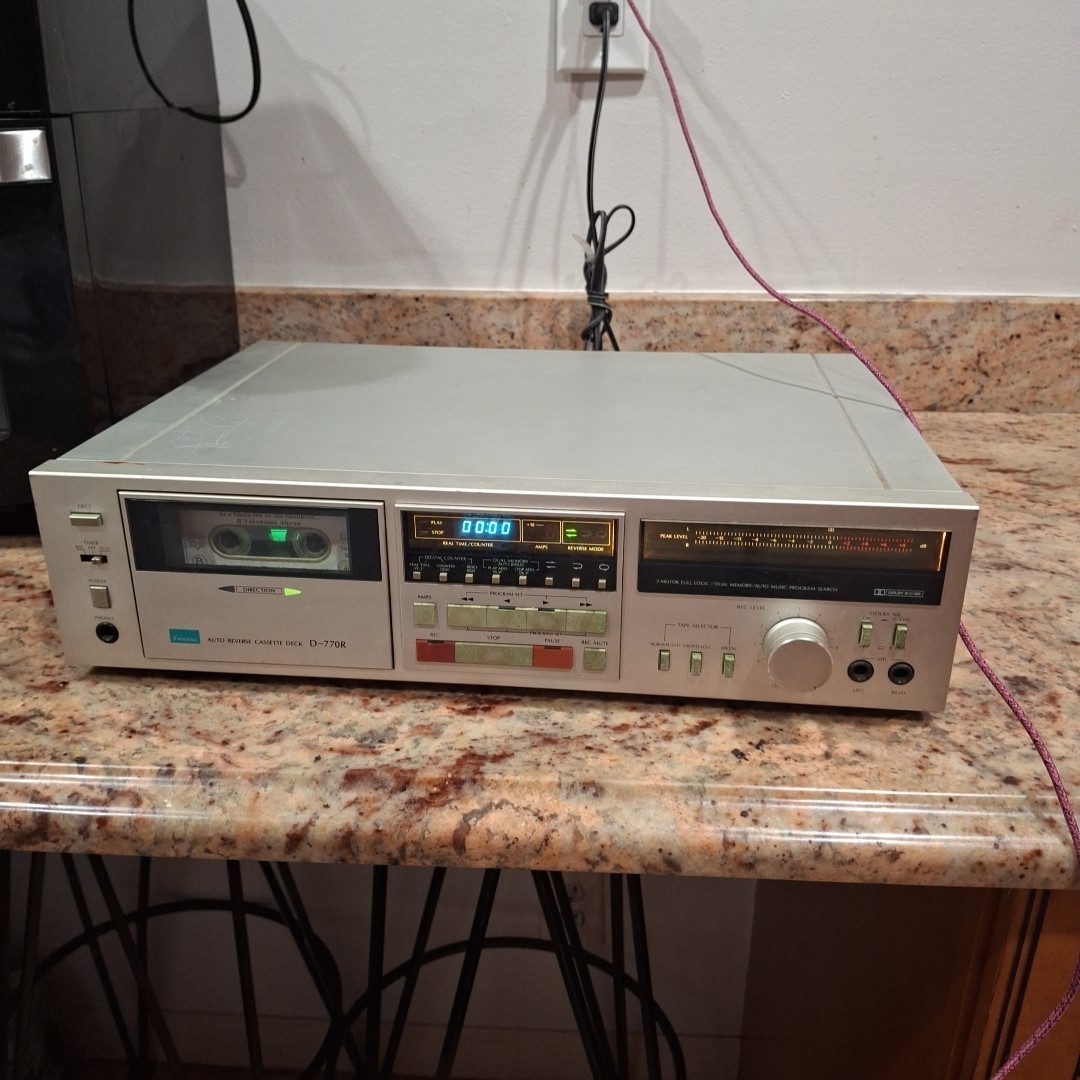
The Sansui D-770R isn’t just another auto-reverse cassette deck from the early '80s—it’s a precision-engineered statement that says, “We’re not here to babysit tape heads.” Built between 1982 and 1984, this stereo cassette deck was Sansui’s answer to the growing demand for seamless, high-fidelity tape playback without the chore of manual flipping. And it delivers, thanks to a clever system they called “Computer Reverse,” which flips direction in just 0.6 seconds—faster than most decks even registered that the tape had ended. That’s not marketing fluff; that’s a spec pulled straight from the manual. For anyone who ever cursed at a clunky mechanism mid-album, this thing feels like witchcraft.
It’s not all speed, though. The D-770R is packed with features that were top-tier for its time: Dolby C noise reduction, a dual-mode electronic counter, and a fixed 4-track inline head made of hard permalloy—no moving parts, no wobble, just consistent contact. That head, paired with a 2+1 motor system (electronically controlled DC for the capstan, plus DC motors for the reels and mechanical drive), gives it the kind of transport stability that made it a favorite among those who actually recorded, not just played back. And with a wow and flutter rating under 0.045% WRMS, it’s no wonder owners report playback and record levels that “live up to Sansui expectations.” One user put it plainly: “For an auto-reverse, it’s imo one of the better ones from that era.”
But you got what you paid for: a machine that didn’t just play tapes, it respected them. The frequency response stretches to 19 kHz on metal tape, and the SN ratio hits 60 dB or more without Dolby—solid for the time, and with Dolby C, you’re looking at up to 20 dB of noise reduction. That’s real hiss-killing power, not just a checkbox. And with a 12-dot LED peak level meter, you could actually see what you were recording, not guess at it.
Specifications
| Manufacturer | Sansui |
| Track format | 4-track 2-channel stereo reciprocal recording and playback |
| Heads | Recording & Playback : 4-track 4-channel hard permalloy head; Erase : Two double-gap ferrite heads |
| Motor | For Capstan : Electronically Controlled DC Motor; For Reel : DC Motor; Mechanical Drive : DC Motor |
| Wow and flutter | Less than 0.045% (WRMS) ± 0.08% (W. peak, EIAJ) |
| Early winding time | Approximately 80 Seconds (C-60) |
| Frequency response (-20VU) | Metal Tape : 20 Hz ~ 19 kHz (35 Hz ~ 18 kHz ± 3 dB); CrO2 : 20 Hz to 18 kHz (35 Hz to 17 kHz ± 3 dB); LH : 20 Hz ~ 17 kHz (35 Hz ~ 16 kHz ± 3 dB) |
| SN ratio (read / write, 1 kHz, 3% signal level, 3rd harmonic distortion, metal tape) | Dolby off : 60 dB or more; Dolby B : 10 dB improvement at 5 kHz or more; Dolby C : 20 dB improvement at 1 kHz or higher |
| Input Sensitivity / Impedance (1 kHz, 0 VU) | Mic : 0.4mV/200 Ω ~ 5k Ω; Line : 70mV/47k Ω |
| Output level (1 kHz, 0 VU) | Line : 350mV/47k Ω; Headphone : 100mV/8 Ω |
| Power consumption | 27W |
| External dimensions | Width 430x Height 111x Depth 324 mm |
| Weight | 6.6kg |
Key Features
Computer Reverse: The 0.6-Second Flip
The standout feature—literally what sets this deck apart—is the “Computer Reverse” system. Unlike many auto-reverse decks that physically pivot or shift the head, the D-770R uses a fixed 4-track inline head with an infrared photocoupler sensor and what the specs call a “computer for Oatley berth control.” The result? A direction change in just 0.6 seconds before sound resumes. No clunk, no delay, no waiting. It’s instantaneous. And because the head doesn’t move up, down, or rotate, there’s less wear and better long-term alignment. That’s a big deal for reliability and consistent playback quality.
Dolby C with Type Selection
Noise reduction isn’t an afterthought here. The D-770R comes equipped with Dolby C, which delivers up to 20 dB of noise reduction using a two-stage sliding band system—significantly more effective than Dolby B, especially in the midrange. But Sansui didn’t lock you in: there’s a type selection switch that lets you toggle between Dolby C and the more common Dolby B, giving you flexibility depending on the tape or your source. Owners note that with metal tapes, the difference is night and day—“Nak tapes do sound a bit better on this deck,” one reported, and given the extended frequency response on metal (up to 19 kHz), that tracks.
Dual Memory Repeat & AMPS Track Jumping
This deck was built for control. The dual memory repeat function lets you set two points and loop between them—handy for learning solos or analyzing a section of audio. Even more impressive is the A-plane B-plane continuous AMPS function, which allows jumping forward or backward across up to 15 tracks. That’s a level of navigation most decks didn’t offer, making the D-770R feel more like a studio tool than a living room accessory.
Smart Monitoring & Timing
The 12-dot LED peak level meter gives a clear, responsive view of input levels—no guessing whether you’re distorting. The dual-mode electronic counter can show either a 4-digit counter or real-time, thanks to microcomputer control. And for hands-off operation, there’s a recording/playback timer with a REC/PLAY switch, plus a 4-second auto REC mute that prevents those annoying pops at the start of a recording. A direction indicator shows which way the tape’s moving—small touch, but helpful when you’re not watching the display.
Build & Usability
At 6.6kg and 111mm tall, it’s compact but substantial, fitting neatly into standard audio racks. The fixed head design eliminates a major failure point found in rotating-head mechanisms. However, one owner notes the “hinged Dolby pc board” is a “pain” to work around during servicing—something to keep in mind if you’re planning a deep clean or repair. The included accessories are modest: two pin plug cords and a cleaning rod, but nothing extravagant.
Collectibility & Value
Current market prices vary widely. Listings show the D-770R selling for as little as $50.96 in auction histories, while others are priced at $100 on US Audio Mart or as high as $239.99 on eBay, sometimes with a $174.99 protection plan tacked on—so buyer beware. Shipping alone has been noted at $60, which can sting for a used deck. Condition clearly drives value: one seller emphasized that “all of the lights work and it sounds really great,” suggesting cosmetic and functional integrity matter.
Common issues include weak output, which one owner attributed to needing internal cleaning—a fixable problem, but one that underscores the importance of maintenance. Another reported an electrical malfunction where input signal from the left channel was audible in the headphones during playback, indicating potential crosstalk or grounding issues. These aren’t widespread failure reports, but they’re real quirks to test for. Fortunately, a service manual is available via HiFi Engine, making repairs more feasible than with orphaned models.
While not a unicorn, the D-770R has its fans. One owner called it a satisfying addition that “completes my Sansui D-*** series line up from 1982 vintage,” hinting at a quiet cult following among brand loyalists. It’s not the rarest, nor the most powerful, but for those who value speed, precision, and that classic Sansui build quality, it’s a compelling piece of early '80s tape tech.
eBay Listings


As an eBay Partner, we earn from qualifying purchases. This helps support our independent vintage technology research.
Related Models
- Sansui sax-200 (Late 1970s)
- Sansui sax-600 (Late 1970s)
- Sansui sr-222 (1973-1975)
- Sansui sr-717 (1974-1976)
- Sansui sr-2050c (1975-1977)
- Sony ps-5550 (1978-1980)
- Sony ps-lx5r (1983-1985)
- Sony ss-7220a (1970s)
- Sony ss-97 (Late 1970s (approximately 1977-1979))
- Sony ss-999 (Late 1970s (approximately 1977-1979))