Sansui BA 2000 (1977–1979)
A 110-watt-per-channel power amp with a chimney-cooled chassis, a current-mirror front end, and a power meter that reads down to a single milliwatt.
Overview
The BA-2000 weighs 18.3 kg, and the transformer is the reason. Sansui built it as a stereo power amplifier - no preamp section, no tone controls, just an input, a gain stage, and a pair of outputs rated at 110 watts per channel into 8 ohms from 20 Hz to 20 kHz at no more than 0.03% total harmonic distortion. Into 4 ohms the rating holds at 110 watts, with distortion rising only to 0.05%. That flat rating across load impedance is the number to watch. The amp keeps its output when a speaker's impedance dips.
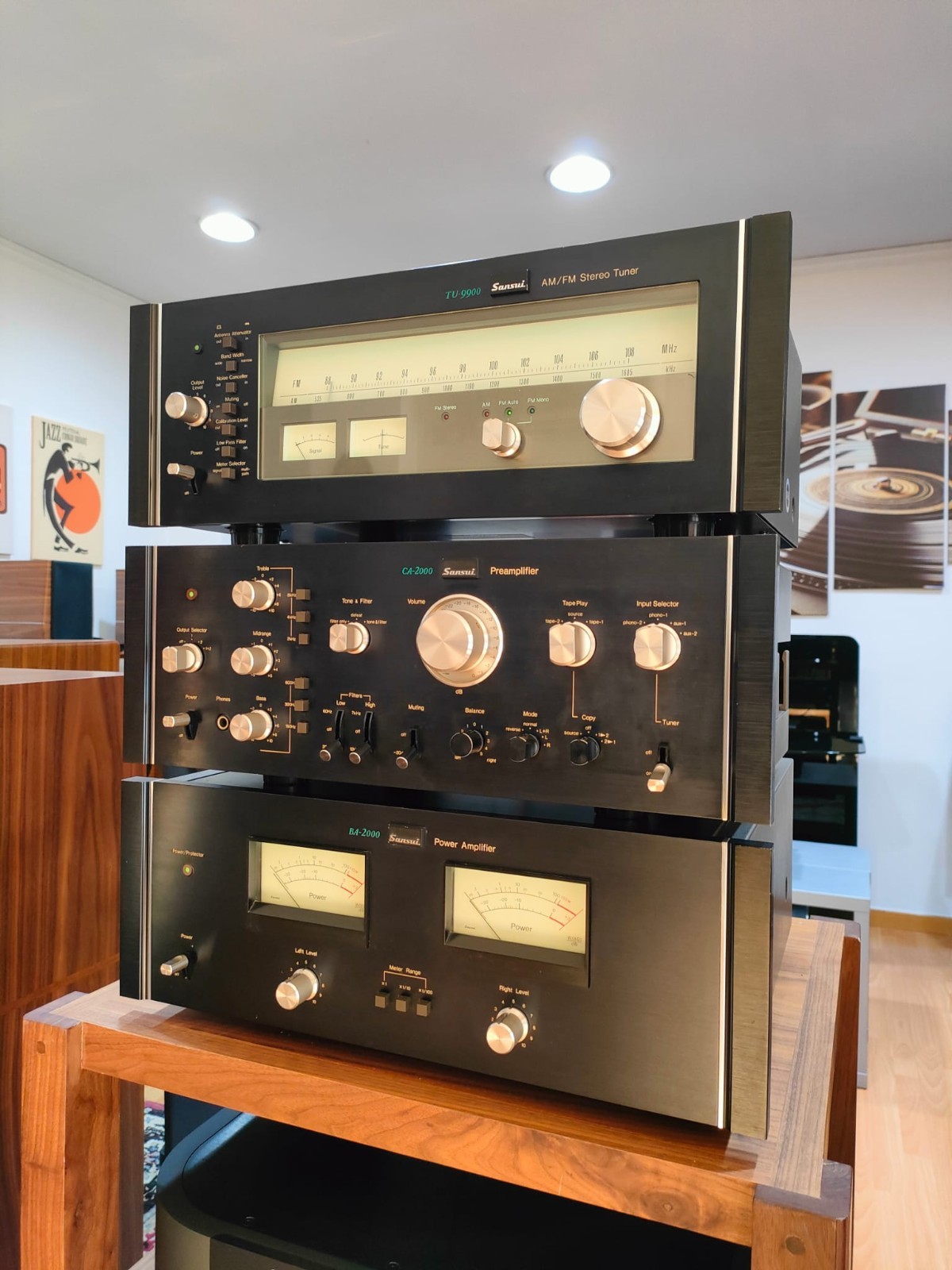
It was made to pair with the CA-2000 preamplifier, and the two were often sold alongside the TU-9900 tuner as a complete Sansui separates system. Original Japanese-market price was ¥120,000, which in the mid-1970s put it in serious-audiophile territory. It was not flagship money, but well past casual. Sansui's own literature called it a high-output amplifier that "not only faithfully reproduces the original music but also reproduces the sound of the music itself." That is the kind of copy you'd expect from a company that had been building transformers since 1947 and had spent three decades earning its reputation.
The measured specs back up the pitch. Frequency response at 1 watt runs 5 Hz to 100 kHz, +0/−1 dB, which is flat well past the audible range. Signal-to-noise is 115 dB or better by the IHF A-network short-circuit method, and channel separation holds at 75 dB or more at 1 kHz. Input sensitivity is 1000 mV into 50k ohms, so it wants a proper line-level source. Damping factor is rated at 70 into 8 ohms, and the minimum speaker load is 8 ohms. Don't pair it with low-impedance speakers without thinking it through.
Power consumption is 480 watts rated and 910 watts maximum. That gap between idle and full tilt is typical of a class-AB design with real headroom and a power supply built to deliver transient peaks without sagging. Owners tend to describe the sound in terms of smoothness and soundstage rather than brute force, which tracks with the circuit topology. This is a refined design, not a muscle amp.
Key Features
Fully Complementary OCL Circuit, Direct-Coupled Throughout
The signal path is DC-coupled from input to output, with a fully complementary output stage operating without a coupling capacitor. Sansui described the circuit as a refinement of their pure complementary OCL topology. In practice that means no output cap sits between the amplifier and your speakers, rolling off bass and adding its own coloration. The differential amplifier at the front uses a newly developed dual transistor with matched operating and thermal characteristics. Two devices share a substrate, so they drift together as the amp warms up. DC balance is further stabilised by combining a constant current circuit with a current mirror circuit, a pairing that Sansui's own service documentation credits with improving signal-to-noise ratio, distortion, and DC stability.
Three-Stage Darlington Drive with Parallel Push-Pull Output
The pre-drive stage is a two-stage class A amplifier with an active load. The drive stage uses a three-stage Darlington connection in a parallel push-pull configuration, with two high-output transistors per channel sharing the work. Sansui's service literature says the current mirror section raises open-loop gain from the roughly 30-35 dB typical of a conventional differential amplifier to approximately 70-80 dB. That allows 40-50 dB of negative feedback to be applied without the circuit becoming unstable. More feedback, properly applied, means lower distortion. That is how the BA-2000 gets to 0.03% THD at rated output into 8 ohms.
Dual-Winding Toroidal Transformer and Independent Supply Rails
The power supply uses an independent two-winding toroidal transformer feeding a high-capacity silicon rectifier and large electrolytic capacitors. Two separate supply rails run independently to the pre-drive and drive stages, and the pre-drive gets its own stabilised supply built around a constant current circuit. Isolating the sensitive front end from the current-hungry output stage is a classic way to keep noise and crosstalk out of the signal, and it's why the channel separation figure holds at 75 dB. Main filter capacitors are 12000 µF, 63 V screw-terminal types, in 51 mm diameter cans. They are the first thing most restorers replace.
Chimney-Type Heatsink with Four Convective Radiators
Rather than bolting the output transistors to a flat plate, Sansui built a chimney. The heatsink uses four convective radiators with an envelope volume of 1,200 cc, arranged so that cool air is drawn in from the bottom and hot air exhausts upward. It works without a fan. It's clever thermal engineering, and part of why these amps survive decades of use. The driver stage, output stage, and power supply are also physically separated into distinct blocks inside the chassis, which keeps heat away from the small-signal circuitry.
Logarithmic Power Meter with Three-Range Switching
The front-panel meter is an effective-value display type with a logarithmic compression circuit. It can track pulse signals and small output levels that a conventional VU meter would miss. Three range settings - x1, x1/10, and x1/100 - let you read output from 0.001 W all the way up to 110 W, or from −34 dB to +3 dB. It's one of the more useful meters fitted to a 1970s power amp. The needle barely moves during quiet passages, and the reading can still be trusted.
Protection Circuits with Front-Panel Indicator
Output transistors are guarded by a current limiter that detects the safe operating area (ASO) plus a temperature detection circuit. The speakers are protected by a DC detection circuit working with a relay, and a front-panel indicator lights red whenever any of these protection functions engage. Sansui also fitted special relays and inrush-current prevention circuits for power-on, which makes sense with a transformer this size. The parts list reads like an engineer's shopping list: ultra-low-noise transistors, low-leakage capacitors, fuse resistors, non-flammable resistors, and varistors throughout.
Historical Context
The BA-2000 dates from the mid-1970s. Sources place production between 1976 and 1979, with several citing 1977-79 specifically. It was designed as the power-amp half of a separates system, complementing the CA-2000 preamplifier, and the TU-9900 tuner completed the set. The CA-2000 is remembered as one of Sansui's most highly regarded products.
Sansui had been founded in Tokyo in 1947 by Kosaku Kikuchi, originally as a transformer manufacturer, and by the time the BA-2000 arrived the company had been building audio equipment for the better part of thirty years. That transformer heritage shows in the toroidal iron inside this amp. Original Japanese-market price was ¥120,000 around 1976, and the amp was sold in the Japanese domestic market.
High Fidelity (September 1977, p.67) reviewed the BA-2000 and called it "a superb amplifier from Sansui." The reviewer noted that the sound character differences between amplifiers can be subtle enough that listeners struggle to articulate exactly what they're hearing. The same review (p.68) pointed to the three-stage Darlington-configuration output stage driven by a high-gain, high-slew-rate front end as the likely source of the amp's sonic excellence. That lines up with Sansui's own circuit documentation.
eBay Listings

As an eBay Partner, we earn from qualifying purchases. This helps support our independent vintage technology research.
Related Models
- Sansui 2000A (1968-1970)
- Sansui 5000X (1969-1971)
- Sansui 6060 (1975-1977)
- Sansui 7000X
- Sansui 881 (1974-1976)
- Braun AUDIO-1 (1965)
- Braun AUDIO-250 (1965)
- Magnavox Component Systems (1972)
- Acoustic Research AR (1967-1976)
- Acoustic Research 11