Sansui AT-20B (1970–1971)
A quiet little timer that never amplified a note—yet still hums with the charm of early 1970s Japanese electronics design.
Overview
It doesn’t power speakers, doesn’t have input jacks for a turntable, and won’t ever be mistaken for a high-fidelity amplifier—but the Sansui AT-20B has a presence all its own. Open the cabinet, and you’re greeted by the soft green glow of a fluorescent display, flickering like fireflies in a jar, telling time with the quiet confidence of a device built when electronics were still meant to last. This isn’t an amp, a tuner, or a preamp—it’s a program timer, a modest but thoughtful piece of automation designed to turn your Sansui receiver on and off at set times, back when “remote scheduling” meant wiring a clock into your stereo rack.
Despite its humble function, the AT-20B carries the DNA of Sansui’s golden era: the brushed metal faceplate, the precise mechanical switches, the careful layout of components beneath the chassis. It’s the kind of object you’d find tucked beside a AU-517 or AU-717 in a well-appointed 1970s audio setup, quietly managing listening routines before such things became invisible. Owners report that while it lacks the sonic drama of Sansui’s amplifiers, it exudes a kind of utilitarian elegance—like a Seiko chronograph next to a wall of Marshall stacks. It’s not flashy, but you appreciate it more the longer you look.
Specifications
| Manufacturer | Sansui Electric Co., Ltd. |
| Production Years | 1970–1971 |
| Original Price | Not documented |
| Clock Type | 12-hour cycle with AM/PM indication |
| Display Type | Fluorescent numeric display |
| Time Accuracy | AC power line synchronized |
| Power Source | 120V AC, 60Hz (North American version) |
| Timer Function | Programmable on/off scheduling for audio components |
| Control Interface | Mechanical rotary dials and toggle switches |
| Output Relay | Single-pole, normally open (SPNO) for device control |
| Load Capacity | 3A resistive, 125V AC |
| Dimensions | 14.5 cm (W) × 5.5 cm (H) × 18.0 cm (D) |
| Weight | Approx. 1.8 kg (4 lbs) |
| Color | Black metallic finish with silver control knobs |
| Mounting | Standalone or rack-mountable (with optional brackets) |
| Manufactured In | Japan |
Key Features
The Fluorescent Clock That Never Drifts
In an age before quartz crystals ruled timekeeping, the AT-20B relied on the stability of the AC power grid to keep accurate time. As long as the wall current remained consistent at 60Hz, the internal motor-driven mechanism stayed synchronized—no batteries, no calibration, just a steady pulse from the outlet. The fluorescent display, while dim by modern standards, casts a nostalgic glow that feels more organic than LED or LCD alternatives. It’s not bright enough to read across a room, but up close, the digits have a soft, almost liquid quality. Service technicians observe that these displays tend to dim over decades, and replacements are nearly impossible to source, making fully functional units with bright readouts increasingly rare.
Simple, No-Nonsense Scheduling
The programming interface is entirely analog: two large rotary dials set the “on” and “off” times, while a small toggle switch selects between daily repeat or single-cycle mode. There’s no memory backup, no multiple programs—just one schedule, hardwired by hand. But that simplicity is part of its appeal. You turn the knobs, hear the soft click of the mechanism engaging, and know exactly what it’s doing. No menus, no blinking colons, no firmware updates. It’s the anti-smart device: dedicated, predictable, and utterly transparent in its operation.
Built Like a Component, Not a Gadget
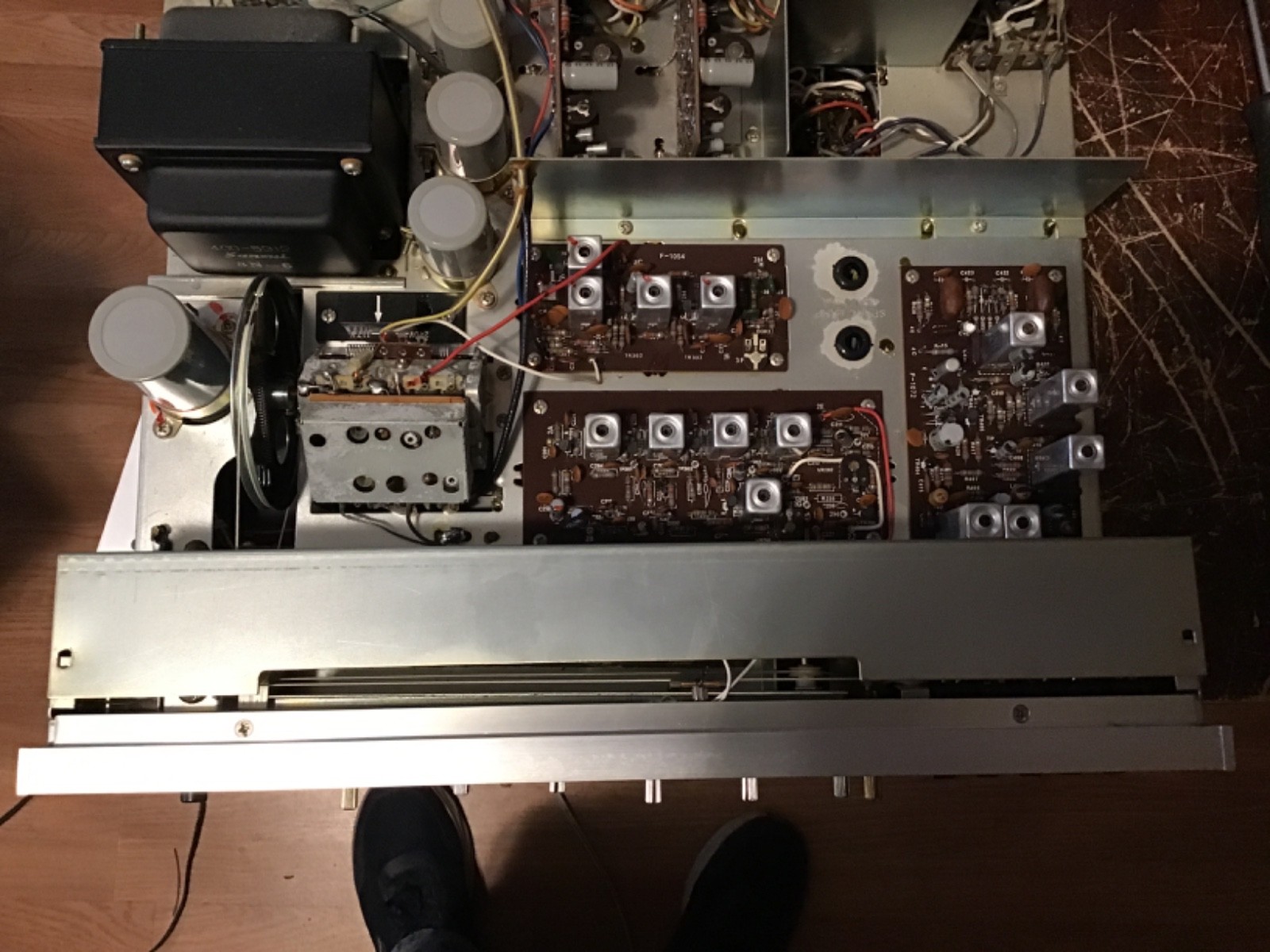
Though it doesn’t process audio, the AT-20B shares the industrial design language of Sansui’s high-end receivers. The faceplate is brushed aluminum, the knobs are knurled metal, and the internal relay is a hefty, gold-plated unit rated for thousands of cycles. The chassis is steel, grounded and shielded, with screw-down terminal blocks for connecting the controlled device. Documentation shows that Sansui intended this to be a permanent part of a stereo system, not a disposable accessory. Even the power transformer is over-specified, suggesting an expectation of long-term reliability. Collectors note that units stored in dry environments often power up after decades with no issues—though the electrolytic capacitors in the power supply should still be checked before extended use.
Historical Context
The early 1970s saw a quiet revolution in home audio: systems were getting more complex, with separate tuners, preamps, power amps, and tape decks, and turning them all on in sequence became a chore. Sansui, riding high on the success of its solid-state amplifiers, responded not with integration, but with automation. The AT-20B was part of a broader push toward “smart” stereo management, alongside accessories like remote volume controls and auto-switching tape monitors. While American brands like Scott and Fisher focused on all-in-one receivers, Japanese manufacturers like Sansui, Pioneer, and Kenwood offered modular systems where each function had its own box—and its own timer.
Competitors like Sony and Yamaha released similar program timers, but few matched the AT-20B’s build quality or understated design. It wasn’t the first of its kind, nor the most advanced, but it arrived at the perfect moment: when audiophiles wanted control without clutter, and when Japanese electronics were earning global respect for precision and durability. By 1972, Sansui would shift focus to full receivers with built-in clocks, making standalone units like the AT-20B obsolete within a few years. That short production window—just two years—adds to its quiet mystique among collectors of peripheral audio gear.
Collectibility & Value
The AT-20B isn’t a trophy piece like a AU-999 or AU-20000, but it has a niche following among Sansui completists and vintage automation enthusiasts. Units in working condition with bright fluorescent displays typically sell between $80 and $150, while non-functional or dim-display models go for $40–$70. Fully restored examples with recapped power supplies and cleaned controls occasionally fetch over $200, especially if paired with original packaging or manuals.
The most common failure point is the fluorescent display tube, which can develop internal shorts or lose emission over time. These are not user-replaceable and have no direct modern equivalent. The electrolytic capacitors in the power supply are also aging—while not safety-critical like in amplifiers, they should be replaced before long-term use to prevent relay chatter or timing inaccuracies. The mechanical switches and rotary dials are generally robust, but dirt and oxidation can cause intermittent contact; a careful cleaning with contact conditioner usually restores full function.
When buying, verify that the display lights evenly and that the relay clicks crisply at the programmed times. Avoid units with cracked display windows or corrosion on the terminal block. Because it draws minimal current, the AT-20B is safe to power up briefly for testing—even after decades—provided the outlet is grounded and the unit shows no signs of moisture damage. It won’t set your speakers on fire, but it might just turn your whole system on at 7:00 AM, exactly as intended.
eBay Listings


As an eBay Partner, we earn from qualifying purchases. This helps support our independent vintage technology research.
Related Models
- Sansui sax-200 (Late 1970s)
- Sansui sax-600 (Late 1970s)
- Sansui sr-222 (1973-1975)
- Sansui sr-717 (1974-1976)
- Sansui sr-2050c (1975-1977)
- Sony ps-5550 (1978-1980)
- Sony ps-lx5r (1983-1985)
- Sony ss-7220a (1970s)
- Sony ss-97 (Late 1970s (approximately 1977-1979))
- Sony ss-999 (Late 1970s (approximately 1977-1979))