Realistic STA-65D: The RadioShack Workhorse of the 1970s Hi-Fi Era
In the golden age of analog audio, when turntables spun vinyl and receivers anchored living room stereo systems, the name Realistic was a familiar sight on store shelves across America. As the house brand of RadioShack, Realistic brought affordable, reliable audio equipment to the masses. Among its lineup of amplifiers and receivers, the STA-65D stands out as a quintessential example of mid-tier 1970s hi-fi engineering—offering solid performance, practical features, and the kind of rugged build quality that has allowed many units to survive—and still perform—over four decades later.
Released around 1975, the STA-65D was positioned as a step-up model in RadioShack’s amplifier range, offering 65 watts per channel into 8 ohms—a respectable figure for its time, especially considering its price point. Unlike some of the more flamboyant receivers from Japanese brands, the STA-65D wasn’t designed to impress with flashy meters or excessive knobs. Instead, it focused on clean power, reliable operation, and straightforward functionality, making it a favorite among budget-conscious audiophiles and casual listeners alike.
Technical Specifications
The STA-65D is a solid-state stereo power amplifier, part of a generation of components that emphasized power output and stability over exotic circuitry. While not as feature-rich as full receivers (it lacks a built-in tuner or phono preamp), it served as a powerful amplifier for systems where users already had source components.
| Specification | Detail |
| Model | Realistic STA-65D |
| Manufacturer | Tandy Corporation (RadioShack) |
| Year Introduced | 1975 |
| Type | Stereo Power Amplifier |
| Power Output | 65W per channel (8Ω, RMS, 20Hz–20kHz) |
| Total Harmonic Distortion | <0.1% (at full power) |
| Frequency Response | 20Hz – 20kHz, ±1dB |
| Input Sensitivity | 250mV for full output |
| Input Impedance | 47kΩ |
| Damping Factor | >100 (8Ω) |
| Speaker Impedance | 8Ω minimum |
| Inputs | 2x RCA (Tape, Aux) |
| Outputs | Speaker terminals (A/B optional) |
| Power Supply | Dual mono with toroidal transformer (estimated) |
| Dimensions (W×H×D) | 17" × 6" × 15" (approx.) |
| Weight | ~25 lbs |
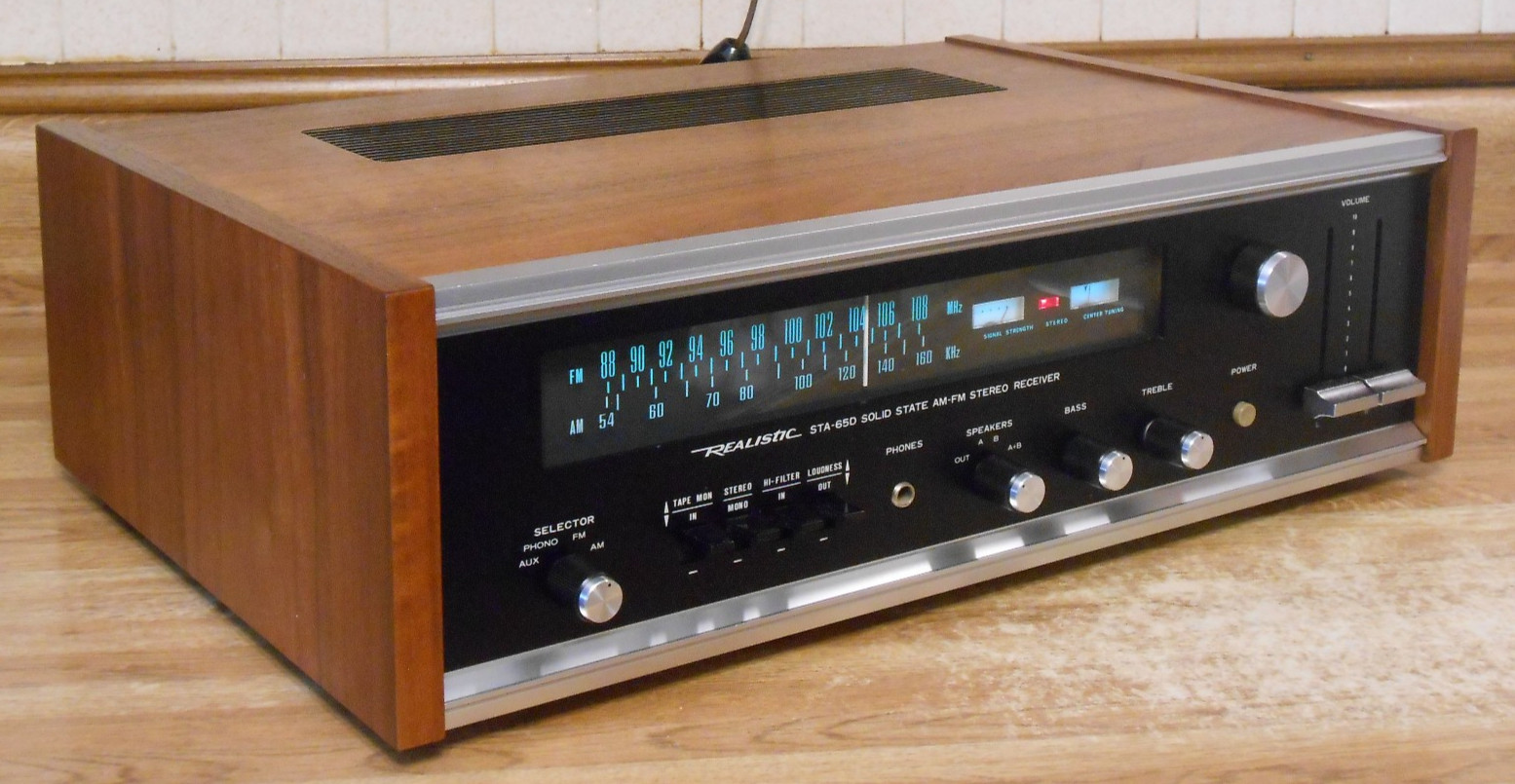
The amplifier uses a dual differential input stage and complementary symmetry output transistors, typical of the era’s robust Class AB design. Its large heatsinks and substantial power transformer suggest a design built for sustained performance, not just peak power ratings. The front panel is minimalist: a large volume knob, source selector, mute switch, and power indicator. The rear panel includes gold-plated speaker terminals—uncommon at this price point—suggesting RadioShack’s intent to offer real value.
Sound Characteristics and Performance
The STA-65D delivers a warm, smooth, and slightly laid-back sound signature—common among American-designed amplifiers of the 1970s. It doesn’t aim for clinical precision like some Japanese contemporaries, but instead emphasizes musicality and listening comfort. Bass is tight and well-controlled, though not overly aggressive; mids are clear and natural, making vocals and acoustic instruments shine. Highs are smooth, avoiding the harshness that can plague budget gear.
Thanks to its high damping factor and robust power supply, the STA-65D handles dynamic swings with confidence. It pairs well with efficient bookshelf or floor-standing speakers from the era—models like the AR-3a, KLH Model Eight, or JBL L100—driving them with authority without strain. While it may not match the micro-detail retrieval of modern high-end amps, its analog warmth and harmonic richness make it a compelling choice for vinyl lovers and classic rock enthusiasts.
Notable Features and Innovations
While not groundbreaking, the STA-65D includes several thoughtful touches:
- Gold-plated speaker terminals: A premium feature that resists corrosion and ensures solid connections.
- Dual speaker outputs (A/B): Allows switching between two pairs of speakers—useful for multi-room setups.
- Mute switch: A rare inclusion at this price, helping prevent turn-on thumps.
- Sturdy steel chassis and ventilation: Designed for long-term reliability and heat dissipation.
- Non-microprocessor control: Pure analog operation, appealing to purists.
The STA-65D was often sold alongside other Realistic components like the TAS-3000 tuner or TIC-500 preamp, forming a complete, budget-friendly system. Its modular nature allowed users to build a system piece by piece—a hallmark of RadioShack’s consumer-friendly approach.
Common Issues and Maintenance
Like any vintage amplifier, the STA-65D benefits from periodic maintenance. After 45+ years, several components may degrade:
- Electrolytic capacitors: The most common failure point. Power supply and signal path caps should be checked or replaced to prevent hum, distortion, or channel dropouts.
- Output transistors: While generally robust, thermal stress over decades can weaken them. Testing for DC offset and bias current is recommended.
- Dust and oxidation: Pots and switches can become noisy. Cleaning with contact cleaner often restores smooth operation.
- Rubber feet and cosmetic wear: Original rubber feet often dry out or crumble. Replacement is easy and improves stability.
Many STA-65Ds have survived due to their overbuilt power supplies and conservative thermal design. With a recapped unit and proper bias adjustment, the STA-65D can deliver decades more service.
Current Market Value and Collectibility
The Realistic STA-65D is not a high-end collector’s item like a McIntosh or Marantz, but it holds a nostalgic and functional appeal among vintage audio enthusiasts. Units in working condition typically sell for $75–$150, depending on cosmetic condition and whether they’ve been serviced.
Fully restored models with replaced capacitors and cleaned controls may fetch slightly more, especially when sold as part of a matching Realistic system. While not rare, original, unmodified units are becoming harder to find—particularly those with intact badges and no cosmetic damage.
Its value lies not in investment potential, but in affordable vintage performance. For under $100, a refurbished STA-65D can serve as the heart of a classic analog setup, delivering warm, engaging sound that modern budget amps often lack.
Conclusion and Legacy
The Realistic STA-65D may not have the brand prestige of Marantz or the engineering acclaim of Sansui, but it represents something equally important: accessible, reliable hi-fi for the everyday listener. In an era when RadioShack stores dotted every shopping mall, the STA-65D brought serious power and clean sound to thousands of homes without breaking the bank.
Today, it stands as a testament to a time when electronics were repairable, modular, and built to last. While overshadowed by more glamorous contemporaries, the STA-65D deserves recognition as a workhorse of American audio—a no-nonsense amplifier that did its job well and continues to do so for those who appreciate vintage gear with honest performance.
If you stumble upon one in a basement, garage sale, or online listing, don’t overlook it. With a little care, the Realistic STA-65D can still deliver a rich, musical experience that reminds us why we fell in love with analog audio in the first place.
eBay Listings



As an eBay Partner, we earn from qualifying purchases. This helps support our independent vintage technology research.
Related Models
- Realistic STA-2250 (1975)
- Realistic STA-2290 (1977)
- Realistic STA-720 (1975)
- Realistic TR-169 (1975)
- Realistic STA-2080 (1978)
- Pioneer QX-949A (1978)
- Pioneer SX-2000 (1978)
- Pioneer SX-2500 (1978)
- Marantz SR-2000 (1999–2001)
- Onkyo TX-1500MKII (1975)