Quad ESL (1957–?)
The loudspeaker that taught a generation what "transparent" means - and then spent the next sixty years reminding its owners that nothing that good comes free.
Overview
Quad's own technical literature dates the introduction of the original Electrostatic to 1957. A small British firm decided to throw out the cone, the surround, the box and the crossover, and drive a sheet of charged plastic suspended between two perforated metal plates. It was sold simply as the "Quad Electrostatic" for most of its life. It only picked up the "ESL-57" designation retrospectively, when Quad introduced the ESL-63 in 1981-82 and needed a way to tell the two apart in the catalogue.
Owners still describe this speaker with something close to reverence decades after production ended. The diaphragm has almost no mass and is driven uniformly across its entire surface. There is no cone breakup, no surround, and no crossover between drivers, so nothing for the signal to cross on its way to the air. The qualities that keep these speakers in service are the midrange transparency, the sense of a window opening onto the original acoustic event, and the coherence that comes from a single full-range diaphragm doing all the work.
The trade-offs are well documented, and Quad's own literature does not pretend otherwise. The bass diaphragms are not large enough, and not mounted rigidly enough, to couple efficiently with the air in a room at low frequencies. The treble diaphragm, by contrast, is often described as too large to perform ideally at the top end. Dipole radiation from the rear of the panel gets listed as a weakness by people who have never lived with one. Plenty of owners argue it is one of the speaker's greatest strengths once the speaker is given room to breathe. None of this is fatal. All of it is real, and anyone considering a pair should hear it before buying.
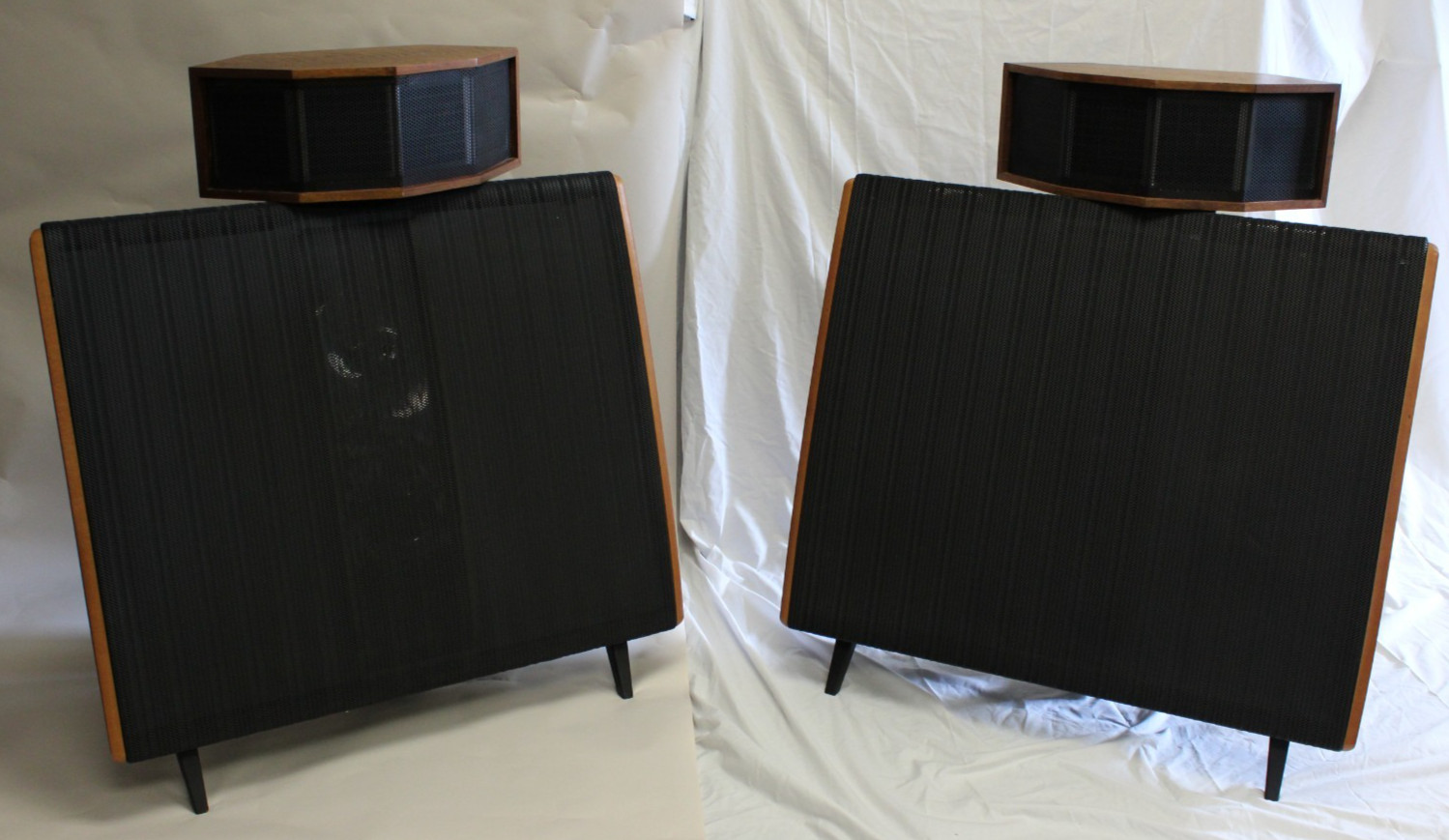
The headline numbers explain the amplifier conversations that inevitably follow. Quad's service documentation describes the speaker as a two-way, three-driver system: two electrostatic bass panels flanking a single electrostatic treble panel, mounted in a wooden frame with polished side rails and front and rear grilles. The published frequency response runs 50 Hz to 10 kHz. Contemporary coverage of the ESL-63 in Audio (June 1985, p.112) listed that successor model's response as 35 Hz to 20 kHz, ±6 dB. The official impedance figure is 15 ohms, and the official sensitivity is 93 dB (though some reviewers have measured closer to 83 dB at 2.83 volts). Owners and reviewers have long reported that the real-world load swings far more wildly than that single number suggests. One period account describes a curve that starts around 60 ohms in the bass and collapses toward 1.8 ohms in the treble region. That is the number that matters when choosing an amplifier, and it is why the ESL has a reputation for eating underbuilt solid-state designs alive.
Physically, the speaker is 880 x 790 x 270 mm and weighs 18 kg. The grille was offered in aluminum, bronze, or black. The EHT supply that polarizes the diaphragm is a discrete external unit. Quad shipped regional variants for Canada, Sweden, and Demko (Denmark) markets, with real regulatory differences between territories.
Key Features
A Diaphragm With Almost No Mass
The ESL uses a thin, tensioned conductive diaphragm suspended between perforated stator plates and driven at high voltage from the external EHT supply. The diaphragm is driven uniformly across its whole surface rather than from a voice coil at the center, so it starts and stops faster than moving-coil drivers can manage. The absence of a crossover is arguably the bigger deal. There is no inductor or capacitor between the amplifier and the diaphragm, which means no phase shift, no insertion loss, and no crossover point where the character of the sound changes. The speaker behaves as one driver across its entire range, and that is what owners mean when they talk about coherence.
Two-Way, Three-Driver Panel Layout
Quad's service documentation lists the ESL as a two-way, three-driver system: two electrostatic bass panels and one electrostatic treble panel. Each unit has its own dust cover. The treble unit's uses a dedicated frame and material, and the bass unit's is a separate assembly again. That sectionalised approach was a deliberate design choice, not a cost-saving measure. Splitting the bass and treble duties across separate panels allowed each section to be tensioned and spaced appropriately for its frequency range, and it made the treble more dispersive than a single full-range panel would have been.
Running Changes at Serial Numbers 16800, 44000, and 45590
This is the part that matters most to anyone shopping for a used pair today. At serial number 16800 (March 1966), Quad added additional filtering to protect the treble unit from damage caused by high-level low-frequency signals. That is a genuine failure mode, and earlier speakers could be modified to address it when used with the Quad 303 or other amplifiers of comparable output. At serial number 44000, the AC supply voltage plug and socket were changed to a new type, and Quad explicitly notes the two types are not interchangeable. At serial number 45590, the supply indicator neon was changed, again to a non-interchangeable type. An early example and a late example are not the same speaker electrically, and the spares for one will not necessarily fit the other.
Stacking — Endorsed by Quad Itself
Quad's Technical Information sheet 021, dated 23 August 1990, describes a suggested method of mounting two ESLs one above the other using a frame constructed from "Speedframe" or similar 25 mm square material. The polished wood side rails have to be removed to mount the speakers this way. The lower speaker is mounted upside down and the upper one the right way up, so the connections are brought conveniently close together. Quad advises that the ESLs be connected in parallel, and that each speaker be fitted with the company's clamp protection circuit kit (QELCLPK). A note in the same document warns that only 0.5" of the fixing screws must be allowed to enter the wooden framework of the ESLs.
The benefits of stacking are well attested in period commentary. Bass power and extension improve noticeably, and because the two speakers are connected in parallel, the overall impedance curve is considerably flatter - hovering around 8 to 12 ohms rather than the 15-going-on-30-ohm curve of a single panel. The same source notes the obvious caveat that the impedance at high frequencies will be close to a short circuit, and recommends vertical bi-amping as a safer approach. Room placement becomes a subject for experiment, because the low-frequency cancellation effects now occur at different points than they do with a single pair. Once the placement is right, imaging improves considerably as well.
High-Voltage Safety and the EHT Supply
The EHT supply that polarizes the diaphragm is a discrete external unit, and it holds dangerous voltages. Quad's service documentation instructs technicians to remove the AC supply and allow two hours for the EHT to discharge before working inside the speaker. Quad's own warning about badly re-wired examples is blunt: an ESL that someone has tried to re-wire and done badly can, at best, incur a large repair bill and, at worst, be a death trap. Anyone who can make clean, rounded solder joints and has some experience with electronics should have no trouble re-wiring an ESL, but the margin for error is not generous.
Historical Context
Quad introduced the ESL-63 in 1981-82, and that introduction forced the retrospective "ESL-57" designation onto the original speaker. Contemporary coverage of the ESL-63 highlighted the company's claims of low distortion, low colouration, and controlled directivity as the areas where the new model set standards (Studio-Sound, November 1983, p.17). The new model replaced the old one, though not necessarily as an improvement in every listener's estimation. Period commentary notes that even after the ESL-63 arrived, the original speaker rose in many people's estimation, and some listeners found its sound quality more acceptable than the newer model's.
Prominent figures experimented with stacked pairs. Alistair Robertson-Aikman, the founder of SME, is documented as having begun with one pair of Electrostatics, then moved to a stacked pair, and at one point used eight pairs per side arranged in a continuous symmetrical arc. Mark Levinson, in the early 1970s, built systems using stacked Quads and appreciated their relaxed performance, utterly transparent midrange, and "window on the concert hall" quality. He ultimately abandoned them because of siting limitations, limited dynamic range, and sensitivity to high-power amplifiers with possibly damaging results.
Hi-Fi News named the ESL the greatest hi-fi product of all time in 2000. It established the template - full-range electrostatic, external EHT supply, dipole radiation, obsessive attention to diaphragm behavior - that Quad has followed ever since, and it is the model against which every later Quad electrostatic is measured.
Collectibility & Value
Complete, original examples command serious money today. A fully restored pair of ESL-57s with stands has been listed on eBay at $5,800. A single original bass panel, just the panel and not a working speaker, has been listed at $200. Anyone buying a used pair is advised to have the units checked for faults and repaired as required before putting them into serious service.
The panels should be thoroughly cleaned occasionally, because they attract dust while operating and over time a thick layer will develop on the dust cover. One documented owner account describes a bass panel that began giving trouble three weeks after a stack was assembled. The diaphragm had suffered damage from prolonged leakage and discharge, audible as a buzz from the panel and accompanied by excessive ozone in the area. On disassembly, a rivet had corroded to the point of falling out of the panel. A small drill hole in the side of the panel near the faulty rivet, apparently a pilot hole drilled too far during original assembly, had allowed moisture in, causing a small amount of discharge and slow cumulative damage over the years.
Parts availability is the biggest factor separating a restorable pair from a parts pair. At the time of one period account, the only part an owner could not buy from Quad was the wooden frame. Everything else, including replacement panels, remained available. Spare parts for the ESL have also been sourced through Quad's German distributor. But because of the running changes at serial numbers 16800, 44000, and 45590, an early example and a late example are not the same speaker electrically, and the spares for one will not necessarily fit the other. Buyers should identify the serial number before committing to a restoration.
eBay Listings


As an eBay Partner, we earn from qualifying purchases. This helps support our independent vintage technology research.
Related Models
- Quad 15
- Quad 18
- Quad esl-63 (1981–1999)
- Quad ESL-63PRO
- Quad esl-2805 (1981)
- Braun AUDIO-1 (1965)
- Braun AUDIO-250 (1965)
- Magnavox Component Systems (1972)
- Acoustic Research AR (1967-1976)
- Acoustic Research 11