Pioneer SX-1980: The Apex of the Golden Age of Hi-Fi
The Pioneer SX-1980, introduced in 1978, stands as one of the most legendary stereo receivers ever produced—a true titan of the late 1970s "monster receiver" era. Revered by audiophiles, collectors, and vintage audio enthusiasts alike, the SX-1980 was not merely a receiver; it was a statement of engineering ambition, sonic excellence, and aesthetic grandeur. With its massive power output, luxurious build quality, and cutting-edge features for its time, the SX-1980 remains a benchmark against which all vintage receivers are measured.
Historical Context and Release
The late 1970s marked the peak of the high-fidelity receiver wars, where Japanese manufacturers like Pioneer, Sansui, Marantz, and Yamaha competed fiercely to deliver ever-more powerful and feature-rich integrated units. The oil crisis had subsided, consumer electronics were booming, and stereo systems were becoming centerpieces of home entertainment.
Pioneer, already known for its robust engineering and innovative designs, unleashed the SX-1980 as the flagship of its SX series. It followed the acclaimed SX-1250 and SX-1550 models but dwarfed them in both power and prestige. Marketed as a "Super Tuner/Super Amplifier," the SX-1980 was designed for the discerning audiophile who demanded nothing less than the best. It was built during a golden age when manufacturers prioritized sound quality, over-engineering, and premium components—often at the expense of cost.
Technical Specifications
The SX-1980’s specs were nothing short of extraordinary for its time. Here's a detailed breakdown:
| Specification | Detail |
| Power Output | 170W RMS per channel (8Ω, both channels driven), 220W per channel (4Ω) |
| Total Harmonic Distortion | 0.04% (20Hz–20kHz) |
| Frequency Response | 20Hz – 20kHz (±0.5dB), 6Hz – 60kHz (–3dB) |
| Damping Factor | 50 (8Ω, 1kHz) |
| Signal-to-Noise Ratio | 100dB (MM, IHF-A weighted) |
| Input Sensitivity | 2.5mV (MM), 150mV (line) |
| Output Level | 150mV (pre-out), 600Ω |
| Tuner Sections | FM: PLL Synthesized Tuning, AM: High-selectivity double conversion |
| FM Sensitivity | 1.8 µV (50 dB quieting) |
| FM Stereo Separation | 40dB at 1kHz |
| Phono Equalization | RIAA (switchable for MC/MM) |
| Headphone Output | Yes, with dedicated amplifier |
| Dimensions | 485mm × 170mm × 425mm (19-1/8" × 6-3/4" × 16-3/4") |
| Weight | 24.5 kg (54 lbs) |
| Power Supply | Massive toroidal transformer, 160,000 µF total capacitance |
The SX-1980 was equipped with dual toroidal transformers—a rarity even among high-end receivers—ensuring stable power delivery under heavy loads. Its amplifier section used 60 power transistors (30 per channel), contributing to its legendary current delivery and dynamic headroom.
Sound Quality Characteristics
The sonic signature of the SX-1980 is often described as authoritative, dynamic, and highly detailed, with a surprising degree of musicality for such a powerful machine. Unlike some high-powered receivers that sound clinical or harsh, the SX-1980 delivers a warm, rich midrange with tight, controlled bass and smooth, extended highs.
Its enormous power supply allows it to drive even difficult speaker loads with ease, making it ideal for large rooms or inefficient speakers. The damping factor of 50 ensures excellent control over bass drivers, minimizing "boomy" or loose bass.
The phono stage is particularly impressive, especially for a receiver. With switchable MC/MM inputs and low noise, it can extract fine detail from vinyl records without the need for an external phono preamp. The FM tuner is also top-tier, with excellent selectivity and sensitivity, capable of pulling in weak stations with clarity.
Many owners report that the SX-1980 has a "live" quality—music feels present and engaging, with excellent soundstaging and instrument separation.
Notable Features and Innovations
The SX-1980 was packed with advanced features for its era:
- Dual Toroidal Transformers: One for the left and one for the right channel, minimizing crosstalk and maximizing power stability.
- Direct Connection Amplifier Circuit: A short signal path design that reduces distortion and improves transient response.
- High-Current Output Stage: Capable of delivering 15A peak current per channel.
- Precision Tuning with Digital Display: A large, easy-to-read LED frequency display for FM/AM—cutting-edge in 1978.
- Four-Stage IF Filtering (FM): For exceptional selectivity and rejection of adjacent stations.
- Loudness Control with Compensation: Adjusts bass and treble at low volumes while preserving tonal balance.
- Tape Monitor with Multiple Loops: Three tape inputs/outputs for flexible recording and monitoring.
- Assignable Input Selector: Allows reassignment of inputs for system flexibility.
- Heavy-Duty Speaker Terminals: Gold-plated, robust binding posts that accept banana plugs or bare wire.
Market Value and Collectibility
Today, the Pioneer SX-1980 is highly collectible and commands premium prices on the vintage audio market. A fully functional, well-maintained unit in good cosmetic condition typically sells for $1,500 to $2,500, with rare examples in mint condition or with original packaging fetching even more.
Its collectibility stems from several factors:
- Rarity: It was expensive when new and not mass-produced.
- Reputation: Universally praised in vintage audio circles.
- Build Quality: Over-engineered with premium components.
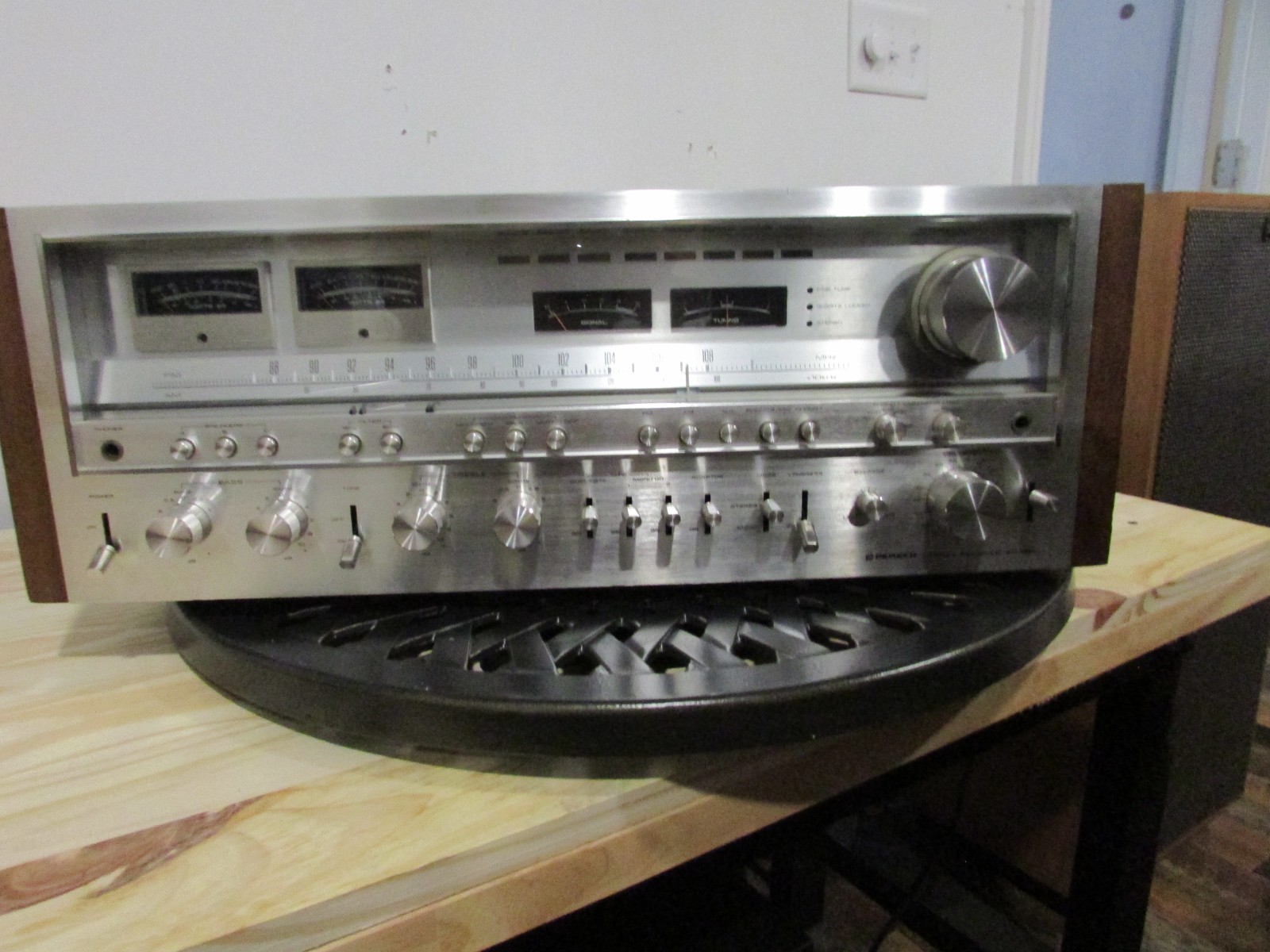
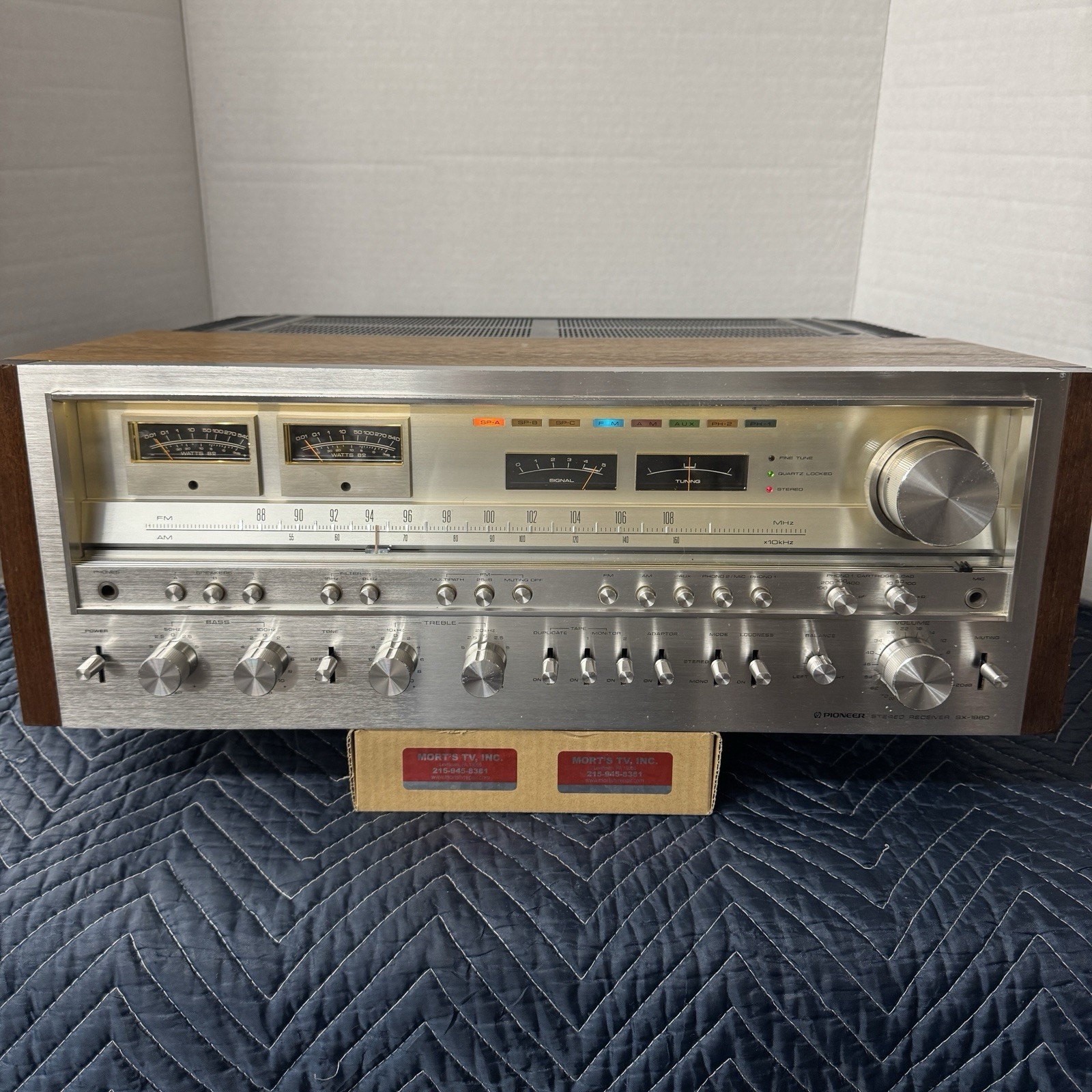
- Aesthetic Appeal: The brushed aluminum faceplate, large VU meters, and imposing size make it a showpiece.
It is often sought after by both audiophiles who want to use it and collectors who display it as a museum piece.
Common Issues and Maintenance
Despite its robust construction, the SX-1980 is over 45 years old, and age-related issues are common:
- Capacitor Degradation: The power supply and signal path capacitors should be checked or replaced. The 160,000 µF reservoir caps are critical.
- Bias Drift: The output transistors require proper bias adjustment; incorrect bias can lead to distortion or thermal runaway.
- Relay Clicking or Failure: The speaker protection relay may fail; replacement with modern equivalents is recommended.
- Tuner Alignment: FM sensitivity may degrade; realignment by a technician may be needed.
- Cleaning: The front panel, knobs, and controls should be cleaned gently to preserve the finish. Use isopropyl alcohol and lint-free cloths.
- Ventilation: Due to its high power output, ensure adequate airflow. Never enclose it in a tight cabinet.
It is strongly advised to have an SX-1980 serviced by a qualified technician before regular use, especially if it has been in storage.
Comparison to Similar Models
| Model | Power (RMS) | Key Differences |
| Pioneer SX-1250 | 120W | Smaller, less powerful, single transformer, lower damping factor |
| Pioneer SX-1550 | 140W | Predecessor; powerful but not as refined or current-capable |
| Sansui AU-α907 | 160W | Known for warmer, more "analog" sound; excellent tuner |
| Yamaha CR-1 | 110W | More compact; less powerful but highly musical |
| Marantz 2270 | 120W | Smooth, "lush" Marantz sound; less dynamic than SX-1980 |
While competitors offered excellent sound, the SX-1980 stands out for its raw power, engineering rigor, and technological sophistication. It was built to be the best—and by many measures, it was.
Conclusion
The Pioneer SX-1980 is more than a vintage receiver; it is a monument to an era when audio engineering pushed the boundaries of what was possible. With its thunderous power, exquisite detail, and overbuilt construction, it remains a top-tier performer even by modern standards. For the audiophile who values both performance and heritage, the SX-1980 is not just a component—it’s a legacy. Whether used daily or displayed as a centerpiece, it continues to inspire awe and admiration, truly earning its place as the king of the golden age of hi-fi.
eBay Listings


As an eBay Partner, we earn from qualifying purchases. This helps support our independent vintage technology research.
Related Models
- Pioneer QX-949A (1978)
- Pioneer SX-2000 (1978)
- Pioneer SX-2500 (1978)
- Pioneer QX-646 (1978)
- Pioneer SX-1900 (1978)
- Marantz SR-2000 (1999–2001)
- Onkyo TX-1500MKII (1975)
- Pioneer SX-201 (1978)
- Pioneer SX-251R (1976)
- Realistic STA-2250 (1975)