Pioneer SX-1500T (1968–1969)
Fire it up and you’re greeted with a deep, confident hum—the kind of sound only serious iron and decades-old silicon can make.
Overview
The Pioneer SX-1500T isn’t trying to impress with flashy specs or chrome trim. It’s a no-nonsense, solid-state AM/FM stereo receiver built during a brief but pivotal window—only sold in **1968 and 1969**—when Pioneer was refining its transistorized audio architecture with serious engineering intent. This isn’t a receiver that chases headline numbers; it’s built for musicality, serviceability, and long-term reliability. With **35 watts per channel RMS into 8Ω**, it delivers clean, stable power that was more than sufficient for the efficient speakers of the era. Owners consistently report a sound that’s warm, natural, and thick—smoother and more organic than many of its contemporaries, with a midrange presence that feels alive. Some even claim they’d part with higher-end models like the SX-939 before letting go of their 1500T. It’s described as “a very nice early receiver,” and while it lacks the pedigree of later flagships, its reputation among those who’ve heard a properly restored unit is quietly glowing.
Specifications
| Manufacturer | Pioneer |
| Production Year | 1968–1969 |
| Product Type | Solid state AM/FM stereo receiver |
| Dimensions | 418mm (W) × 140mm (H) × 347mm (D) |
| Weight | 11.3kg (25lbs) |
| RMS Rated power output | 35 watts per channel (8Ω) |
| Harmonic Distortion | Less than 0.5% (at 1kHz, rated output) |
| Frequency Response | +1dB, 20Hz – 70kHz (overall) |
| Damping Factor | 25 (8Ω, 1kHz) |
| Speaker Load Impedance | 4Ω to 16Ω |
| Signal to noise ratio | 80dB (MM), 90dB (line) |
| FM Usable Sensitivity | 1.7 µV |
| FM Capture Ratio | 1dB (at 98 MHz) |
| FM Stereo Channel Separation | 37dB (at 1 kHz) |
| AM Usable Sensitivity | 20 µV |
| PHONO Equalization | RIAA |
| Tone Controls | BASS: boost 12dB, cut 14dB (at 50Hz); TREBLE: boost 10dB, cut 11.5dB (at 10kHz) |
| Loudness Contour | Switchable ON-OFF, boost 12dB at 50Hz, 6.5dB at 10kHz (with volume at -40dB) |
| Power Supply | 117V, 50–60Hz, 220 watts (max) |
| Semiconductors | 4 IC, 1 FET, 42 transistors, 34 diodes |
| Tuning Range | FM, MW |
Key Features
FET Front-End and IC-Based FM Tuner
The SX-1500T’s FM section stands out with a front-end that uses a **FET (Field Effect Transistor)**—a relatively advanced choice in 1968 that reduced noise and improved weak-signal reception. Paired with a **4-gang variable air capacitor**, the tuner delivers smooth, precise dialing and strong station capture, backed by a **1dB capture ratio at 98 MHz**. The IF amplifier uses **integrated circuits (ICs)**, a sign of Pioneer’s move toward more compact, stable designs. With **76dB image rejection** and **1.7µV usable sensitivity**, it pulls in distant FM stations cleanly, especially when connected to a good outdoor antenna via its **300-ohm balanced input**. The AM section uses a **superheterodyne design** with a **built-in ferrite loopstick antenna**, and at **20µV sensitivity**, it handles weak AM signals respectably for its time.
Single-Ended Push-Pull Amplifier with Direct Coupling
The audio circuitry uses a **single-ended push-pull** configuration, a classic and reliable topology that balances efficiency with low distortion. Unlike later designs that relied on STK power modules, the SX-1500T uses discrete **transistors in the output stage**, making repairs more feasible for those who can source equivalents. Notably, the receiver features a **directly coupled output**, meaning there are no coupling capacitors between the driver and output stages—a design that improves low-frequency response and transient accuracy. This, combined with a wide **20Hz–70kHz frequency response** and **less than 0.5% harmonic distortion**, contributes to its reputation for smooth, natural sound. The **damping factor of 25** suggests moderate control over speaker cones—not as tight as modern high-feedback amps, but enough for a musical, forgiving presentation.
Full Schematics and Service-Oriented Design
One of the most appreciated aspects of the SX-1500T is that the **owner’s manual included full schematics**—a rarity that makes troubleshooting and restoration far more approachable than with many of its peers. With **42 transistors, 34 diodes, 4 ICs, and 1 FET** on board, the circuit is complex but well-documented. This wasn’t a black box meant to be discarded when it failed; it was built to be repaired. The power supply uses transistors and diodes that may require modern equivalents today, but the availability of service documentation gives restorers a fighting chance. Combined with DIN tape jacks, RIAA phono equalization, and a full suite of tone controls, it’s a receiver designed for real-world use, not just showroom appeal.
Collectibility & Value
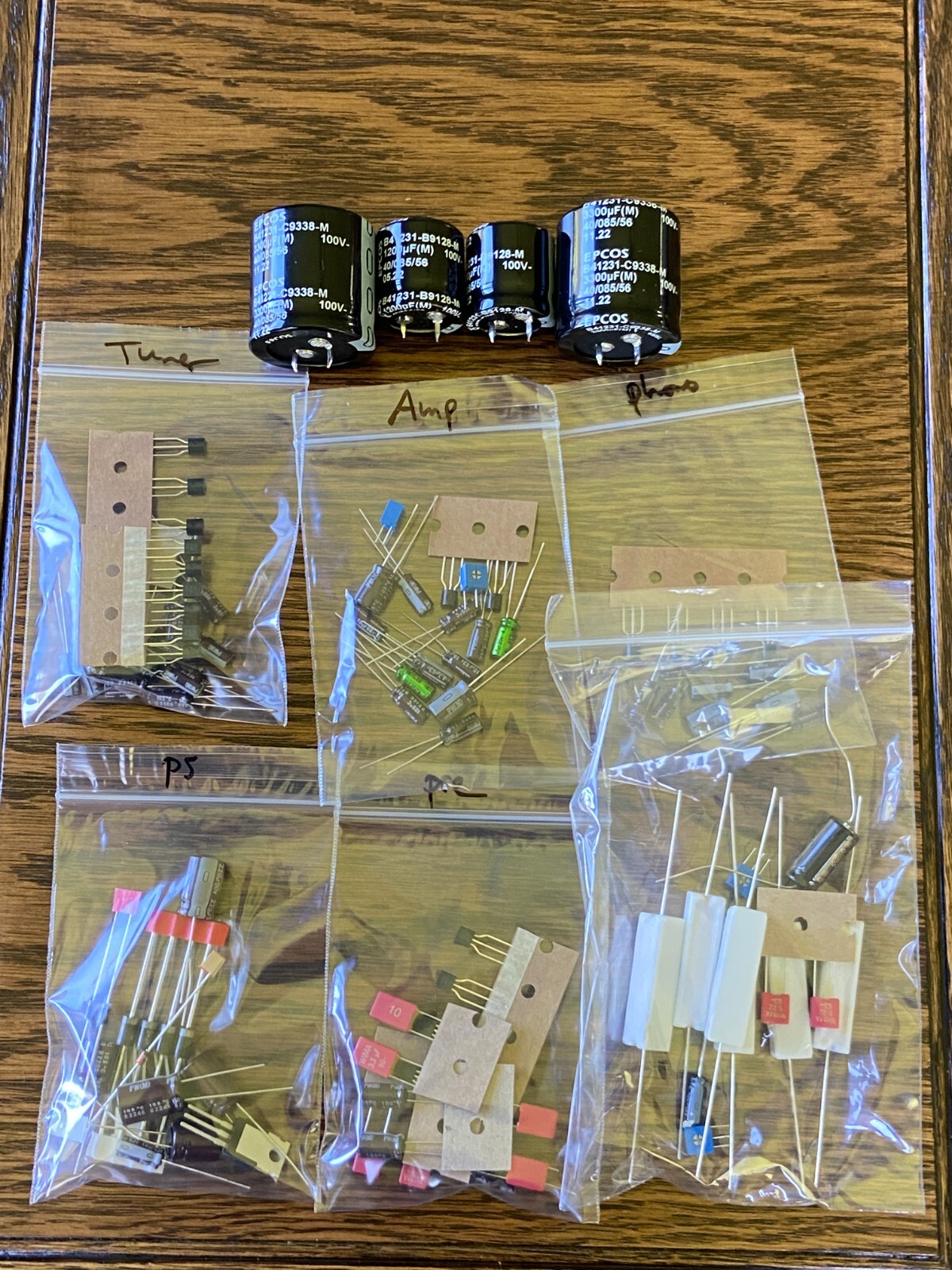
The SX-1500T trades quietly in the vintage market, often overlooked in favor of flashier flagships, but it’s gaining recognition among those who value musicality over specs. Asking prices vary widely: one unit was listed on Reverb for **$324.99 OBO**, another on PicClick for **$89.99**, and some hunters have scored working or project units for as little as **$20 at a thrift store**. However, repairs are almost always necessary after 50+ years. Common issues include **crackling noise from the amplifier board**, **blown output transistors**, **failed transistors in the differential amplifier stage**, and **blown fuses**. A particularly frustrating fault is **mono-only output with the stereo indicator off**, pointing to internal tuner or multiplex circuit problems. Recapping is essential—restorers recommend **Nichicon PW, KL, Panasonic FM, or Elna Silmic II** capacitors for critical stages. Given its reputation for warm, thick sound and serviceable design, a fully restored SX-1500T offers excellent value for listeners who want a vintage receiver that’s both musical and maintainable.
eBay Listings



As an eBay Partner, we earn from qualifying purchases. This helps support our independent vintage technology research.
Related Models
- Pioneer QX-949A (1978)
- Pioneer SX-2000 (1978)
- Pioneer SX-2500 (1978)
- Pioneer QX-646 (1978)
- Pioneer SX-1900 (1978)
- Marantz SR-2000 (1999–2001)
- Onkyo TX-1500MKII (1975)
- Pioneer SX-201 (1978)
- Pioneer SX-251R (1976)
- Realistic STA-2250 (1975)