Pioneer SX-110 (1971–1973)
Warm tube glow, serious weight, and a dial that pulls you back to the dawn of stereo—this is analog with presence.
Overview
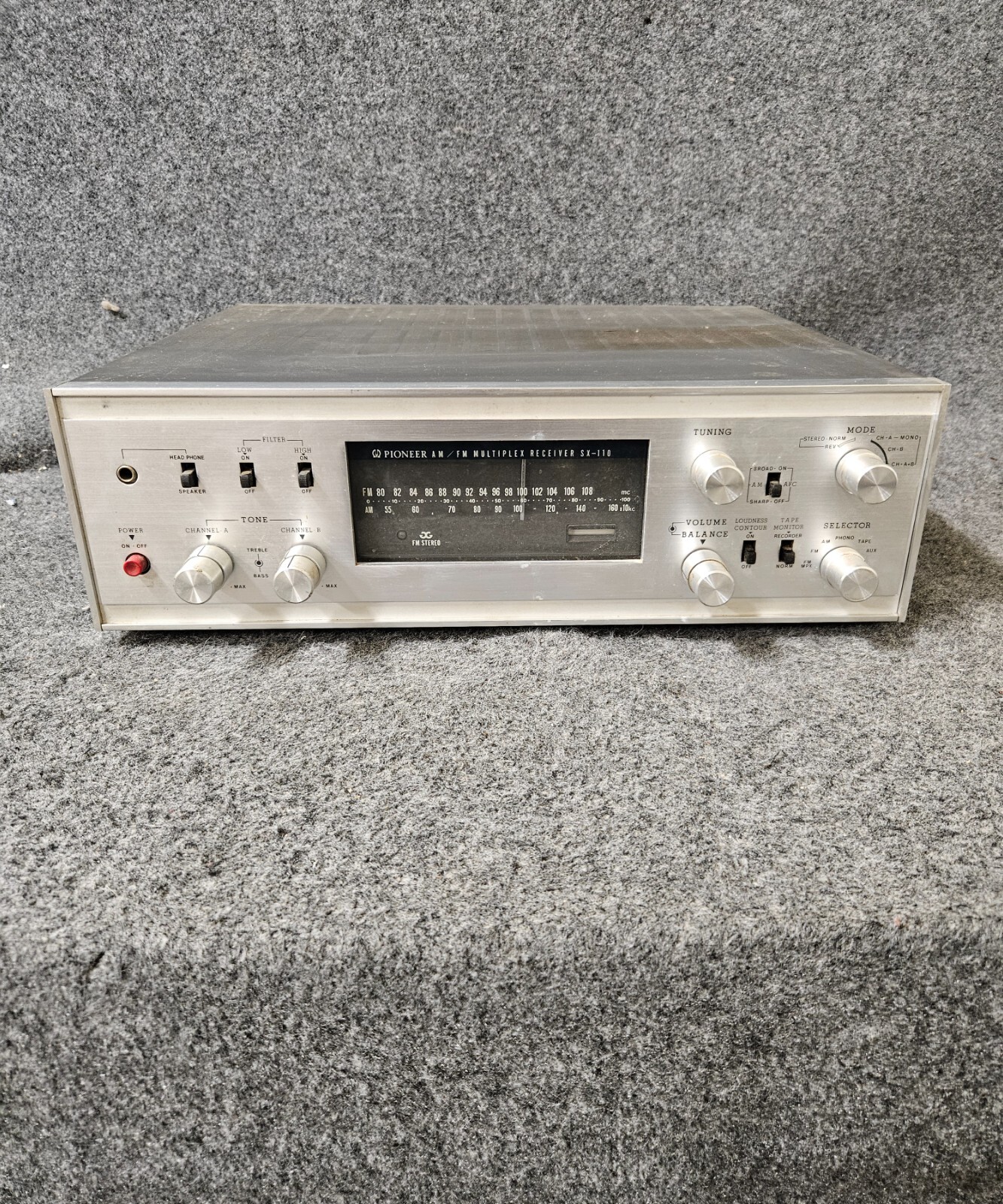
The Pioneer SX-110 isn’t just a receiver—it’s a statement from an era when high-fidelity gear was built like furniture and powered by glowing glass. Released between 1971 and 1973, this AM/FM stereo receiver stands as a rare tube-powered flagship from Pioneer, a company better known today for solid-state behemoths. At a time when the industry was shifting toward transistors, the SX-110 doubled down on valves, packing 21 tubes into its metal chassis to deliver a rich, dynamic sound that still turns heads. It’s not the loudest or most powerful by modern standards, but what it lacks in brute force it makes up for in character, craftsmanship, and sheer presence on the shelf.
This is a bookshelf unit in name only—weighing in at 8.5kg and measuring 420mm wide, it demands space and attention. It’s a full-featured tuner amplifier with AM and FM bands, a full suite of inputs and outputs, and that unmistakable tube warmth that made vintage audio legendary. If you’ve ever wanted to hear vinyl the way it was meant to be heard in the early '70s—warm, spacious, and alive—the SX-110 is a direct line to that experience.
Specifications
| Manufacturer | Pioneer |
| Model | SX-110 |
| Production Years | 1971–1973 |
| Product Type | AM/FM Stereo Receiver |
| Technology Type | Tube |
| Power Output | 20 watts per channel into 8Ω (stereo) |
| Frequency Response | 20Hz to 40kHz |
| Total Harmonic Distortion | 0.8% |
| Input Sensitivity | 2.5mV (MM), 150mV (DIN), 150mV (line) |
| Signal to Noise Ratio | 65dB (MM), 70dB (line) |
| Output | 150mV (line), 0.5V (DIN) |
| Speaker Load Impedance | 4Ω to 16Ω |
| Tuner Section | AM/FM |
| Tuning Range | FM, MW |
| Wave Bands | Broadcast (BC) and FM or UHF |
| Main Principle | Superhet with RF-stage |
| Tuned Circuits | 7 AM circuit(s), 11 FM circuit(s) |
| Number of Tubes | 21 |
| Valves / Tubes | 6CW4, 6AQ8, 6BA6, 6BA6, 6R-E13, 6BA6, 6BA6, 6BE6, 6AQ8, 6CG7, 6AQ8, 6AV6, 12AX7, 12AX7, 12AX7, 6AN8, 6AN8, 7868, 7868, 7868, 7868 |
| Semiconductors | 1 x IC, 25 x transistors, 13 x diodes |
| Power Type and Voltage | Alternating Current supply (AC) / 100; 117 or 115; 230 Volt |
| Dimensions | 420 x 145 x 305mm |
| Weight | 8.5kg |
Key Features
The Heart of the Machine: 21-Tube Design
The SX-110 doesn’t mess around—21 tubes drive every stage of the signal path, from RF amplification to final output. The output section relies on four 7868 tubes in a fixed bias configuration, known for their robust performance and ability to deliver clean power without flinching. These finals are supported by a full complement of preamp and driver tubes, including three 12AX7s and multiple 6AQ8s and 6AN8s, ensuring rich gain and harmonic complexity. It’s a design that prioritizes musicality over efficiency, and it shows.
Tuner Section: Precision in a Glass Bottle
Tuning isn’t an afterthought here. With 11 FM and 7 AM tuned circuits, the SX-110 was engineered for strong reception and fine selectivity. The superheterodyne design with an RF stage improves sensitivity and reduces interference, while the 5-gang tuner ensures smooth, accurate tracking across the dial. Whether you’re chasing distant FM stations or digging into the AM band, this receiver was built to pull in signals cleanly—even if today, that dial needle might be stuck on one end.
Construction and Components
Housed in a sturdy metal case, the SX-110 feels substantial and well-shielded. Inside, the layout follows classic tube-era practices: coupling capacitors connect to grid leak resistors, and the original design used paper-oil capacitors—components now notorious for aging poorly. These capacitors, particularly the Suzuki-branded ones noted by owners, degrade over time and are a primary reason many units today need restoration. Replacing them with modern polypropylene types (like Orange Drops) is common practice, but care must be taken: increasing capacitance too much can saturate the output transformer, leading to arcing or failure. Voltage ratings on replacements must also account for potential B+ spikes.
Controls and Features
Despite its age, the SX-110 offers a full complement of user controls. It includes tone adjustments, a loudness contour switch to boost bass at low volumes, and standard input selection for phono (MM), line, and tuner sources. The inclusion of DIN connectors reflects its era, catering to European gear and modular systems. It’s not flashy, but it’s complete—everything an audiophile of the early '70s would have expected, and then some.
Collectibility & Value
The Pioneer SX-110 is a niche collectible, prized more for its rarity and tube pedigree than its market value. One recent listing noted a unit selling for $50, described as “works, but the tuner dial needle is stuck.” That price reflects the reality: these units need work, and buyers are often hobbyists or restorers, not casual listeners. The original schematic is available for $7.00, though it reportedly lacks module identification lead numbers, complicating full rebuilds.
Common issues center on aging components—especially the paper-oil coupling capacitors, which are almost certainly bad in any un-restored unit. Replacing them is essential for safe operation and good sound. Owners of similar Pioneer tube models (like the SX-304B) report success with polypropylene replacements, noting improved clarity and reliability. Given the complexity and the number of tubes, a full refurbishment isn’t trivial, but for the right enthusiast, the payoff is a receiver that sounds as good as it looks.
Reddit users have called it “Gorgeous” and noted it may be “the oldest Pioneer unit I've seen in the wild”—a testament to its visual appeal and rarity. It’s not a daily driver, but a centerpiece, a conversation starter, a machine that demands to be touched, powered up, and listened to at least once.
eBay Listings


As an eBay Partner, we earn from qualifying purchases. This helps support our independent vintage technology research.
Related Models
- Pioneer QX-949A (1978)
- Pioneer SX-2000 (1978)
- Pioneer SX-2500 (1978)
- Pioneer QX-646 (1978)
- Pioneer SX-1900 (1978)
- Marantz SR-2000 (1999–2001)
- Onkyo TX-1500MKII (1975)
- Pioneer SX-201 (1978)
- Pioneer SX-251R (1976)
- Realistic STA-2250 (1975)