Pioneer SF-850 (1974–1977)
It doesn’t play music—it routes it, with surgical precision and a cult following that still swears by its flexibility
Overview
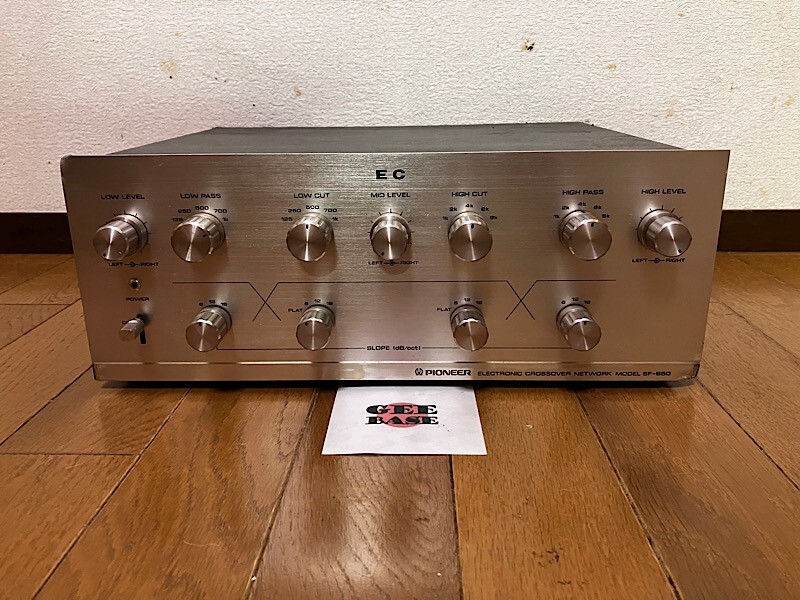
Let’s set the record straight: the Pioneer SF-850 isn’t a speaker, an amplifier, or some forgotten tuner. It’s an electronic crossover network—specifically, a 2/3-way active crossover designed for serious multi-amplifier setups. Built between 1974 and 1977, this unassuming box was engineered for audiophiles and semi-pro users who wanted to take full control of their speaker systems by splitting the audio signal before amplification. Pioneer marketed it as part of a vision for “component stereo at its best,” and in that context, the SF-850 wasn’t just a supporting player—it was a linchpin. By allowing users to send tailored frequency bands to dedicated amps and drivers (tweeter, midrange, woofer), it opened the door to cleaner, more dynamic sound with reduced intermodulation distortion. It wasn’t for the casual listener; it was for the tinkerer, the system builder, the kind of person who measured phase alignment with a stopwatch and a sine wave.
Specifications
| Manufacturer | Pioneer |
| Type | Electronic Crossover Network |
| Crossover type | 2/3-way active crossover |
| Crossover points | 5 |
| Crossover point frequencies | Low Band: 125, 250, 500, 700, 1K Hz; Mid Band Low side: 125, 250, 500, 700, 1K Hz; Mid Band High side: 1k, 2k, 4k, 6k, 8k Hz |
| Slope | 6dB, 12dB, 18dB |
| Additional slope selection | Flat |
| Circuitry | Discrete Class A circuitry |
| Controls | Each band has independent level control |
Key Features
Adjustable 3-Way Signal Routing
The core of the SF-850’s design is its role as an adjustable crossover network, letting users divide the incoming audio signal into two or three distinct frequency bands. This means you could send bass to a dedicated amplifier and woofer, mids to another amp and driver, and highs to yet another—eliminating the passive crossover’s power loss and component limitations. With five selectable crossover points and slope options of 6dB, 12dB, and 18dB per octave (plus a flat setting for bypassing filtering when needed), the SF-850 offered rare flexibility for its time. That kind of control was aimed at building “2-way or 3-way multi-amplifier systems of the highest grade,” as Pioneer put it—systems capable of meeting “even professional needs.”
Discrete Class A Circuitry & Precision Adjustments
Under the hood, the SF-850 uses discrete Class A circuitry—a design choice that prioritizes linearity and low distortion over efficiency. While not sonically “colored” in the way tube gear is, Class A operation ensures minimal crossover distortion and a clean signal path, which matters when your entire system’s fidelity hinges on this one box. Each frequency band has independent level controls, allowing fine-tuning of output levels between drivers—a critical step in achieving time- and amplitude-coherent sound. The manual even includes adjustments for speaker phasing, acknowledging that real-world driver placement and cabinet design can throw off timing. This isn’t a set-and-forget box; it’s a tool for optimization, with knobs for cut-off slopes, level matching, and phase alignment. Owners report that when properly calibrated, the SF-850 delivers transparency without editorializing—exactly what a crossover should do.
Historical Context
The Pioneer SF-850 emerged during a period when high-end audio was shifting toward modular, component-based systems. It was explicitly designed to “provide component stereo at its best,” fitting into a philosophy where each part of the signal chain was optimized independently. Alongside related models like the SF-500, SF-700, CD-1000, CD-621, and CD-630, the SF-850 represented Pioneer’s commitment to high-grade, customizable audio architecture. These weren’t mass-market accessories—they were tools for building systems that could satisfy even professional needs. In an era when most listeners still relied on passive crossovers buried inside speakers, the SF-850 offered a radical alternative: active filtering before amplification, with all the control and clarity that entailed.
Collectibility & Value
The Pioneer SF-850 is not just uncommon—it’s described as “very hard to find,” “remarkably rare,” and “vintage rare,” which says a lot for a component that wasn’t mass-market to begin with. Its niche role means fewer were made, and fewer still survive in working order. Recent listings reflect that scarcity: $349 on Reverb (March 7, 2026), CA$650 on Canuck Audio Mart (December 4, 2025), and a bid of ¥1,200 on Yahoo Auctions Japan (September 17, 2025). One older Reverb listing ended at $599 plus $45 shipping, suggesting prices can vary widely based on condition and buyer urgency. Units are occasionally described as “works great” and “looks brand new,” though minor scratches are expected. Given the age of these units, recapping is a common and necessary upgrade—electrolytic capacitors degrade over decades, and replacing them is often the difference between noise and silence. A service manual (PIONEER SF-850 ART0830 SM) is available, which helps keep units alive. For those building a vintage multi-amp system or chasing the purity of active crossover topology, the SF-850 remains a functional artifact—and a rare one.
eBay Listings



As an eBay Partner, we earn from qualifying purchases. This helps support our independent vintage technology research.
Related Models
- Pioneer QX-949A (1978)
- Pioneer SX-2000 (1978)
- Pioneer SX-2500 (1978)
- Pioneer QX-646 (1978)
- Pioneer SX-1900 (1978)
- Marantz SR-2000 (1999–2001)
- Onkyo TX-1500MKII (1975)
- Pioneer SX-201 (1978)
- Pioneer SX-251R (1976)
- Realistic STA-2250 (1975)