Pioneer SA-6500
A 200-watt integrated amplifier with the transformers ripped out of the signal path — and a paper trail that can't seem to decide whose badge it wore.
Overview
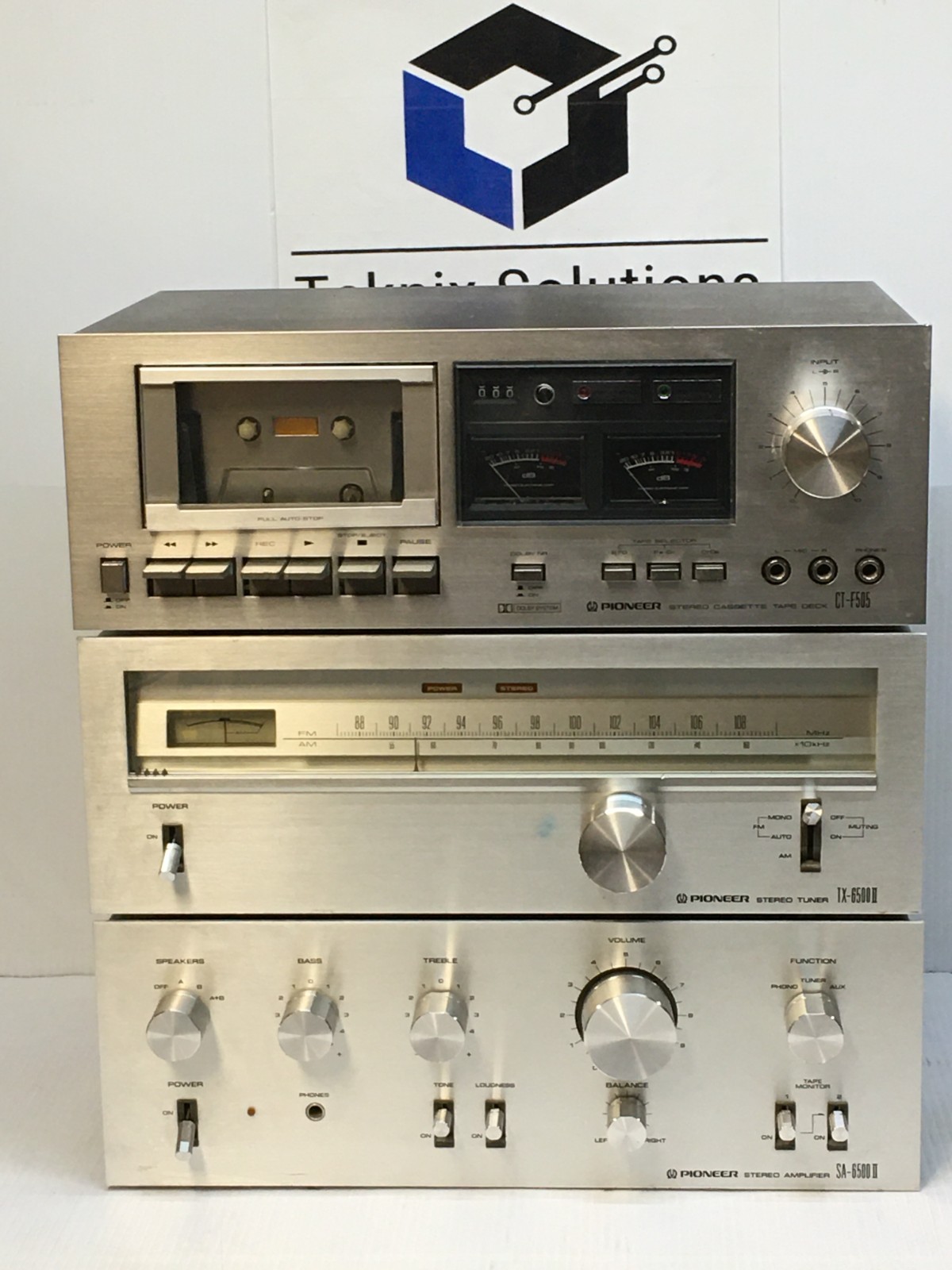
Here's the thing collectors run into the moment they start digging into the SA-6500: the documentation is a mess. The period advertising that survives for this model — and there's a fair amount of it in the 1972 audio press — describes a direct-coupled amplifier rated at a "full 200 watts of power (IHF)," with the input transformer, output transformer, and output capacitor all removed from the circuit to improve transient response and damping. That's the pitch. It's a good pitch, and it's repeated almost word for word across several placements in Audio during the first half of 1972. The trouble is that the same ad copy, in the same magazines, also sells the SA-6500 as a receiver — complete with FM specs, tuning meters, and a Lumina-Band dial — and elsewhere the identical text is attributed to Panasonic rather than Pioneer. Owners report the confusion is real and not just a scanning artifact.
So what can be said with confidence? The amplifier section, as described in the surviving promotional material, is direct-coupled to the speaker terminals. That topology was the selling point: with no coupling capacitor between the output devices and the speakers, damping and transient response improve, and the literature claims distortion below 0.5%. One version of the copy pegs it at "less than 0.3% harmonic distortion"; another says 0.5%; a third says 0.8%. The power bandwidth is quoted as 5 Hz to 60,000 Hz, and the amplifier frequency response as 10 Hz to 100,000 Hz at −1 dB in one telling and 20 Hz to 50,000 Hz ±1 dB in another. These are advertising numbers, not bench measurements, and they wobble depending on which month's magazine you're holding.
The tuner section, where it's described at all, is credited with two 4-pole MOS FETs in the front end for a claimed 1.8 µV FM sensitivity — enough, the copy insists, to pull in stations "too weak or too far to make it on their own." Selectivity comes from two RF stages, a four-section tuning capacitor, four tuned circuits, and an IF stage with a crystal filter and integrated circuit. There are dual tuning meters for signal strength and center, an FM muting switch, and a linear FM dial scale that spreads the crowded top of the band so 106 to 108 MHz gets as much room as 90 to 92. A high filter, a low filter, and a loudness switch round out the front panel, and one version of the copy mentions linear-sliding bass and treble controls while another describes rotary knobs — a discrepancy that suggests the ad was adapted from a sibling model without fully rewriting the control description.
One surviving spec block, attributed to the SA-6500 in a 1972 Audio issue, lists dimensions of 16 inches wide by 5½ inches high by 14 inches deep, a weight of 24 lbs, and a retail price of $299.95. Treat those figures cautiously — 24 lbs is light for a 200-watt direct-coupled amplifier of this description, and the same page carries AM tuner specs (15 µV IHF sensitivity, 30 dB selectivity, 65 dB image rejection, 70 dB IF rejection) that don't obviously belong to an integrated amp. It reads like a spec sheet assembled from more than one product.
The honest summary for anyone shopping one today: the SA-6500 is a documented name with a genuinely interesting circuit philosophy behind it, wrapped in promotional material that can't keep its story straight about whether it's an amp or a receiver, a Pioneer or a Panasonic, and how much distortion it actually produces. That's not a reason to walk away — it's a reason to verify the exact unit in front of you against its own rear-panel markings before you hand over money. Collectors note that the direct-coupled design, if it is what the badge says, is the reason to care; the rest of the paperwork is a puzzle best solved with the amplifier on the bench.
eBay Listings


As an eBay Partner, we earn from qualifying purchases. This helps support our independent vintage technology research.