Pioneer PL-50LII (1981–1984+)
At 14.6 kg, it lands on the rack like a vault door—dense, deliberate, and humming with quartz-stabilized precision.
Overview
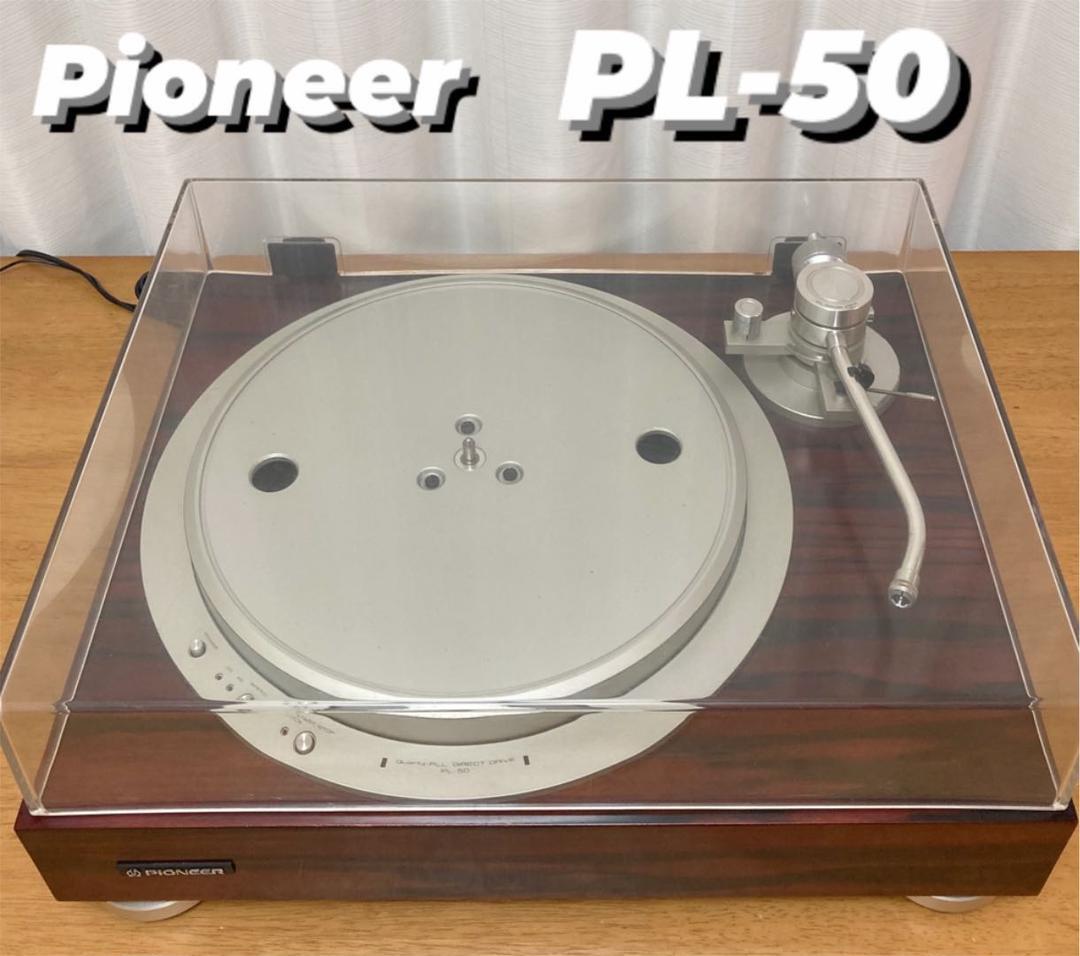
The Pioneer PL-50LII isn’t just another direct-drive turntable from Japan’s golden era—it’s a statement piece built for those who demanded engineering rigor without sacrificing usability. Introduced in September 1981 as the third iteration of the PL-50 series and derived from the Pioneer Exclusive P3, this turntable refined an already mature platform into something more accessible, yet no less serious. It was, according to available documentation, extremely successful—outpacing earlier models in sales and visibility, likely due to its blend of semi-auto convenience and high-end performance cues borrowed from the flagship PL-70. At ¥95,000, it wasn’t cheap, but it offered features that felt borderline extravagant: silent electronic lift-up, a dual-wand tonearm system, and a coreless motor designed to eliminate cogging entirely.
The 31 cm platter, diecast aluminum back-coated with a special damping compound, spins on the Stable Hanging Rotor (SH) system—a design that places the bearing just below the turntable for lower center of gravity and reduced resonance transmission. This version, however, uses a lighter, second-generation SH system (sometimes called "v2"), which collectors note may be less durable over decades than the original. The motor, a coreless quartz PLL DC servo Hall type, reaches full speed in under one-third of a rotation and maintains rotational accuracy within 0.002%, with drift figures so low they border on laboratory-grade: 0.00008% per hour and 0.00003% per degree Celsius. These aren’t just numbers—they translate into a turntable that locks onto speed like it’s bolted to time itself.
Despite its technical depth, the PL-50LII doesn’t feel cold or clinical. It’s a semi-auto machine with a quiet elegance—quartz lock indicator, quick stop, and that rare silent lift-up mechanism, which uses a moving-coil principle similar to a speaker to raise the arm without clunk or vibration. The cabinet, wrapped in marble ebony finish over a high-density four-layer laminate, grounds the unit visually and acoustically, while low-center-of-gravity insulator feet further isolate it from external noise. Internally, oxygen-free copper is used for tonearm leads and contacts, and critical components are machined to micron-level tolerances—details that suggest Pioneer wasn’t cutting corners, even in a model positioned below the PL-70.
Specifications
| Manufacturer | Pioneer |
| Type | Direct drive |
| Motor | Coreless quartz PLL DC servo Hall motor |
| Bearing structure | Stable Hanging Rotor (SH) system |
| Turntable/Platter Diameter | 31 cm |
| Turntable inertia mass | 330 kg·cm² |
| Speeds | 33 1/3, 45 rpm |
| Uneven rotation (Wow & Flutter) | 0.023% or less (WRMS/JIS) |
| S/N ratio | 82 dB or more (DIN-B) |
| Load characteristic | 0% up to 200g needle pressure |
| Start-up time | 1/3 rotation or less to reach speed |
| Starting torque | 1.6 kg·cm |
| Rotational speed deviation | 0.002% or less |
| Drift | Time drift: 0.00008% / h; Temperature drift: 0.00003% / °C |
| Brake mechanism | Pure electronic |
| Tone Arm Type | Static balance S-shaped pipe arm with variable oil damping (twin pipe exchange system) |
| Effective length | 250 mm |
| Overhang | 12 mm |
| Tracking error | +2.7° / -1.3° |
| Needle pressure adjustment | 0-3g, 1 rotation = 1g (0.1g scale) |
| Applicable Cartridge Weight | Straight arm wand: 3g ~ 11g; S-shaped arm wand (with attached headshell): 6g ~ 32g |
| VTA adjustment range | +3 mm / -4 mm |
| Head shell | Carbon fiber composite material |
| Attachment mechanism | Quartz lock indicator, Quick stop, Silent lift-up (electronic, PL-50L/LII only) |
| Semiconductors used | Quartz: 1, IC: 10, Hall element: 3, LED: 4, Transistor: 11, Diode: 6 |
| Power supply | 100 VAC, 50Hz/60Hz |
| Power consumption | 15W |
| External dimensions | 490 mm (W) x 190 mm (H) x 401 mm (D) |
| Weight | 14.6 kg |
Key Features
Interchangeable Carbon Graphite Tonearm Wands
The tonearm system stands out as one of the PL-50LII’s most flexible and forward-thinking features. It uses a twin pipe exchange system, allowing users to swap between a straight arm wand and an S-shaped variant—both constructed from carbon graphite for rigidity and low resonance. This adaptability meant the turntable could accommodate a wide range of cartridges, from lightweight moving magnets to heavier moving coils. The included headshell is also made of carbon fiber composite, further reducing mass and coloration. While the straight arm supports cartridges from 3g to 11g, the S-shaped version—with headshell attached—handles a broader 6g to 32g range, making it compatible with notoriously heavy models like the Ortofon SPU, provided the optional JP-507 counterweight is used.
5-Step Variable Silicon Oil Damping
Damping in the tonearm isn’t fixed—it’s adjustable via a 5-position top-mounted control, allowing users to fine-tune the arm’s lateral and vertical compliance based on cartridge characteristics and record condition. This system, carried over unchanged from the PL-50L, gives experienced users a rare level of control over tracking behavior. Too stiff, and the arm may skip on warped pressings; too loose, and inner-groove distortion creeps in. The ability to dial it in—using viscous silicon oil—adds a layer of customization uncommon in semi-auto decks of this era.
Coreless Direct-Drive Motor with Quartz PLL Control
Pioneer’s motor design eliminates cogging by using a coreless rotor, a refinement over earlier generations that relied on iron cores prone to magnetic irregularities. Paired with a quartz phase-locked loop (PLL) DC servo system and Hall element speed detection, the motor delivers near-perfect speed stability. The all-round integration method FG (frequency generator) ensures continuous monitoring, while the starting torque of 1.6 kg·cm gets the 330 kg·cm² platter up to speed in under one-third of a rotation. This isn’t just fast—it’s audibly seamless, with no hunting or overshoot. The result is a turntable that feels instantaneous, almost alive, in its response.
Stable Hanging Rotor (SH) System (v2)
The bearing system suspends the rotor from above, placing the main bearing just below the platter to lower the center of gravity and reduce vertical vibration transmission. In the PL-50LII, this is the second-generation, lightweight version—smaller and less massive than the original used in the PL-50/L. While this may have reduced manufacturing cost and simplified assembly, collectors note that the v2 SH system is reportedly less durable over the long term. Some sources suggest that official repair services in Japan no longer support these units, which could complicate restoration efforts today. The junction between shaft and spindle is also modified: instead of a ball bearing, the two components are directly stacked, a change that may affect long-term wear characteristics.
Silent Electronic Lift-Up Mechanism
One of the most distinctive features of the PL-50L and PL-50LII—absent in the base PL-50—is the silent lift-up system. Unlike typical solenoid-based lifters that clunk and vibrate, this mechanism uses a moving-coil principle, similar to a speaker driver, to raise and lower the tonearm with near-silent smoothness. It’s not just a gimmick; it reduces mechanical shock to the stylus and minimizes disturbance to the record surface. Combined with the quartz lock indicator and quick stop function, it makes the PL-50LII a genuinely user-friendly high-end deck—semi-automatic but never compromised.
Heavy Zinc Die-Cast Arm Base and Micron-Level Machining
The tonearm is anchored to a heavy zinc die-cast base, a design choice that prioritizes rigidity and resonance control. This massive foundation, combined with VTA adjustment ranging from +3 mm to -4 mm (an improvement over earlier models limited to +3 mm), allows for precise setup across a wide range of cartridges and record thicknesses. Critical parts throughout the turntable are machined to micron-level tolerances, a claim that reflects Pioneer’s commitment to precision engineering during this period. These tolerances aren’t just for show—they ensure consistent alignment, reduce play in moving parts, and contribute to the overall stability of the system.
Historical Context
The PL-50LII emerged during a transitional period in high-fidelity audio, just before the CD boom reshaped consumer priorities. It represented a refinement of Pioneer’s direct-drive expertise, distilled from higher-end models like the PL-70 and rooted in the successful Exclusive P3 line. As one observer noted, this era saw manufacturers stepping back from "sci-fi" technologies and refocusing on well-engineered analog performance. The PL-50LII fit perfectly into that shift—offering advanced engineering without unnecessary complexity. While the original PL-50 saw limited production, the PL-50L and its successor, the PL-50LII, achieved broader market penetration, likely due to their balance of automation and audiophile-grade build.
Collectibility & Value
The PL-50LII occupies a respected niche among vintage turntable enthusiasts. Forum discussions, such as those on Steve Hoffman TV, position it as a standout in the sub-$1000 vintage market, praised for its build quality and performance potential. An eBay listing cited in a Frieve review shows one unit offered at $575, suggesting strong demand among collectors. However, a notable concern shadows its longevity: the second-generation Stable Hanging Rotor system is reportedly less durable than its predecessor, and official repair support in Japan may no longer exist. This could make restoration challenging, especially if the bearing or motor assembly fails. While relubrication of the motor, spindle, and lift cylinder has been documented in similar models, specific service data for the PL-50LII remains sparse. The availability of accessories like the JP-507 counterweight for heavy cartridges adds to its appeal but doesn’t offset the risk of obsolescence in critical mechanical systems.
eBay Listings
As an eBay Partner, we earn from qualifying purchases. This helps support our independent vintage technology research.