Gates SA-50 "Programaster" Dual Speech Console
Not a hi-fi component at all — a broadcast studio console built by Gates Radio Company, where the goal was getting a station's signal to air without a mistake.
Overview
Anyone searching for a Pioneer SA-50 will find something else entirely, and it's worth saying so up front. The documentation trail for the name "SA-50" leads to the Gates SA-50 Dual Speech Console, a broadcast board from Gates Radio Company of Quincy, Illinois — the same firm that stamped "Manufacturing Engineers Since 1922" on its literature. Gates marketed it under the nickname "Programaster," and the trade advertising leaned heavily on the console's operating conveniences rather than on sound quality in the audiophile sense. That framing tells you what this thing was for: it's studio furniture, built so an engineer could keep a station on the air through a complicated shift without fumbling.
The architecture is the giveaway. The SA-50 provides nine mixing channels — five for microphones, two for turntables, and one each for remote and network service. Separate PBX-type keys let the operator route any mixing channel into one of two program amplifiers, which is the "dual-channel" part of the dual-channel console billing. Inside, five 2-stage preamplifiers and two 4-stage high-gain program amplifiers live in the main chassis. A ten-watt low-distortion monitoring amplifier and a two-watt cueing amplifier sit in the separate power supply unit rather than the console itself, and the console has room for two additional preamplifiers if a station needed to grow into it.
The build reflects that duty. The cabinet is cast aluminum, which Gates advertised as providing the best RF shielding — a real concern in a building full of transmitters, turntables, and long cable runs. Service access was a selling point too: the sub-chassis units are individually removable, so a failed preamp could be pulled for repair without taking the rest of the console off the air. Gates also made the program amplifiers interchangeable and color-coded the important keys so operators could identify them instantly, which is the kind of detail that only matters to someone working under pressure at 2 a.m.
Two VU meters are fitted, one per program channel. Gates' copy is blunt about why: a meter in each channel means no guessing about levels on either program bus. There's also an integral cueing amplifier for remotes, network, and turntables, and the console supports remote override — useful when a network feed or a remote site needs to take priority over local programming. A companion piece, the SA-40 Speech Input Console, is described in the same Gates literature as similar in size and symmetry to the SA-50 but configured differently: nine channels as well, but five preamplifiers, three turntables, and one net-remote, with seven amplifiers total including a 4-stage program amplifier and a 3-stage monitoring amplifier. The SA-40's cabinet construction follows the SA-50's.
What the documentation does not provide is a price, a production run, a year, or any measured performance figures beyond the amplifier wattages and channel counts. There are no frequency response curves, no distortion numbers, no dimensions, and no weight. Gates' own advertising simply invited stations to write for the Speech Input Catalog, where functional block diagrams and additional data would "better acquaint" a chief engineer with the consoles. That's the honest state of the record: this is a piece known through its sales literature and its surviving hardware, not through independent bench testing.
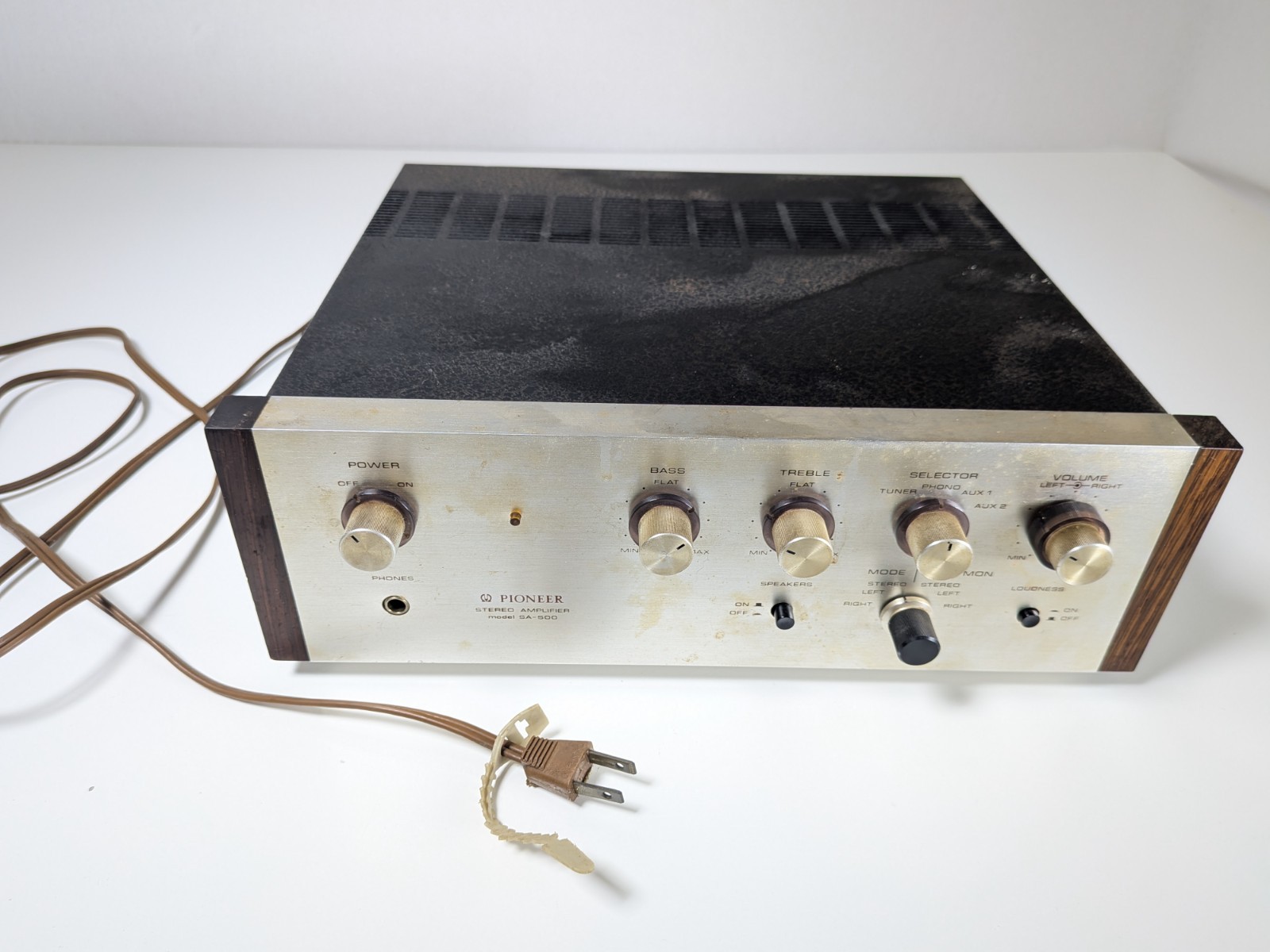
One caveat for anyone who turns up a "Pioneer SA-50" listing and lands here: the name collides. Pioneer built plenty of gear wearing SA prefixes, and the brand catalog for this archive is thick with them. None of those are this. The SA-50 in the Gates documentation is a speech input console, and the archive has no verified Pioneer product by that exact designation. Treat any listing that describes an SA-50 as a home amplifier with suspicion until the paperwork says otherwise.
eBay Listings


As an eBay Partner, we earn from qualifying purchases. This helps support our independent vintage technology research.
Related Models
- Pioneer SR-202W (1971–1977)
- Pioneer QX-949A
- Pioneer SA-8800II
- Pioneer SX-1050 (1978)
- Pioneer SX-1080 (1978)
- Marantz 2226 (1974-1976)
- Marantz 2226B (1979-1980)
- Marantz 2235 (1974-1977)
- Marantz 2238B (1978-1980)
- Marantz 2250B (1978-1980)