Pioneer QX-949A (1973)
That first burst of quadraphonic sound—four channels swirling from a single gold-and-black behemoth—still gives me chills.
Overview
The Pioneer QX-949A wasn’t just another receiver with a quadraphonic label slapped on—it was a full-scale declaration of war on audio limitations, a statement that integration didn’t have to mean compromise. Introduced in 1973, it stood as the flagship and most advanced of all Pioneer's quadraphonic offerings, the ultimate expression of their high-end QX series. This wasn’t just marketing spin; with 60 watts per channel in stereo and 40 watts per channel into 8Ω in full quad mode, it had the muscle to drive even demanding speaker loads. At 22.4kg and spanning 550mm wide, it was a physical presence—no shelf could hide this beast. Its front panel, a dramatic three-dimensional expanse of gold and black, bristled with controls but never felt cluttered, a design praised for balancing complexity with elegance. More than just power, it offered full integration: built-in CD-4 demodulation, a regular matrix (RM) decoder, and a “full logic” SQ matrix decoder—all native, no external boxes required. And that hypnotic four-channel level indicator didn’t just look cool; it gave users real-time visual feedback of the entire soundfield. For collectors today, the QX-949A isn’t just a relic of a failed format—it’s a monument to what integrated receivers could achieve when engineering ambition met no-holds-barred design.
Specifications
| Manufacturer | Pioneer |
| Power output (stereo) | 60 watts RMS per channel into 8 ohms |
| Power output (quadraphonic) | 40W per channel into 8 ohms |
| Frequency response | 35Hz to 20kHz |
| Total harmonic distortion | 0.3% |
| Damping factor | 35 |
| Input sensitivity | 2.5mV (MM), 150mV (line) |
| Signal to noise ratio | 70dB (MM), 90dB (line) |
| Output | 150mV (line) |
| Speaker load impedance | 4Ω to 16Ω |
| Dimensions | 550 x 160 x 440mm (W x H x D) |
| Weight | 22.4kg (49lbs) |
| Semiconductors | 12 x FET, 11 x IC, 85 x transistors, 63 x diodes |
| Tuning range | FM, MW |
| Inputs | 2 x Phono Inputs, 1 x Aux Input, 1 x 2Ch Tape Input, 2 x 4CH Tape Input |
| Features | Built-in CD-4 demodulator, SQ matrix decoder, regular matrix decoder, Dolby NR adapter, Low & High Filters, provision for up to 8 speakers, four-channel level indicator |
Key Features
Built-In CD-4, Full Logic SQ, and RM Matrix Decoding — No External Boxes Needed
The QX-949A didn’t just support quadraphonic formats—it mastered them. It came with a built-in CD-4 demodulator featuring a phase lock loop (PLL) circuit, plus both an SQ matrix decoder (featuring “full logic” design) and a regular matrix (RM) decoder, all integrated into the chassis. This was no minor convenience; in an era when most quad systems required a stack of external processors, Pioneer packed everything into one unit. The “full logic” SQ decoder was a significant upgrade over earlier designs, improving channel separation and decoding stability. Combined with Front and Rear CD-4 Separation Controls, it gave users real-time control over decoding performance, letting them tweak the sound based on disc quality or listening preference. Owners report that with a good CD-4 pressing and properly aligned cartridge, the spatial resolution is startling—like hearing a live performance unfold in your living room.
Four-Channel Level Indicator — Sound You Can Watch
That glowing display on the front isn’t just for show—it’s a functional, mesmerizing window into the quadraphonic mix. Officially called a “4-channel level indicator,” it uses four illuminated green light beams radiating at 45-degree angles to show the real-time output of each channel. Sensitivity is adjustable over a 30 dB range using -10 dB and -20 dB pushbuttons, and each channel has its own level control. When music plays, the beams dance in sync with the audio, creating a live visual map of the soundfield. It’s the kind of analog theater that modern gear can’t replicate. But it’s not just pretty—owners use it to balance channels and diagnose imbalances. That said, it’s also a known failure point: lamps burn out, and some units arrive with only one or two beams working. Fortunately, lamp kits and rebuild kits are available for those willing to dive in.
All-Stage Direct-Coupled OCL Amplifier — Clean, Capable Power
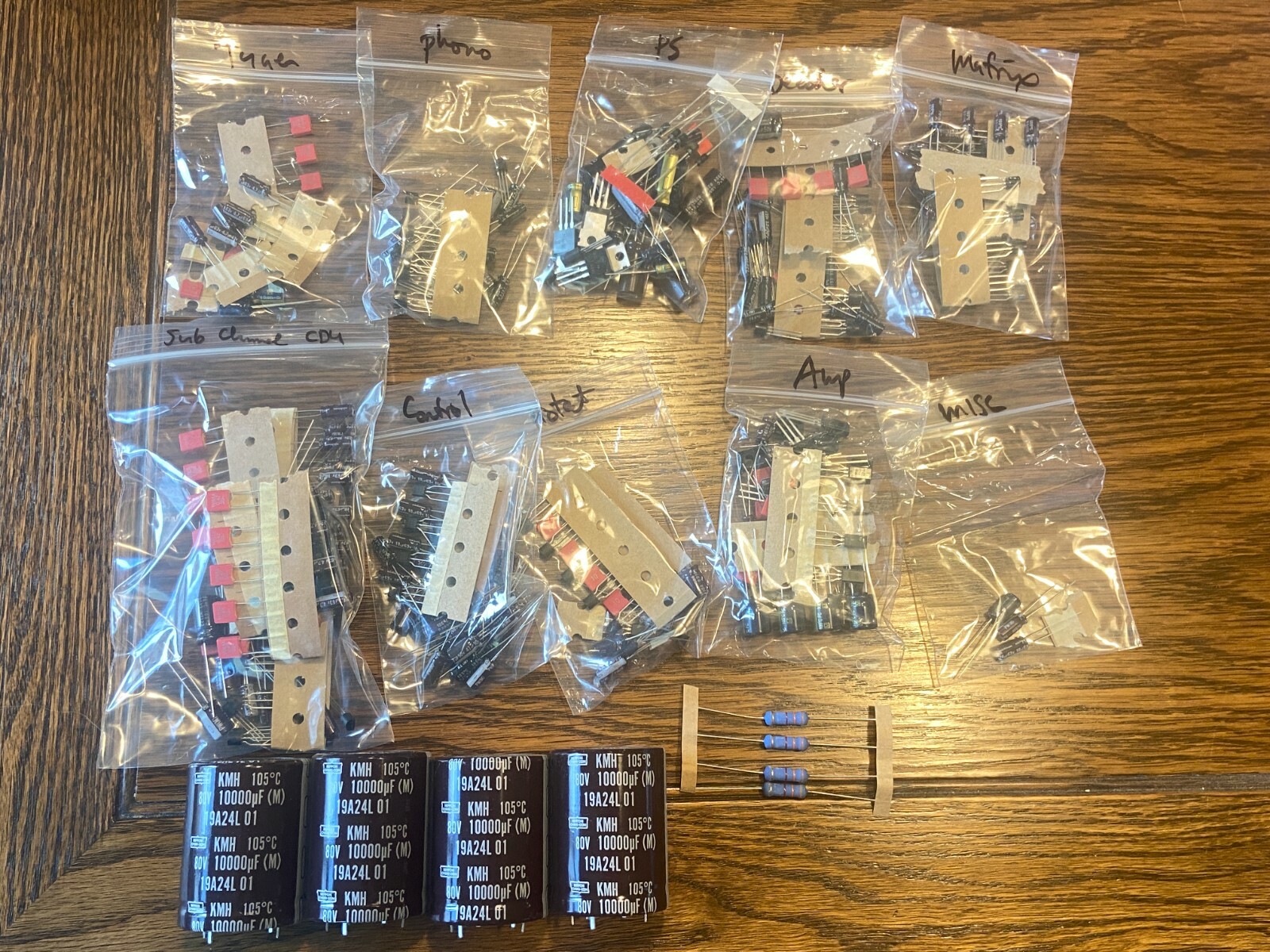
Pioneer didn’t cut corners on amplification. The QX-949A uses an “All-Stage Direct Coupled Complementary OCL” (output capacitor-less) circuit, meaning no coupling capacitors in the signal path—reducing phase shift and improving transient response. Fed by a dual power +/- supply with a heavy transformer and four 10,000µF electrolytic capacitors (40,000µF total), it delivers 60 watts per channel in stereo and 40 in quad, both at less than 0.3% THD. The damping factor of 35 means it can control difficult speaker loads, and the 4Ω to 16Ω impedance range gives flexibility. This wasn’t just powerful—it was *stable*. Owners praise its “crystal clear” performance, with “loud, very strong sound” that holds up even by modern standards. The “Power Select” feature lets users switch between 4-channel and 2-channel power output, optimizing performance depending on the listening mode.
Discrete Amplification with Expanded Heat Vents — Built to Last
Under the hood, the QX-949A is a fortress of discrete components. Unlike many receivers that leaned on integrated circuits for cost savings, this one uses a fully discrete amplifier section, backed by massive heat sinks to manage thermal load. The heat vent design was expanded compared to its predecessor, the QX-949, improving airflow and long-term reliability. With 85 transistors, 12 FETs, and 11 ICs on board, this wasn’t a minimalist design—it was an engineered solution built for performance and durability. As one 1974 review noted: “A study of its schematic diagram leaves us with a sense of amazement that such a complex instrument can be sold for only $750.” That complexity wasn’t just for show; it delivered results that rivaled standalone components of the era.
High-Performance Tuner with MOS FET Front End
The tuner section wasn’t an afterthought—it was engineered with the same seriousness as the amp. It features a 4-gang variable capacitor for FM and a 3-ganged capacitor for AM, ensuring precise tracking. The FM front end uses dual gate MOS field effect transistors (MOS FET) in the high frequency amplifier and mixing stages, reducing noise and improving sensitivity. The IF section uses three 2-element phase linear ceramic filters, a high-performance IC, and includes a diode limiter, quadrature detector, and FM muting circuit. The AM section uses an IC and ceramic filter IF amplifier. This wasn’t just a tuner to fill space; it was a high-performance section that rivaled standalone tuners of the era. As one source put it: “in respect to the electrical performance of its tuner and amplifier, it rivals some of the finest separate-component systems.”
Expansion for the Quad Lifestyle — Inputs, Outputs, and Beyond
This thing was built to be a hub. With two phono inputs (MM), an aux input, a 2-channel tape input, and *two* 4-channel tape inputs, it’s ready for serious quad tape dubbing. The 4 CH-MPX out terminal lets you connect external processors, and the back panel is packed: AM and FM antenna connections, a 3 AC outlet power strip (one switched), Dolby adaptor jacks, and an AM ferrite antenna. It can drive up to eight speakers and includes a tape monitor switch for seamless source switching. One owner noted it “works well as a traditional stereo receiver as well that has more inputs/outputs than most receivers and pre-amps.” Whether you were deep in the quad world or just wanted a future-proof stereo rig, the QX-949A had you covered.
Historical Context
When the QX-949A arrived in 1973, it wasn’t just another model in Pioneer’s lineup—it was their statement piece. Positioned as the flagship and most advanced of all their quadraphonic offerings, it was part of a QX series that included the QX-949, QX-747, and QX-646. The QX-949A was the direct successor to the QX-949, featuring upgraded "full logic" SQ decoder and improved heat dissipation thanks to expanded rear heat vents. At a time when many manufacturers treated quad as a gimmick, Pioneer went all in. With its integrated CD-4 and SQ decoding, direct-coupled OCL amplifier, and comprehensive control set, it represented Pioneer’s top-of-the-line approach to receiver design. It was built to eliminate the need for external decoders by incorporating CD-4, RM, and SQ decoding directly into the unit. This was quadraphonic audio at its most serious, most ambitious moment. And while the format ultimately faded, the QX-949A didn’t—it remains a benchmark for what integrated receivers could achieve.
Collectibility & Value
The QX-949A is very popular among quad collectors today, often described as “one of the most powerful quadraphonic receivers ever made.” Original pricing was $749.95 (including walnut cabinet), which adjusts to approximately $2,908 in 2014 dollars—putting its current market value into perspective. As of 2022–2023, units have been listed between $1,200 and $1,995, depending on condition and functionality. However, ownership isn’t without its challenges. Common problems include protection circuit engagement due to DC offset or failing components—particularly 2SC1451 transistors and specific Sanyo capacitors—leading to audio cutout. Hissing or uneven channel output is also reported. Fortunately, parts, lamp kits, and restoration kits are available, making repairs feasible for those with technical inclination. For those who get it running right, the payoff is immense: a receiver that still delivers “cadillac performance” decades later.
eBay Listings

As an eBay Partner, we earn from qualifying purchases. This helps support our independent vintage technology research.
Related Models
- Pioneer SX-2000 (1978)
- Pioneer SX-2500 (1978)
- Pioneer QX-646 (1978)
- Pioneer SX-1900 (1978)
- Pioneer SX-201 (1978)
- Marantz SR-2000 (1999–2001)
- Onkyo TX-1500MKII (1975)
- Pioneer SX-251R (1976)
- Realistic STA-2250 (1975)
- Realistic STA-2290 (1977)