Pioneer QX-8000 (1971–1972)
At 15.6kg, it arrives like a declaration—this is not just a receiver, but a command center for quadraphonic sound at its most ambitious.
Overview
The Pioneer QX-8000 isn’t subtle. From the moment it’s lifted—its 15.6kg weight confirming serious iron inside—it broadcasts intent. This was Pioneer’s flagship quadraphonic receiver during the brief, feverish window when four-channel sound promised to redefine home audio. Released in 1971 and produced into 1972, the QX-8000 stood at the top of Pioneer’s first wave of quad receivers, a statement piece designed to handle every format the era could throw at it. Priced at ¥97,000 at launch, it was a premium product for serious enthusiasts chasing immersive sound before the concept fragmented into competing standards and eventual obscurity.
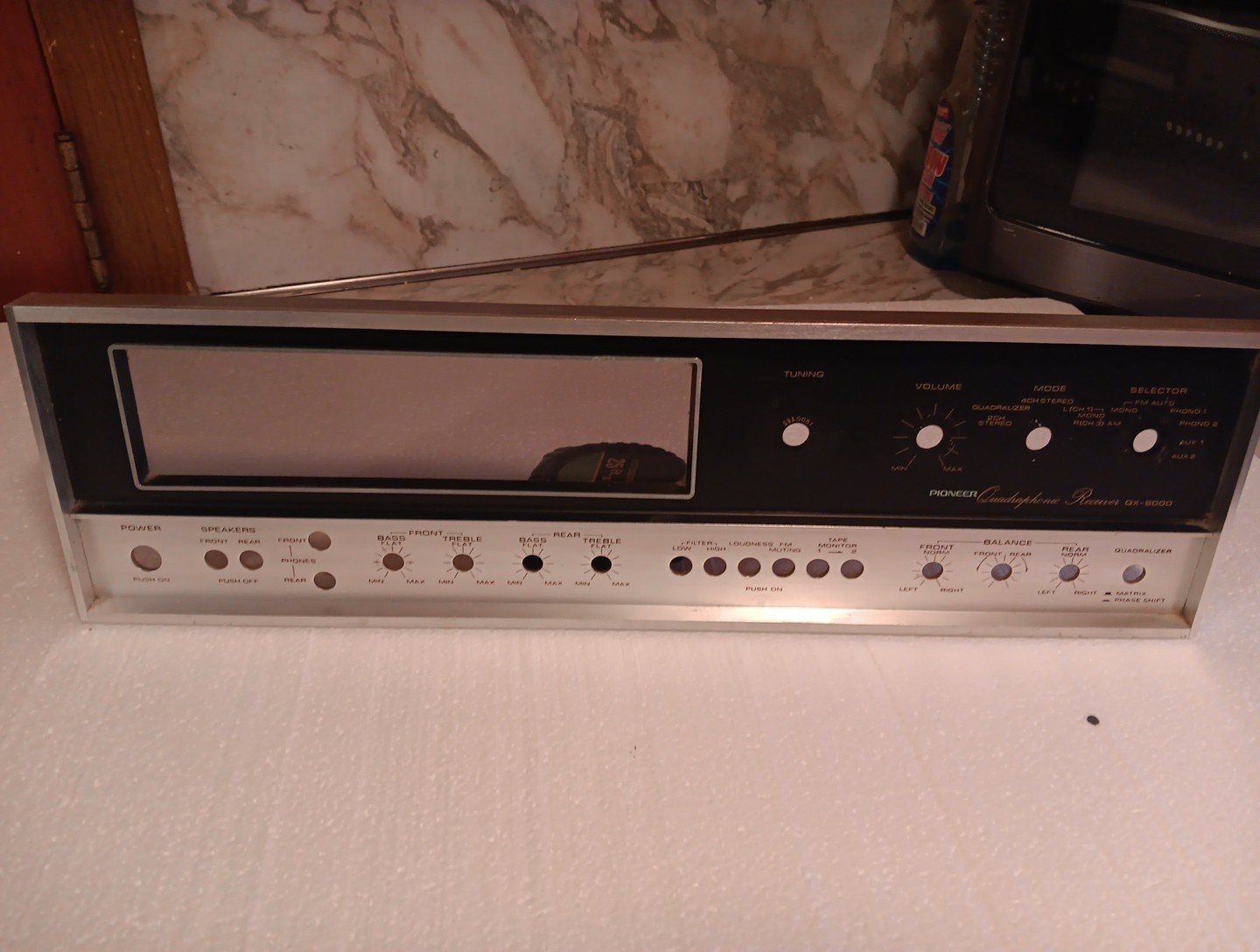
Despite its age, the QX-8000’s engineering remains impressive on paper. The FM tuner section leans on an FET front end for low-noise reception, backed by an IC and ceramic filter in the IF stage—solid choices for stability and selectivity in the early '70s. Tuning precision is supported by a dual-meter system: a signal strength meter and a center tuning indicator on a linear scale, making it easier to hit and hold the sweet spot on a station. A muting switch eliminates the usual hiss and crackle between stations, a small but thoughtful touch for listeners chasing pristine reception.
Under the hood, the power amplifier section is rated for 27W per channel into 4 ohms with all four channels driven at 1 kHz, stepping up to 36W per channel in stereo mode at the same impedance. At 8 ohms, output drops to 22W × 4 (4-ch drive) or 27W × 2 (2-ch drive), figures that reflect real-world performance rather than inflated peak claims. The frequency response stretches from 5 Hz to 100,000 Hz (±3 dB), and with a damping factor of 35 at 1 kHz into 8 ohms, it suggests decent control over speakers— Distortion is rated at 1% or less at full output, dropping to 0.05% at a more modest 14W into 8 ohms, a figure that aligns with the high-fidelity standards of its time.
The preamplifier offers full quad control: independent tone adjustment for front and rear channels, along with balance controls for front L/R and rear L/R pairs, allowing fine-tuning for room asymmetry or seating position. Input sensitivity is standard for the era—2mV/50kΩ for MM phono, 170mV/120kΩ for AUX— The inclusion of a loudness contour (adding +11.5dB at 100Hz and +7dB at 10kHz when volume is at -40dB) hints at its role in real living rooms, where low-level listening demanded compensation. The preamp and power amp sections can be used independently, a feature appreciated by system builders who wanted to mix and match components.
Specifications
| Manufacturer | Pioneer |
| Model Rating Type | 4-channel receiver |
| FM Tuner Section Practical sensitivity (IHF) | 2.2 μV |
| FM Tuner Section Capture Ratio (IHF) | 3.0dB |
| FM Tuner Section Effective selectivity | 45 dB or more |
| FM Tuner Section S/N | 65dB |
| FM Tuner Section Harmonic distortion factor (100% modulation) Stereo | 0.8% or less |
| FM Tuner Section Stereo separation | 40 dB or More (1 kHz) |
| AM Tuner Section Practical sensitivity (IHF) | 15 μV |
| Power Amplifier Unit Music Power (IHF) | 180W (4 Ω) 130W (8 Ω) |
| Power Amplifier Unit Effective power 20 Hz to 20 kHz output (2-ch drive) | 21W + 21W/21W + 21W (8 Ω, 1% or less distortion factor) |
| Power Amplifier Unit Effective output (1 kHz, 4-ch drive) | 27Wx4 (4 Ω) 22Wx4 (8 Ω) |
| Power Amplifier Unit Harmonic distortion factor | 1% or Less (Effective Output) 0.05% or Less (8 Ω, 14W + 14W/14W + 14W output) |
| Power Amplifier Unit Frequency characteristic | 5 Hz to 100,000 Hz ± 3 dB |
| Preamplifier Section Input Sensitivity / Impedance (1 kHz at effective output) Phono1, 2 | 2mV/50k Ω |
| Preamplifier Section Input Sensitivity / Impedance (1 kHz at effective output) AUX1, 2 | 170mV/120k Ω |
| Preamplifier Section Tone control Bass | 100 Hz, -12dB to + 11 dB |
| Preamplifier Section Tone control Treble | 10 kHz, -8.5 dB to + 10.5 dB |
| General Rated power consumption | 97W |
| General External dimensions | Width 509x Height 172x Depth 377 mm |
| General Weight | 15.6kg |
Key Features
FET Front-End FM Tuner with Ceramic IF Filtering
The FM tuner section starts with a field-effect transistor (FET) in the front end, a design choice that reduces noise and improves sensitivity—critical for pulling in weak signals without adding hiss. Combined with an integrated circuit and ceramic filter in the intermediate frequency (IF) stage, the QX-8000 achieves an effective selectivity of 45 dB or more and an impressive spurious interference ratio of 85 dB or more at 82 MHz. These specs suggest strong rejection of adjacent channels and stray signals, making it a reliable performer even in crowded urban RF environments. The AM section, relying on a ferrite bar antenna, is more modest, with 25 dB or more selectivity at 1 MHz, typical for the era but not exceptional.
Linear Scale Dual-Meter Tuning Display
Centered on the front panel, the tuning display is a standout. It’s a “2-meter system” featuring both a signal strength meter and a center tuning indicator, laid out on a linear frequency scale. This setup allows users to visually confirm peak signal strength and precise station centering simultaneously—no hunting for the quietest null or loudest peak by ear. The result is faster, more accurate tuning, especially useful when chasing weak quadraphonic FM broadcasts or distant stereo stations. The inclusion of a muting switch further enhances the listening experience by silencing interstation noise, a feature not universally available at the time.
Independent Front/Rear Tone and Balance Controls
True to its quadraphonic mission, the QX-8000 provides separate tone controls for front and rear channels, allowing users to tailor the soundfield to their room acoustics or speaker placement. The bass control operates at 100 Hz with a range of ±11 dB, while treble adjusts at 10 kHz from -8.5 to +10.5 dB. This level of granularity was rare even among high-end receivers. Additionally, balance can be adjusted independently for front left/right and rear left/right pairs—crucial for compensating for asymmetrical speaker layouts or off-center seating. The loudness contour, active at lower volume levels, applies a calculated boost to compensate for the ear’s reduced sensitivity to bass and treble at quiet levels.
Four-Channel Discrete, Matrix, and CD-4 Playback Capability
The QX-8000 was built to handle the full spectrum of 1970s quadraphonic formats. It natively supports regular and SQ matrix 4-channel playback, including matrix decoding for FM broadcasts that carried quad content. With the addition of an external demodulator, it can decode CD-4 (Compatible Discrete 4) records, which stored rear channel information in ultrasonic sidebands. It also plays back discrete 4-channel tape, making it a flexible hub for any quad source available at the time. This versatility made it a favorite among early adopters who wanted one receiver to rule them all—before the format wars collapsed the market.
Separate Preamp and Power Amp Operation
One of the QX-8000’s more advanced features is the ability to bypass the internal preamplifier and use the power amplifier section independently. This allows integration into larger systems where an external preamp or processor takes control of source selection and decoding. Similarly, the preamp section can be used standalone with another amplifier, offering flexibility for system upgrades or hybrid builds. This modular approach was ahead of its time and reflects Pioneer’s engineering-first mindset in their flagship models.
Historical Context
The Pioneer QX-8000 arrived in 1971 as the flagship of Pioneer’s first generation of quadraphonic receivers, a bold move during the short-lived but intense push for four-channel home audio. It was designed to decode SQ matrix broadcasts, play discrete quad tapes, and—with an external demodulator—unlock the high-resolution potential of CD-4 records. The fact that it could also receive matrix 4-channel content via FM broadcasting made it a complete solution for early adopters. By 1972, it was replaced by the QX-8000A, a slightly restyled and revised version, suggesting Pioneer was iterating quickly in response to market feedback. Despite its brief production run, the QX-8000 remains a symbol of a moment when audio engineers believed more channels meant better sound—and Pioneer led the charge.
eBay Listings
As an eBay Partner, we earn from qualifying purchases. This helps support our independent vintage technology research.