Pioneer QX-747
A four-channel receiver that made you answer some questions before you bought it, and weighed 42 pounds doing so.
Overview
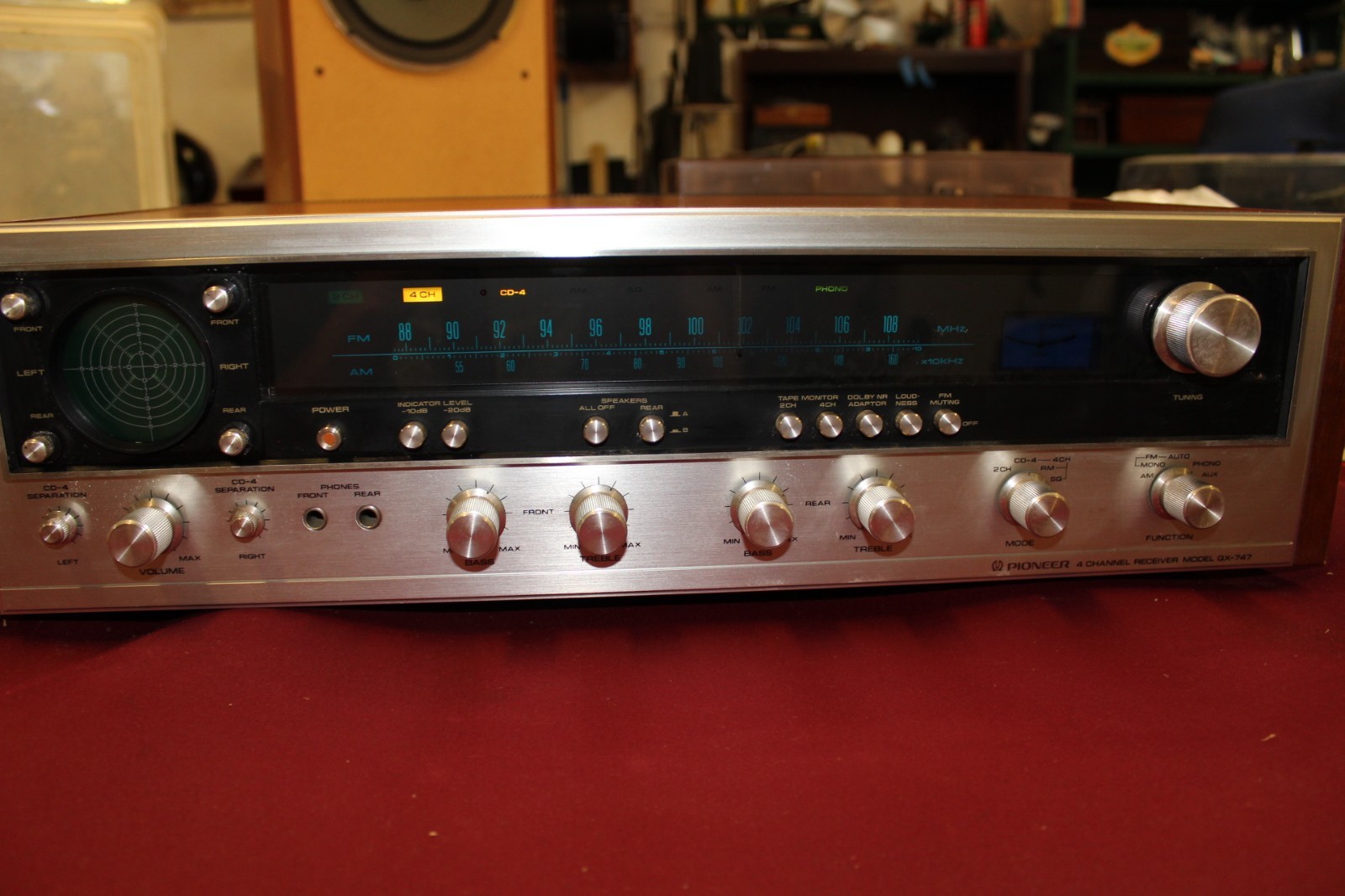
The QX-747 is a quadraphonic receiver from Pioneer's first full line of four-channel gear. It came with a lot of attitude for hi-fi. Pioneer's own advertising in the period press skipped the usual spec bragging and ran under the headline "Quad... Before you buy, demand these answers." The pitch was blunt: most manufacturers claimed "total capability" for their quad receivers, but total capability meant different things to each manufacturer. The implication was that if you couldn't answer the questions, you weren't talking to a Pioneer dealer. That's marketing copy, not a verdict.
Underneath the advertising, the QX-747 is a four-channel receiver built around a direct-coupled complementary OCL amplifier section, with an ambitious decoding section bolted on. The manual lists the built-in decoders as a CD-4 demodulator, a regular matrix decoder, and an SQ matrix decoder. That covers all three of the major quadraphonic formats of the day, in one box. Quad was a format war, and the QX-747 was Pioneer's attempt to not lose it.
The power numbers need some unpacking, because quad receivers were always rated in ways that flattered them. In four-channel operation, the QX-747 is rated at 20W x 4 into 8 ohms across 20Hz - 20kHz, or 25W x 4 into 4 ohms. At 1kHz with all four channels driven, it's 25W x 4 into 8 ohms and 30W x 4 into 4 ohms. Flip the 2CH POWER BOOSTING switch to "2 CH" and the rear channels bridge in to help the front pair: 50W + 50W into 4 ohms across the full 20Hz - 20kHz band, or 45W + 45W into 8 ohms and 55W + 55W into 4 ohms at 1kHz. Each channel driven individually at 1kHz manages 50W into 8 ohms and 65W into 4 ohms. None of those figures are impressive by two-channel standards of the era. That was the tradeoff every quad receiver made, and buyers in 1974 understood it.
Distortion is quoted at less than 0.5% at continuous power output, dropping to less than 0.05% at 1W x 4. Power bandwidth with four channels driven is 7Hz - 40kHz. Speaker outputs are FRONT: A, REAR: A and B, rated for 4-16 ohms, with headphone jacks for both front and rear. Tone controls offer ±10dB at 100Hz and ±10dB at 10kHz. The loudness contour adds +6dB at 100Hz and +3dB at 10kHz when the volume control is set at the -40dB position.
The CD-4 demodulator section is the part collectors care about most. Input sensitivity is 2.5mV with a 1-5mV adjustable range, input impedance 100k ohms, distortion 0.07%, and signal-to-noise better than 70dB. Separation is quoted at 50dB left-to-right and 30dB front-to-rear at 1kHz using a standard test signal. Thirty dB of front-to-rear isn't enormous, but it was the honest number for the era.
The tuner is a serious piece of work by the standards of the time: one MOSFET, a single-stage RF amplifier, a 4-ganged variable capacitor, and a 5-stage limiter. Usable sensitivity is 1.9µV IHF, capture ratio 1dB, selectivity 60dB, signal-to-noise 70dB, image rejection better than 80dB at 98MHz, and IF rejection better than 100dB. Mono harmonic distortion is under 0.2%. Stereo is quoted under 0.2% in one manual revision and under 0.4% in another, so treat the stereo figure as approximate. Stereo separation is better than 40dB at 1kHz and better than 30dB across 50Hz - 10kHz. There's switchable muting and an MPX noise filter, and antenna inputs for both 300-ohm balanced and 75-ohm unbalanced.
The AM section is modest but complete: one stage of RF amplification with a 2-ganged variable capacitor, 300µV/m sensitivity on the built-in ferrite loopstick antenna and 15µV on an external antenna, 35dB selectivity, 50dB signal-to-noise, image rejection better than 45dB, and IF rejection better than 55dB.
The QX-747 measures 21-8/16 x 6-5/16 x 16-9/16 inches and weighs 19.1kg - 42 pounds 3 ounces - without the package. With packing, it's 23.6kg, or nearly 52 pounds. Inside are 9 FETs, 6 ICs, 123 transistors, and 66 diodes. Power requirements vary by market. The UL-approved model runs on AC 120V 60Hz with 140W consumption. The 5-line voltage model switches between 110V, 120V, 130V, 220V, and 240V at 50/60Hz and draws 340W. There are two unswitched AC outlets and one switched.
Around the back, the QX-747 carries a phono jack, speaker output terminals, a 4-pin ground terminal strip, and a binding post for ground. Inside, the pilot lamps are 8V 0.3A for the main five, with additional 6V 30mA and 8V 50mA lamps, and a 4A AC power fuse alongside a separate 4A protection fuse. The unit shipped with an FM T-type antenna, a CD-4 test record (PQX-101), a polishing cloth, and operating instructions.
Pioneer's period advertising pointed to the QX-949's multiplex noise and high/low filters as the step-up features on the top two models. The QX-747 sat below that tier in the lineup, so don't expect those refinements here. The advertising also said that left and right front/rear controls permitted instant adjustment on the higher models, and that the sound level of each channel could be monitored on the scope-type level indicator found on the top two models. Again, those are the top models, not the 747.
One documented service detail matters for anyone buying today. Pioneer issued a modification replacing the conventional sub-channel circuit assembly AWX-051-A with a new type, AWX-051-B, on account of improvements. It affects the CD-4 demodulator section specifically, so check which assembly a given unit has before purchase.
eBay Listings


As an eBay Partner, we earn from qualifying purchases. This helps support our independent vintage technology research.