Pioneer LD-1100
The machine that convinced a skeptical hi-fi world that video could sound like FM radio - if you could afford the disc.
Overview
The LD-1100 is a LaserDisc player, and it showed up while the format was still fighting for legitimacy. Pioneer's own literature makes the pitch plainly. Audio is recorded as two separate FM signals alongside the video, so stereo and bilingual reproduction are both possible. The company claimed the result was comparable to conventional phonograph records or FM broadcasts. That was a bold claim for a videodisc player in an era when most people associated the technology with grainy movies and temperamental discs.
The audio numbers back it up, at least on paper. The LD-1100's audio frequency response is quoted at 40 Hz to 20 kHz, with a signal-to-noise ratio of 60 dB - or 70 dB with the CX noise reduction system engaged - and total harmonic distortion of 0.3% or less. Those are not audiophile-turntable figures, but they are in the territory of decent FM tuner performance. The CX system does real work here. Pioneer's documentation notes that it cuts noise by roughly 10 dB or more without compromising frequency response, and it expands dynamic range in the process.
The disc format is where the LD-1100 gets ambitious. The system complies with MCA Philips specifications, and the laser is a helium-neon unit at 6328 angstroms running 1 mW. Standard-play (CAV) discs offer 30 minutes per side. Extended-play (CLV) discs double that to 60 minutes per side. In constant-linear-velocity mode the spindle runs at 1800 RPM at the inner circumference and drops to 600 RPM at the outer edge. Video output is 1 Vp-p nominal, sync negative, terminated, with a video signal-to-noise ratio of more than 42 dB and NTSC-specification video response.
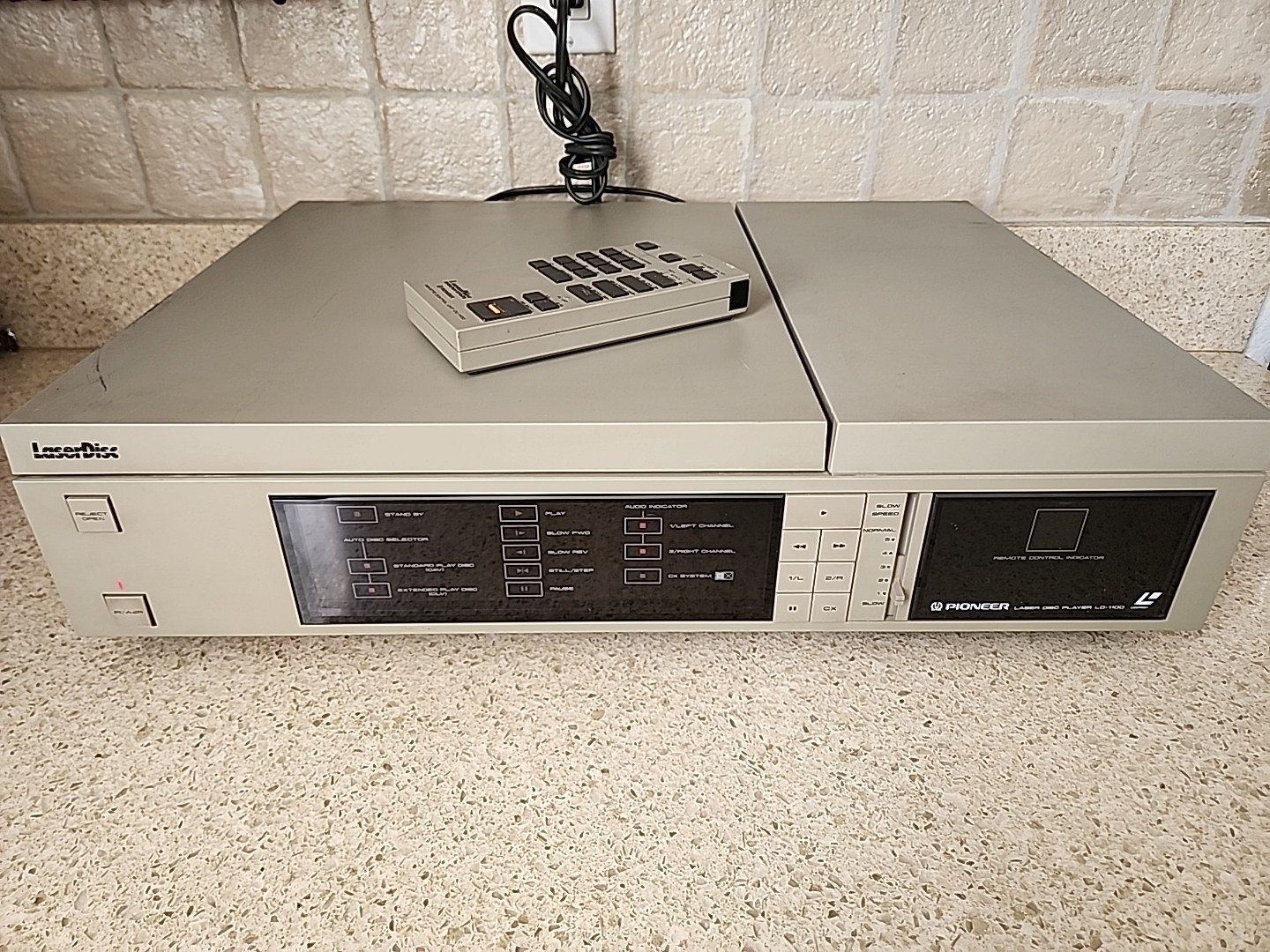
Collectors like the LD-1100 for the computer control layer Pioneer built into it. The disc carries a maximum of 54,000 tracks in a continuous spiral. On CAV discs each video frame occupies one full revolution of a single track, recorded with its own frame number. A microcomputer uses those numbers to deliver still frames, variable-speed slow motion, and frame-number random access, which Pioneer claimed could locate a specific frame automatically within 15 seconds. The feature list is long: play, pause, scan forward and reverse, fast forward and reverse at three times normal speed, slow forward and reverse with variable speed control, still and step forward/reverse, frame number display, elapsed time display, chapter number display, frame number search, chapter number search, chapter stop, and automatic picture stop on special discs. Remote control is included.
The front panel, by contrast, is almost bare. High Fidelity (November 1982, p.53) compared the LD-1100 against RCA's SGT-250 CED player and noted that the on-chassis control panel is sparse. Only PLAY, SCAN, PAUSE, and the two audio defeats sit on the main panel, and the rest of the functions live on the remote. The review pitted the Pioneer laser player directly against RCA's capacitance electronic disc machine, and it is one of the better contemporary documents on how the two competing videodisc formats stacked up feature-for-feature.
Pioneer's own marketing was enthusiastic. A 1982 High Fidelity advertisement (November 1982, p.17) billed the LaserDisc system as a laser beam changing how people would see and hear things forever, and cited a signal-to-noise ratio of 68 dB. That does not match the 60 dB in the owner's manual, so treat it as advertising copy rather than measured specification. The manual's 60 dB (70 dB with CX) is the number to trust.
The format's early software problems are part of the LD-1100's story. Audio (February 1983, p.86) carried Bert Whyte's video column, in which he revisited his August 1981 review of the Pioneer VP-1000 and noted that the software had not been very reliable, frequently exhibiting various forms of glitches on the TV image. Whyte went on to describe a reshuffling of the organizations producing LaserDiscs. Some left the field, others overhauled manufacturing, and Pioneer's Kofu, Japan plant significantly increased production. Better production technology followed. The LD-1100 sits on the far side of that transition.
Connection is simple. An ordinary television set is all that is required for normal video and audio reproduction. Pioneer's manual, however, recommends a hi-fi stereo system - one from Pioneer, naturally - to take full advantage of the laser disc's audio quality.
Service documentation exists in at least two versions. Pioneer issued a service manual covering LD-1100 units with serial numbers beyond 3611501, and directs technicians needing information on earlier units to the original LD-1100 service manual. The two manuals are not interchangeable, and the adjustment procedures are not trivial. The later manual's test-point tables cover focus error, tracking error, focus and tracking oscillator inputs, bridge balance, and tangential error, with warnings about the LSPS board and dangerous voltages. The helium-neon laser tube alone puts this machine in a different servicing category from a typical turntable or cassette deck.
It represents the laser side of the early-1980s videodisc format war, the side that eventually won, and its audio specifications hold up better than the era's reputation for videodisc sound would suggest. The sparse front panel, the deep remote functionality, the CX noise reduction, and the 54,000-track computer-controlled access all point to a machine Pioneer expected to be operated like a serious component rather than a toy.
eBay Listings
As an eBay Partner, we earn from qualifying purchases. This helps support our independent vintage technology research.