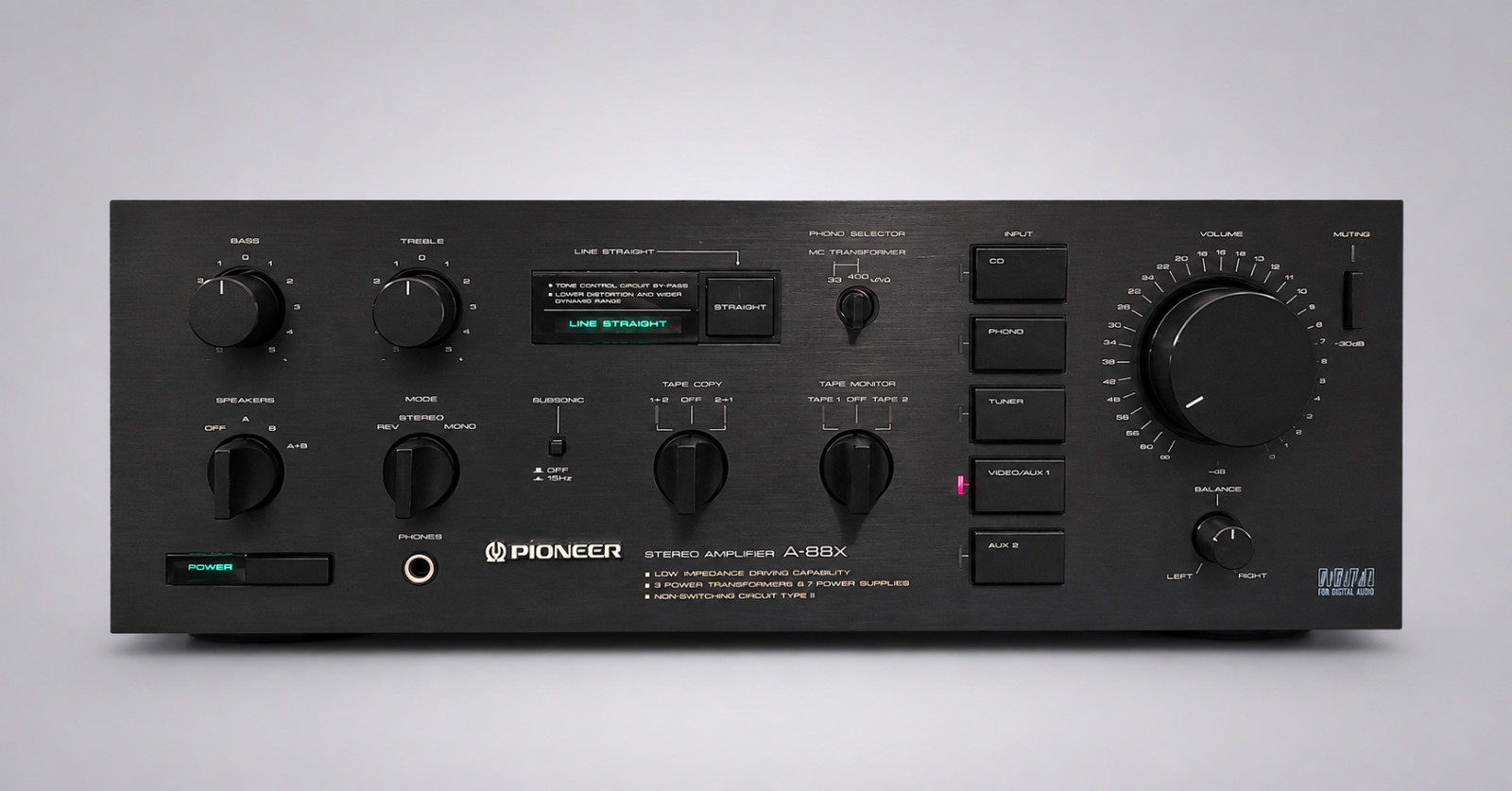
Pioneer A-88X
A 120-watt integrated amplifier that Pioneer's own service literature treats as six different products, depending on which continent's wall socket you happen to own.
Overview
The A-88X is a stereo integrated amplifier from Pioneer's mid-1980s line. The first thing a collector notices is that it isn't one amplifier - it's six. Pioneer's service documentation lists the model in KU, HE, HB, S, S/G, and HEZ versions, split by voltage and market. The KU type is the U.S.A. model, AC 120 V only. The HE is the European continent model with switchable AC 220 V and 240 V. The HB is the United Kingdom version and the HEZ the West Germany version, both on switchable 220/240 V. The S is the general export model and the S/G the U.S. Military model. Those two are the flexible ones, switchable across AC 110 V, 120 V, 220 V, and 240 V. If a buyer is hunting one on the used market, the version on the back panel decides whether it's usable without a step-up transformer. Pioneer's service manual for the KU type also notes that servicing the HE, HB, S, S/G, and HEZ variants requires a separate manual.
The specs are why the A-88X still gets pulled off shelves. Continuous average power output is rated at 120 watts per channel, minimum, at 8 ohms from 20 Hertz to 20,000 Hertz with no more than 0.003% total harmonic distortion. That distortion figure is the headline. 0.003% THD across the full 20 Hz to 20 kHz band at rated output is a genuinely low number for the period, and Pioneer states it twice in the manual's specification section, once as the general power output condition and again measured from CD input at 8 ohms. Cross-harmonic distortion (50 Hz : 7 kHz = 4 : 1) at effective output is likewise quoted at 0.003%. A second manual states 60 Hz : 7 kHz = 4 : 1 at effective output, also 0.003%.
The manual doesn't spell out how the amplifier behaves into real-world loads, and that's where the version differences bite again. Speaker load impedance is rated at 6 to 16 ohms for the HE, HB, and YP models, but 4 to 16 ohms for the KU, KC, S, and S/G models. So the U.S. and general-export versions are the ones specified to drive a 4-ohm speaker, and the European variants are rated down only to 6 ohms. A casual listing won't mention it.
The input section is unusually thorough for an integrated of this class. Phono MM sensitivity is quoted at 2.5 mV into 47 kΩ, with a phono overload level of 250 mV at 0.003% THD at 1 kHz. Phono MC is the more interesting inclusion: 0.25 mV into 40 ohms, plus a second MC input at 0.15 mV into 3 ohms for use with an MC transformer. Line-level inputs (Tuner, CD, Aux 1 and 2, Tape Play 1 and 2) are specified at 150 mV into 30 kΩ. Tape Record outputs 1 and 2 sit at 150 mV into 2.2 kΩ. Hum and noise with inputs short-circuited, A-weighted, is quoted at 110 dB for CD, Aux, Tuner, and Tape Play. That's the kind of figure that explains why these amplifiers still get used as the front end of serious vinyl setups.
Frequency response shows where the design priorities sit. The phono stage, with RIAA equalization, is specified at 20 Hz to 20 kHz ±0.2 dB for both MM and MC, tight enough that the equalization error is essentially inaudible. The line-level inputs are quoted at 10 Hz to 100 kHz, a bandwidth that runs well past anything the source material will contain. Tone controls are conventional: Bass ±8 dB at 100 Hz, Treble ±8 dB at 10 kHz. There's a Subsonic filter, and the manual's operating instructions describe its two positions precisely. Released (off) is for normal playback. Depressed, it cuts frequencies of 15 Hz and below, which is aimed at the super-low-frequency noise that coarse record grooves can generate and which otherwise contributes to distortion. The Muting switch, when engaged, cuts volume by 20 dB and lights an indicator. Releasing it restores the previous level. Period reviewers also praised the A-88X's non-switching output stage, with one noting the amplifier's qualities seemed to grow as listening progressed (High-Fidelity, December 1985, p.53). There's a Phones jack, and a Balance control that the manual advises leaving centered unless one speaker is audibly louder.
Physically, the A-88X is a full-width component: 457 mm wide, 155 mm tall, and 427 mm deep, or 18 by 6-1/8 by 16-3/4 inches. Weight without packaging is 18 kg, or 39 pounds 10 ounces. Power consumption is quoted at 670 W for the KU model under UL, and 820 VA for the KC model under CSA. The KC is a Canadian variant that appears in the power-requirements list alongside the KU but isn't part of the six-version table. The amplifier shipped with an operating instructions booklet, two side panels, and four side-panel mounting screws. Those side panels are the sort of accessory that goes missing and is nearly impossible to replace. Pioneer's manual also carries the standard note that specifications and design are subject to modification without notice, and a footnote stating the power figures were measured pursuant to the Federal Trade Commission's Trade Regulation rule on Power Claims for Amplifiers. That FTC rule forced honest continuous-power ratings out of the industry in the 1970s, and manufacturers continued to cite it through the 1980s.
One more detail from the service literature: the A-88X uses a non-switching output stage. The approach is aimed at reducing the switching distortion that conventional Class-AB output stages can generate. It doesn't show up in a spec sheet, but it does show up in how the amplifier sounds at low levels.
On production years, the manual carries a printing date of February 1985, which places the documentation firmly in that period. No verified production start or end year is available for the model, so the year range is unconfirmed. What is confirmed is the six-version structure, the 120-watt rating, the 0.003% THD figure, and the inclusion of two separate moving-coil phono inputs. That puts the A-88X a step above the average integrated amplifier of its era for anyone running a low-output MC cartridge.
eBay Listings
As an eBay Partner, we earn from qualifying purchases. This helps support our independent vintage technology research.