Pioneer A-66X (1985–1986)
A modest-looking integrated amplifier with a phono stage owners still rave about, built heavy enough to show where the money went.
Overview
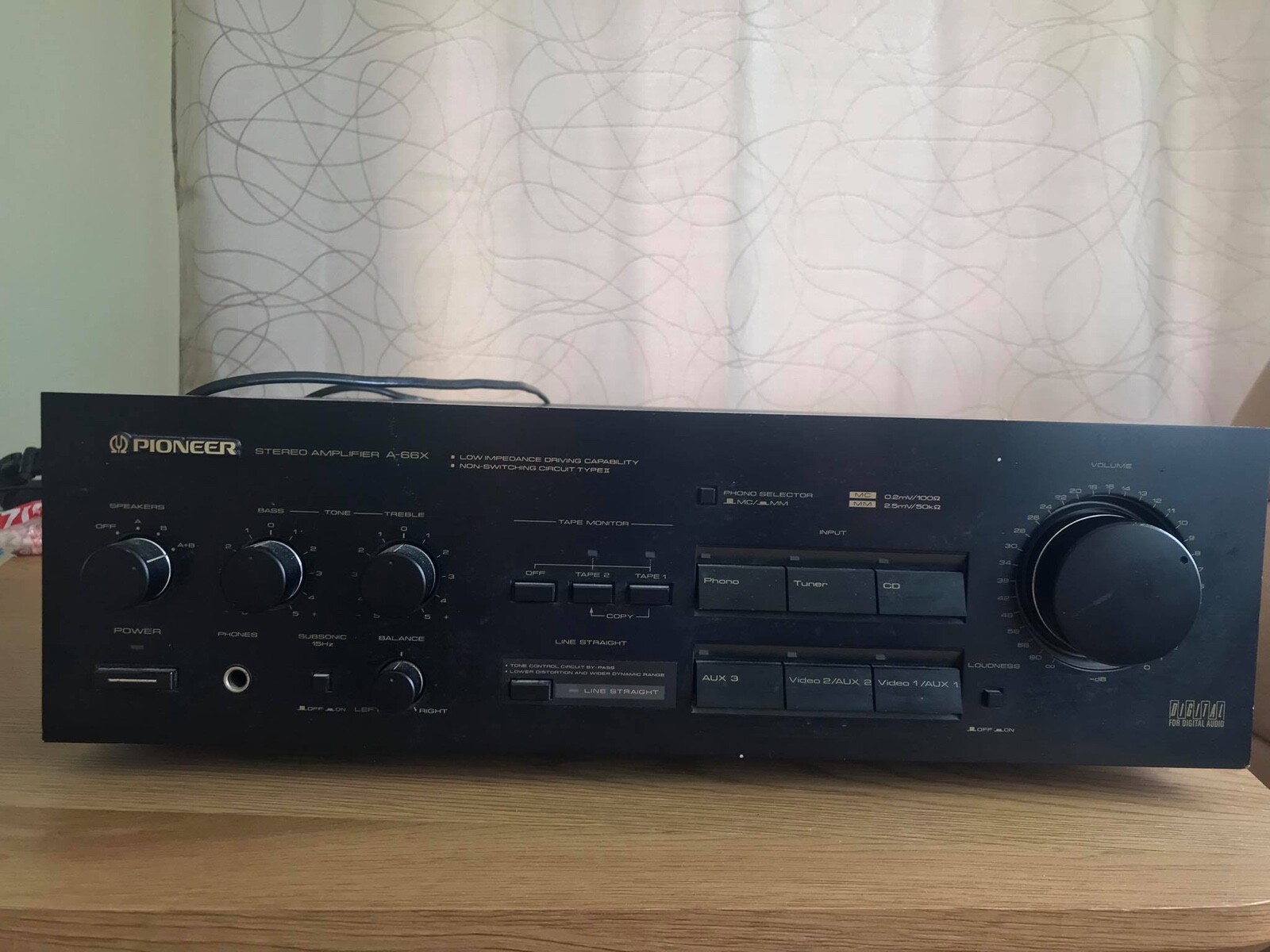
Pick up a Pioneer A-66X and the first thing you notice is the weight - around 11 kg, which is a lot of iron and copper for a box that makes 80 watts per channel into 8 ohms. That heft is the tell. This is a transistor amplifier from the mid-1980s, when Japanese integrated amps were expected to double as furniture anchors. Owners at the time described it simply as "heavy". That's not a complaint, just an observation about where the transformer budget went.
The A-66X arrived in 1985 and ran through 1986 as part of Pioneer's A-X series, a lineup that also included the A-77X. That production window comes from a single source, so treat the dates as reported rather than confirmed. The A-X series placement is consistent across the documentation that survives. There's plenty of service literature: a 28-page service manual, an 11-page user manual in German, and a full-text scan in the Internet Archive. For a mid-line integrated amp pushing forty years old, that's better documentation than most of its contemporaries managed.
The A-66X does not shout. The power rating is honest rather than inflated, the feature set is conventional, and the looks are understated. What it has is a reputation, built largely on one section of the circuit: the phono stage.
Key Features
80 Watts Per Channel Into 8 Ohms — Conservative by Design
The headline number is 80 watts per channel into 8 ohms, confirmed across multiple sources including HiFi Engine and AudioBaza, with listings describing it as "80w x 2." That's a respectable figure for a mid-1980s integrated, enough to drive most speakers of the era without strain. The 11 kg chassis suggests the power supply was sized to actually deliver it rather than just claim it on a spec sheet.
One caveat: a Ukrainian classified listing describes the same amplifier as "2х100Вт" - 100 watts per channel. That conflicts with every other source, and it's the kind of inflated number that shows up in secondhand listings when sellers round up. The 80W/8Ω figure appears in the manufacturer-adjacent documentation and is repeated by AudioBaza and multiple retail listings, so that's the number to trust. If a seller claims 100 watts, ask what test condition produced it.
A Phono Stage Owners Actually Praised
The phono section is what keeps the A-66X relevant. One owner, comparing it directly against Pioneer's own A-307R, noted that the 66's phono stage (фонокоректор) was specifically praised, and that the A-307R "clearly lacked bass" by comparison. That's an endorsement from someone who owned both, and it explains why the A-66X still circulates among vinyl listeners rather than being written off as generic mid-fi.
The signal-to-noise figures back up the phono reputation. The A-66X is rated at 70dB S/N for moving-coil cartridges, 86dB for moving-magnet, and 105dB for line-level inputs. The 70dB MC figure is the interesting one. Moving-coil cartridges put out tiny voltages, and a phono stage that stays quiet with them is doing real work. The 16dB gap between MC and MM performance is typical of the era, but the absolute numbers are good for a mid-line integrated.
Wide Frequency Response and Flexible Loading
The frequency response is quoted as 5Hz to 100kHz. Whether your speakers can reproduce anything near either end is a separate question. A response that wide suggests the amplifier isn't rolling off the extremes to flatter its measurements. Line output is specified at 150mV.
Semiconductor Construction and Service Documentation
The A-66X is a solid-state, transistor-based design. No tubes, no exotic topology, just competent 1980s semiconductor engineering. The service manual identifies a "Control assembly. A-66XCBKJ, A-66X," suggesting at least one regional or market variant, though the CBKJ designation isn't otherwise explained in the surviving documentation. It may be a market code rather than a distinct model.
Two notes from the service literature matter for anyone planning repairs. First: "Parts without part number cannot be supplied". Pioneer's parts channel required a specific part number, so undocumented components are effectively unobtainable through official channels. Second: certain components carry an "A" mark indicating a safety-critical function, and replacements must be identical. Both are standard Pioneer practice of the period, and both get in the way when you're sourcing replacements four decades later.
Historical Context
The A-66X was produced in 1985 and 1986 as part of Pioneer's A-X series, according to a single source documenting the lineup. The A-77X, a dual-mono design, appears alongside the A-66X in period references, though no explicit hierarchy between the two is documented in the surviving material. The A-X series was Pioneer's integrated amplifier lineup during the mid-1980s.
That's the extent of what's documented. Production figures, original retail price, and the amplifier's position within Pioneer's broader catalog are not recorded in the available sources.
Collectibility & Value
The A-66X sits in the working-amplifier tier rather than the collector tier. Recent asking prices have landed around US $285 (approximately EUR 251), with a Ukrainian listing at 6,500 hryvnia. HifiShark maintains a tracking page for the model, which suggests enough transaction volume to make price monitoring worthwhile. It does not command speculative premiums.
Condition notes from sellers are consistent with a well-used but serviceable amplifier. Listings describe units as "working nice" with "cleaned and lubed dirty contacts" - the kind of maintenance any 1980s amplifier with mechanical switches will eventually need. Some sellers offer units as "parts or repair" when they're not fully functional.
No specific failure points or common repair procedures are documented in the surviving owner reports, which is unusual, since most amplifiers of this vintage have known weak spots. The absence of that information doesn't mean the A-66X is trouble-free. It means the collective knowledge base is thinner than for Pioneer's more famous models. Buyers should assume standard 1980s integrated amplifier maintenance: switch cleaning, capacitor inspection, and potentiometer servicing.
The phono stage is the reason to seek one out. If you're running a moving-coil cartridge and want a period-appropriate integrated, the A-66X has a documented reputation that most of its peers lack.
eBay Listings
As an eBay Partner, we earn from qualifying purchases. This helps support our independent vintage technology research.