Pioneer SR-202W (1971–1977)
That lush, dark wash of spring reverb on an Amy Winehouse record? There’s a good chance it came from this unassuming box of transistors and coiled steel.
Overview
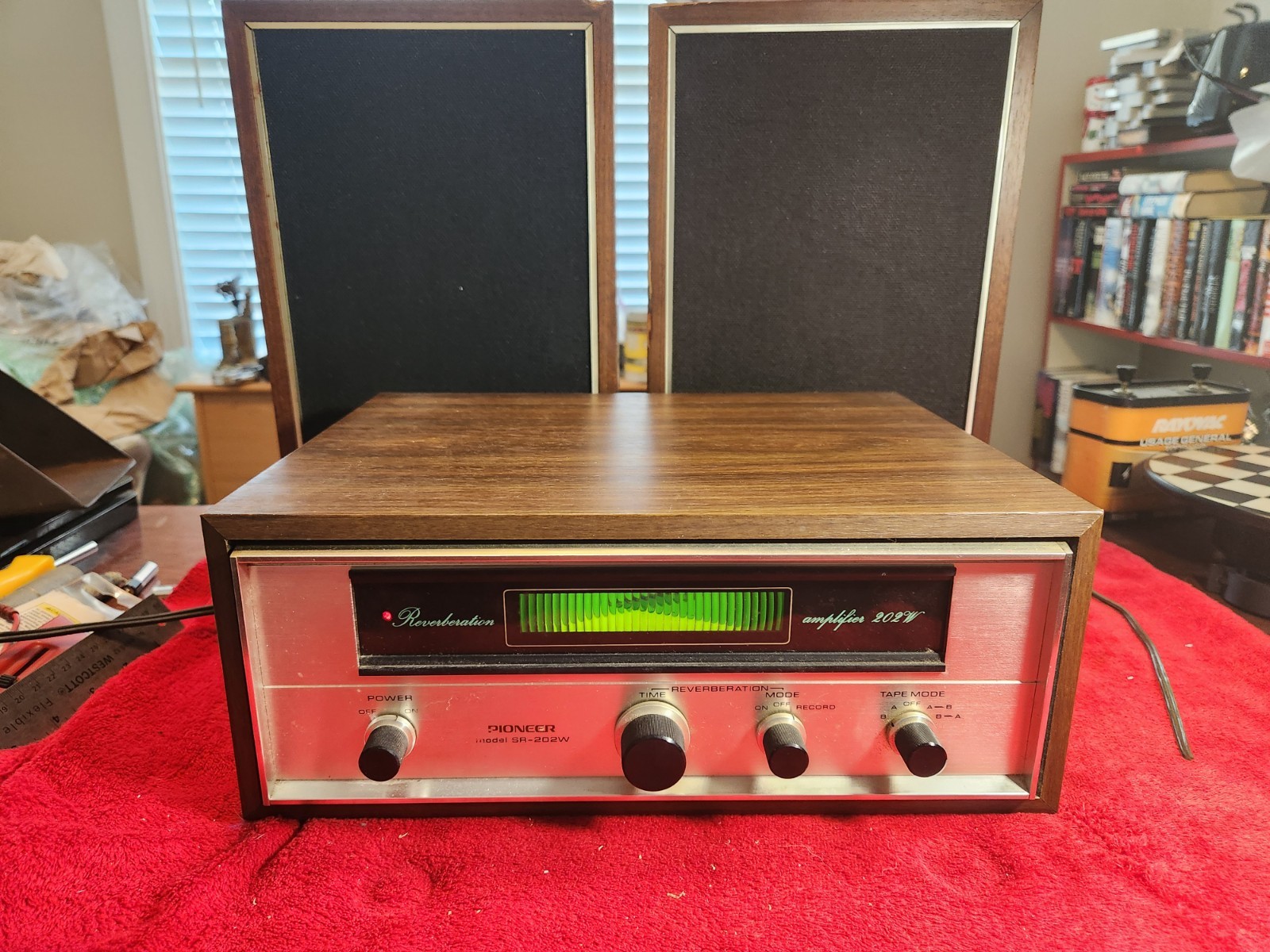
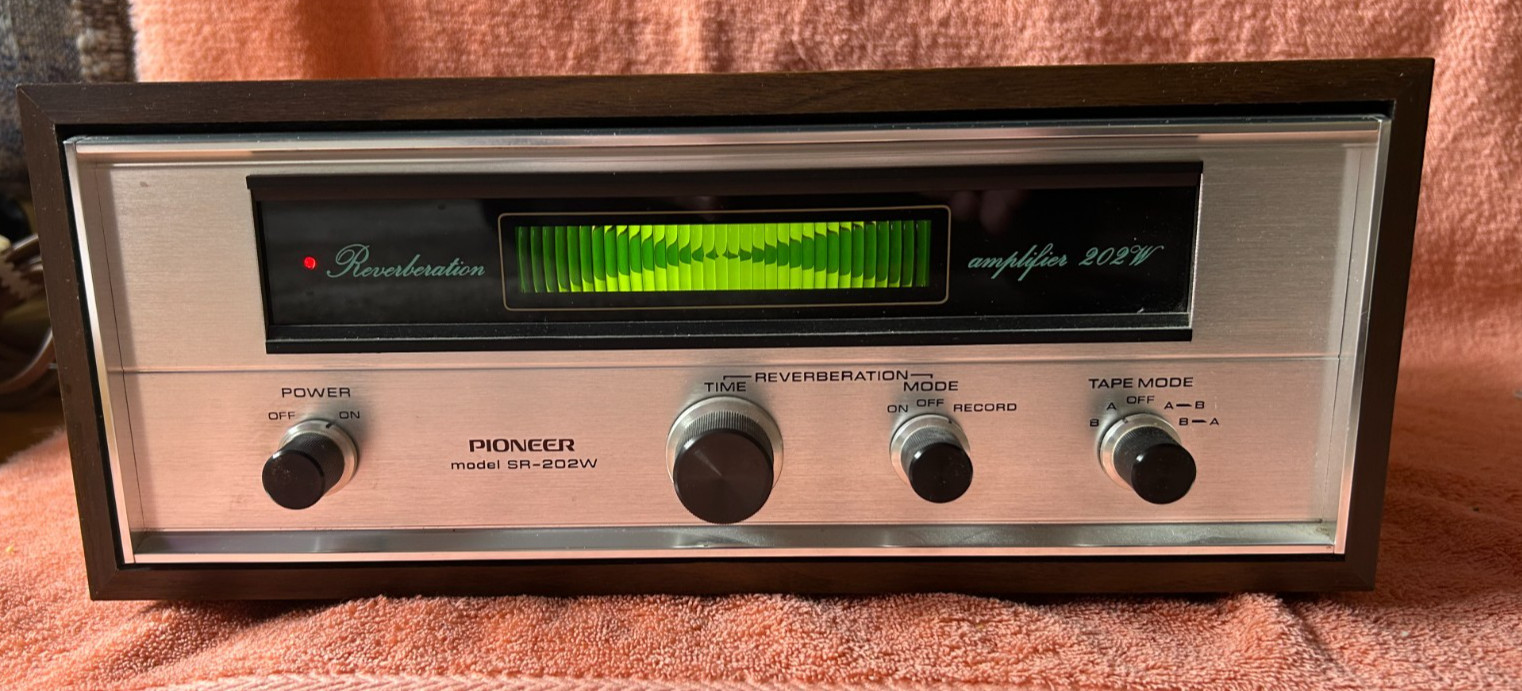
The Pioneer SR-202W Reverberation Amplifier isn’t an amplifier in the way most people think—it’s a dedicated spring reverb unit built for the living room, not the studio. Introduced in 1971 and produced through 1977, it was Pioneer’s answer to the growing appetite for atmospheric sound in home hi-fi setups, letting users add a rich, organic wash of reverb to their existing stereo systems. Marketed as a domestic accessory, it was never meant to compete with high-end studio hardware, yet decades later, it’s found a second life as a cult favorite among engineers who distrust digital emulations and crave the unpredictable soul of analog springs.
This is solid-state gear with a distinctly 1970s aesthetic: a brushed aluminum faceplate, fake wood paneling, and a wooden case that blends into any period-correct audio rack. It wasn’t flashy, but it was functional and stylish enough to sit beside your receiver or tape deck without looking out of place. The SR-202W replaced the tube-based SR-101, marking Pioneer’s shift toward more reliable, cooler-running solid-state designs. And while it lacked the flexibility of professional units, it delivered something rarer—a characterful, dark-toned reverb that could transform a flat vocal or dry guitar into something haunting and dimensional.
Owners report it’s simple to use: feed a line-level signal in via RCA, dial in the amount of reverb with the continuously adjustable time control, and send the wet signal back to your system. It’s not a processor you patch into every track, but the kind of unit you’d use selectively—on a vocal here, a snare there—like a piece of furniture in your signal chain. And despite its modest origins, it’s been spotted in high-end studios, famously used by mix engineer Tom Elmhirst on records by Amy Winehouse, Adele, and Mark Ronson. He called it a “secret weapon,” which says more about its sonic signature than any spec sheet ever could.
Specifications
| Manufacturer | Pioneer |
| Product type | Reverberation amplifier, spring reverb unit |
| Production years | 1971–1977 |
| Power consumption | 9 watts |
| Dimensions (WHD) | 322 x 140 x 263 mm / 12.7 x 5.5 x 10.4 inch |
| Weight | 4.6 kg / 10 lb 2.1 oz |
| RMS Output Voltage | 330mV (at 1KHz, reverberation time: MIN, input level: 200mV) |
| Total Harmonic Distortion | < 0.2% (at 1KHz, reverberation time: MIN, output level: 330mV) |
| Frequency Response | 20 to 35,000Hz ±2dB (reverberation time: MIN) |
| S/N Ratio | 65dB (at 330mV output) |
| Reverberation Time | 0 to 2.5 sec. (at 1kHz) |
| Power type and voltage | Alternating Current supply (AC) / 110/120/130/220/240 Volt |
| Connectors | RCA connectors (phono sockets) |
Key Features
Spring Reverb with Character
At its core, the SR-202W is a spring reverb unit—nothing more, nothing less. But what it lacks in versatility, it makes up for in tone. Described as having a “darker sound that can work wonders in a mix,” its reverb isn’t the bright, shimmering kind you get from plate emulations. It’s warmer, slightly compressed, with a natural decay that feels almost physical. The unit uses a “double scatter amplifier” design, a term that hints at how the signal bounces through the springs in a more complex path than simple units, likely contributing to its rich, layered tail. The reverb time is continuously adjustable from 0 to 2.5 seconds, giving users fine control over the length of the decay.
Distinctive Visual Feedback
One of the SR-202W’s standout features is its large, distinctive display that visually represents the reverb time setting. A colored reverberation indicator gives real-time feedback—no guessing how much wash you’re adding. It’s a small touch, but one that makes the unit feel more interactive, more alive. Combined with the brushed aluminum faceplate and fake wood cabinet, it strikes a balance between utilitarian and stylish, fitting seamlessly into the design language of 1970s home audio.
Solid-State Reliability
As a solid-state unit, the SR-202W was a step forward from its tube-based predecessor, the SR-101. It runs cooler, starts up instantly, and doesn’t require tube replacements. Internally, it’s built around transistors and electrolytic capacitors, with a proper power transformer in the supply. While this makes it more reliable than tube gear, it also means it’s not immune to age-related issues—especially in the capacitors, which degrade over time and are a known point of failure. A service manual and schematic are available, making repairs feasible for those with the skills.
Historical Context
The SR-202W was designed to add spring reverb to a home stereo system—nothing more, nothing less. It was “made for the domestic market,” a supplemental unit meant to enhance the listening experience rather than serve as a professional tool. In the early 1970s, reverb was still largely the domain of studios and guitar amps; bringing it into the living room was a novel idea. Pioneer positioned the SR-202W as an easy-to-install, easy-to-operate way to add depth and dimension to records and tapes. It wasn’t trying to revolutionize audio—it was trying to make your stereo sound bigger, richer, more immersive.
Its release in 1971 marked a transition in Pioneer’s lineup, replacing the tube-driven SR-101 with a more modern solid-state design. This shift reflected broader industry trends: transistors were becoming cheaper, more reliable, and capable of delivering high-quality audio without the maintenance headaches of tubes. While the SR-202W didn’t have the prestige of flagship receivers, it filled a niche for audiophiles who wanted studio-like effects at home.
Collectibility & Value
In the early 2000s, the SR-202W typically sold used for less than $40—a sign of how little attention it received at the time. Today, prices have climbed, with modern listings ranging from $100 to £200, depending on condition and location. That increase isn’t driven by mainstream demand, but by word-of-mouth among engineers and producers who’ve discovered its unique sound. The unit’s cult status, fueled in part by Tom Elmhirst’s endorsement, has turned it into a sought-after “secret weapon” for adding analog character to digital mixes.
However, buyers should be cautious. Electrolytic capacitors are a common point of failure due to age, and degraded pots can introduce noise or crackling. Units that haven’t been serviced may require a full recap and pot cleaning to perform reliably. While not a dealbreaker, it’s a cost to factor in. On the upside, a service manual and schematic are available, making restoration more accessible than with many obscure vintage units. For under $200, even with servicing, it remains one of the more affordable ways to own a genuine spring reverb with proven studio pedigree.
eBay Listings


As an eBay Partner, we earn from qualifying purchases. This helps support our independent vintage technology research.
Related Models
- Pioneer QX-949A (1978)
- Pioneer SX-2000 (1978)
- Pioneer SX-2500 (1978)
- Pioneer QX-646 (1978)
- Pioneer SX-1900 (1978)
- Marantz SR-2000 (1999–2001)
- Onkyo TX-1500MKII (1975)
- Pioneer SX-201 (1978)
- Pioneer SX-251R (1976)
- Realistic STA-2250 (1975)