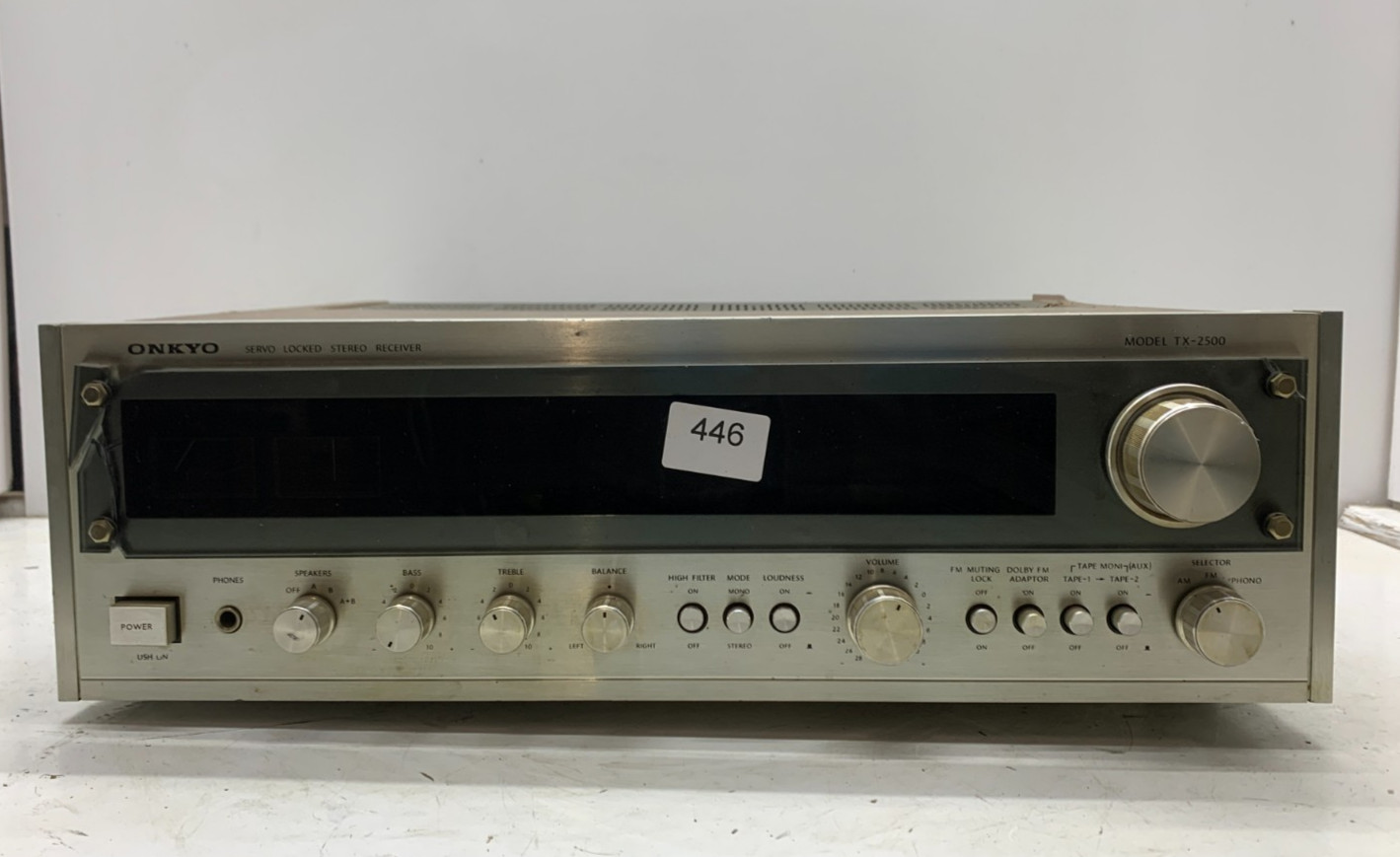
Onkyo TX-2500 (1975)
Onkyo TX-2500: The Powerhouse of 1970s Hi-Fi
In the mid-1970s, the world of high-fidelity audio was undergoing a transformation. Solid-state amplification had matured, and manufacturers were pushing the limits of power, clarity, and design. Among the Japanese brands leading this charge was Onkyo, a company with a reputation for building rugged, performance-oriented components. The Onkyo TX-2500, introduced in 1976, stands as a bold statement from that era—a high-powered, all-discrete stereo receiver that combined serious engineering with the bold aesthetics of its time.
Though not as widely documented as some of its contemporaries, the TX-2500 occupies a special place among vintage audio enthusiasts who appreciate its muscular output, clean signal path, and no-nonsense build quality. It represents a transitional moment when receivers began to offer not just AM/FM tuning and basic preamplification, but genuine high-fidelity performance capable of driving demanding speaker loads with authority.
Technical Specifications
The Onkyo TX-2500 was engineered to compete with the upper echelon of receivers during the golden age of analog audio. It featured a fully discrete amplifier section—meaning no integrated circuits in the output stage—giving it a level of transparency and control that many later IC-based designs struggled to match.
| Model | TX-2500 (and later MK II variant) |
| Years Produced | 1976-1977 (Original), ~1978-1980 (MK II) |
| Manufacturer | Onkyo Corporation, Japan |
| Category | Stereo Receiver |
| Power Output | 27 watts per channel into 8Ω (stereo) |
| Total Harmonic Distortion | 0.5% |
| Frequency Response | 20Hz to 30kHz |
| Input Sensitivity | 2.5mV (MM), 150mV (Line) |
| Signal-to-Noise Ratio | 80dB (MM), 90dB (Line) |
| Speaker Impedance | 8Ω minimum |
| Tuner Bands | AM, FM |
| Tuner Sensitivity | FM: 1.8µV for 26dB SNR; AM: 30µV for 20dB SNR |
| Inputs | 3 Line-level, 1 Phono (MM) |
| Outputs | Preamp Out, Tape Out, Speaker A/B |
| Dimensions | 435mm (W) × 148mm (H) × 340mm (D) |
| Weight | 14.5 kg (32 lbs) |
| Power Supply | Linear transformer, dual power supply rails |
| Construction | All-discrete, Class AB amplifier |
The TX-2500’s robust power supply, featuring a large toroidal-style transformer (for the era) and substantial filter capacitors, contributed to its ability to deliver stable, dynamic power even under difficult load conditions. Its dual speaker outputs (A/B) allowed users to switch between two sets of speakers or bi-amp compatible systems—a rare and useful feature at the time. The real party trick, though, was the tech hiding behind that conservative faceplate: a PLL MPX decoder, a servo-locking tuner, and the fantastic "Accutouch" tuning knob that made finding a station feel like a precision operation.
Sound Characteristics and Performance
The sonic signature of the Onkyo TX-2500 is best described as authoritative, dynamic, and balanced. Unlike some of the more hyped or colored receivers of the 1970s, the TX-2500 aimed for a neutral presentation with strong bass control and a clean midrange. Its discrete output stage delivers excellent transient response, making it well-suited for both rock and classical music. Don't let the 27-watt rating fool you—this thing punches above its weight class, with plenty of detail and a touch of warmth that makes long listening sessions a joy. Is it an audiophile piece? Maybe not in the snobbiest circles, but it's an absolute killer value in its category.
The FM tuner is a highlight, thanks to that servo-lock mechanism. It offers smooth, stable tracking, good stereo separation, and a quiet noise floor—especially when paired with a decent outdoor antenna. The AM band is surprisingly listenable, with decent selectivity and minimal interference. One of the TX-2500’s strengths is its phono stage. Designed for moving magnet (MM) cartridges, it provides ample gain with low noise and a well-implemented RIAA equalization curve. When paired with a quality turntable like a Technics SL-1200 or a Dual 1219, the TX-2500 reveals a warm yet detailed analog character that many modern receivers fail to match.
Notable Features and Innovations
While the TX-2500 may appear conservative compared to flashier receivers with graphic equalizers or digital tuning, its design philosophy was one of substance over spectacle. The all-discrete amplifier design avoids op-amps in the signal path, using individual transistors throughout for a more natural and dynamic sound. The dual speaker outputs were a flexible luxury in a receiver of this class. Build quality is a real selling point—you get a thick steel chassis, a solid faceplate, and high-quality potentiometers that still feel good after decades. The front panel layout is a model of sensible design: large, tactile knobs for volume, tuning, and input selection flank a classic analog VU meter display. It’s not the flashiest light show on the block, but when those warm bulbs glow in a dark room, it just looks right.
Common Issues and Maintenance
Like any 45-year-old electronic device, the Onkyo TX-2500 requires some care to perform at its best. The usual suspects apply here. Electrolytic capacitors in the power supply and signal path are the first to go, potentially leading to hum, reduced power, or channel imbalance. A full recapping is a fantastic investment for long-term reliability and peace of mind. The excellent FM section may drift out of alignment over the decades, so a tune-up by a tech can restore that perfect sensitivity and stereo separation. Dirty controls are a given; a careful application of contact cleaner to the pots and switches will silence the crackles and pops. Despite these age-related concerns, the TX-2500 is generally a tank. Its discrete design makes repairs more straightforward than modern IC-laden units, and replacement parts for transistors and passive components are still available.
Current Market Value and Collectibility
The Onkyo TX-2500 is not as widely collected as some of its more famous siblings (like the TX-8500 or later digital models), but it has a growing following among purists who value its raw power and analog purity. You can still find steals on these—I heard of one guy who scored one at a Goodwill for ten bucks! More typically, units in excellent cosmetic and working condition sell for $250–$400, depending on region and included accessories. Fully restored examples—especially those with recapped power supplies and aligned tuners—can command higher prices. While not a "blue chip" vintage receiver like a Marantz 2270 or Sansui 9090, the TX-2500 offers exceptional value for money and real performance potential. It’s the receiver you buy to actually use, not just to display on a shelf.
eBay Listings



As an eBay Partner, we earn from qualifying purchases. This helps support our independent vintage technology research.
Service Manuals & Schematics
- Service Manual — archive.org
Related Models
- Onkyo TX-1500MKII (1975)
- Onkyo TX-4500II (1975)
- Onkyo A-70 (1977)
- Onkyo INTEGRA-A-815 (1978)
- Onkyo TX-2500II (1975)
- Pioneer QX-949A (1978)
- Pioneer SX-2000 (1978)
- Pioneer SX-2500 (1978)
- Marantz SR-2000 (1999–2001)
- Pioneer QX-646 (1978)