Onkyo TA-2090 (1984–1987)
A no-compromise cassette deck that punched way above its weight—quietly rewrote the rules, then let the tapes do the talking.
Overview
The Onkyo TA-2090 isn’t the kind of deck that screams for attention. No flashy chrome, no towering VU meters—just a clean black faceplate and a confidence that comes from knowing exactly what it can do. Built between 1984 and 1987, it was Onkyo’s top-of-the-line cassette deck, a full-blooded member of their Integra Series, and a serious contender in the high-end analog tape game. This wasn’t some budget recorder slapped with a premium badge; it was a statement piece, engineered to deliver near-reference performance without demanding a Nakamichi-sized fortune.
And that’s exactly why people still whisper about it. The TA-2090 earned the nickname “The Dragon Slayer” in enthusiast circles—not because it roared, but because it delivered a performance that flirted with the legendary Nakamichi Dragon, at roughly half the original price. That kind of value proposition, wrapped in a no-nonsense Japanese chassis built in Japan, made it a quiet favorite among those who cared more about results than reputation. It was also part of Onkyo’s MC-6000 system, meaning it was designed to integrate seamlessly into a high-end setup, not just stand alone.
Owners report it as one of the high-end cassette decks of its era, and the lab tests back that up: excellent wow-and-flutter, very good signal-to-noise ratio, and frequency response that stays impressively flat across tape types. Whether you were laying down a mix, archiving vinyl, or just making a killer mixtape, the TA-2090 treated the source with such fidelity that the difference between playback and tape was “so slight… for all intents and purposes inconsequential.” That’s not marketing speak—that’s a quote from a 1980s lab review, and it still holds weight.
Specifications
| Manufacturer | Onkyo |
| Model | TA-2090 |
| Type | Cassette Deck |
| Production Years | 1984–1987 |
| Head Configuration | 3-head |
| Drive System | Dual-capstan |
| Motor System | Three d.c. motors in closed-loop, solenoid operated |
| Heads | Sendust (separate record and playback) |
| Noise Reduction | dbx, Dolby B, Dolby C |
| Features | Automatic bias adjustment, Dolby HX-Pro, Accubias, REC CAL, real time tape counter, multiple mode display, auto music control system |
| Display | Two sixteen-segment-per-channel peak-indicating displays (-30 to +8 VU), front-panel status indicators |
| Controls | Long-throw master record-level slider, channel-balancing knobs, separate output level control |
| Tape Sensing | Sensors in illuminated cassette well select bias and equalization |
| Frequency Response | Within +1, -2.5 dB from 25 to 20,000 Hz (metal/chrome); ferric has 3-dB peak at ~17,000 Hz |
| Wow and Flutter | Excellent |
| Signal-to-Noise Ratio | Very good |
| Dolby Tracking Error | Low |
| Fast-Forward/Rewind | Excellent |
| Power Consumption | 47 Watt |
| Dimensions | 17-3/4" W × 4-1/4" H × 14-3/4" D (450 × 100 × 392 mm) |
| Weight | Slightly under 20 pounds |
| Color | Black |
| Manufactured in | Japan |
| Optional Accessory | Cable remote control RC-5T |
Key Features
The Three-Motor, Dual-Capstan Transport
At the heart of the TA-2090’s performance is its transport—a Sankyo-built, closed-loop, dual-capstan system driven by three dedicated d.c. motors. One motor is directly coupled to the main capstan for rock-solid speed stability, another powers the reel hubs, and the third handles mechanical operations like head positioning and brake control. This isn’t overkill; it’s precision. The result? Lab tests confirmed excellent wow-and-flutter and fast, quiet tape handling. It’s the kind of engineering that makes you forget you’re listening to cassette tape—until you realize how much detail is coming through.
Dolby HX-Pro and Accubias: The Smart Brains Behind the Bias
The TA-2090 doesn’t just record—it thinks. Its Dolby HX-Pro circuit monitors the audio signal in real time and reduces the bias current when high-frequency content in the music provides its own self-biasing effect. This preserves headroom and improves transient response, especially on metal and chrome tapes. Then there’s Accubias, Onkyo’s system for fine-tuning the recording bias for optimal performance. Paired with REC CAL, which lets you adjust for tape sensitivity, these features give the user serious control over the recording chain—rare in a production deck, and a big reason why users report it can “approach CD S/N and dynamic range values” when set up correctly.
Automatic Everything, But Still in Control
Despite its automation, the TA-2090 never feels like it’s running the show. Sensors in the illuminated cassette well detect tape type and automatically set bias and equalization—no manual switches to flip. But if you want to tweak, you can. The front panel is packed with status indicators, so you always know what mode you’re in. The long-throw record-level slider gives precise control, backed up by individual channel balance knobs and a separate output level control. It’s a rare balance: convenience without surrendering authority.
Historical Context
The TA-2090 arrived in 1984, right when cassette technology was hitting its analog apex. Digital formats like CD were emerging, but serious audiophiles still saw tape as a viable, even superior, medium for portability and recording. Onkyo positioned the TA-2090 as a TOTL (Top Of The Line) deck in their Integra Series, and it was designed as part of the larger MC-6000 system, suggesting it was meant for integration into a full high-end setup. Its international designation was TA-2090, though it was sold as the TA-2900 in Germany—same hardware, just a regional name change.
Its reputation as “The Dragon Slayer” wasn’t earned by accident. At a time when the Nakamichi Dragon commanded a premium price for its three-motor, auto-azimuth wizardry, the TA-2090 delivered a performance that came remarkably close, especially when using Dolby C or dbx. One reviewer noted that with dbx, the deck could produce “superb dubs of digitally recorded material”—no small feat in the mid-80s. It wasn’t trying to beat Nakamichi at its own game; it was offering 90% of the performance at half the cost, which made it a compelling alternative for engineers, broadcasters, and serious hobbyists alike.
Collectibility & Value
Today, the TA-2090 is a sought-after deck among cassette enthusiasts, not because it’s rare, but because it’s genuinely good. A listing in Denmark’s Den Blå Avis in January 2026 showed one priced at DKK 6,000—equivalent to roughly $850 USD—which suggests strong demand among those who know what they’re getting. But be warned: like any 40-year-old mechanical beast, it needs care.
Belt failure is common—expected, really—and a complete repair kit typically includes two belts, a deflection roller, and two additional rollers. More concerning are reports of “a MAJOR problem with the record feature,” possibly tied to the Accubias circuitry on one of the internal boards. These aren’t trivial fixes, but the good news is that the service manual is available at hifiengine.com, and specialists like ESLabs, The Audio Lab, and Soundsmith are known to work on these decks.
If you’re hunting for one, prioritize units that have already been serviced. A clean, fully adjusted TA-2090 with fresh belts and verified recording function is a dream machine. Unrestored units are a project—potentially rewarding, but not plug-and-play. And while the controls are functional, some users have noted they’re “somewhat small and occasionally hard to see” against the black panel, a minor ergonomic quibble in an otherwise excellent design.
eBay Listings

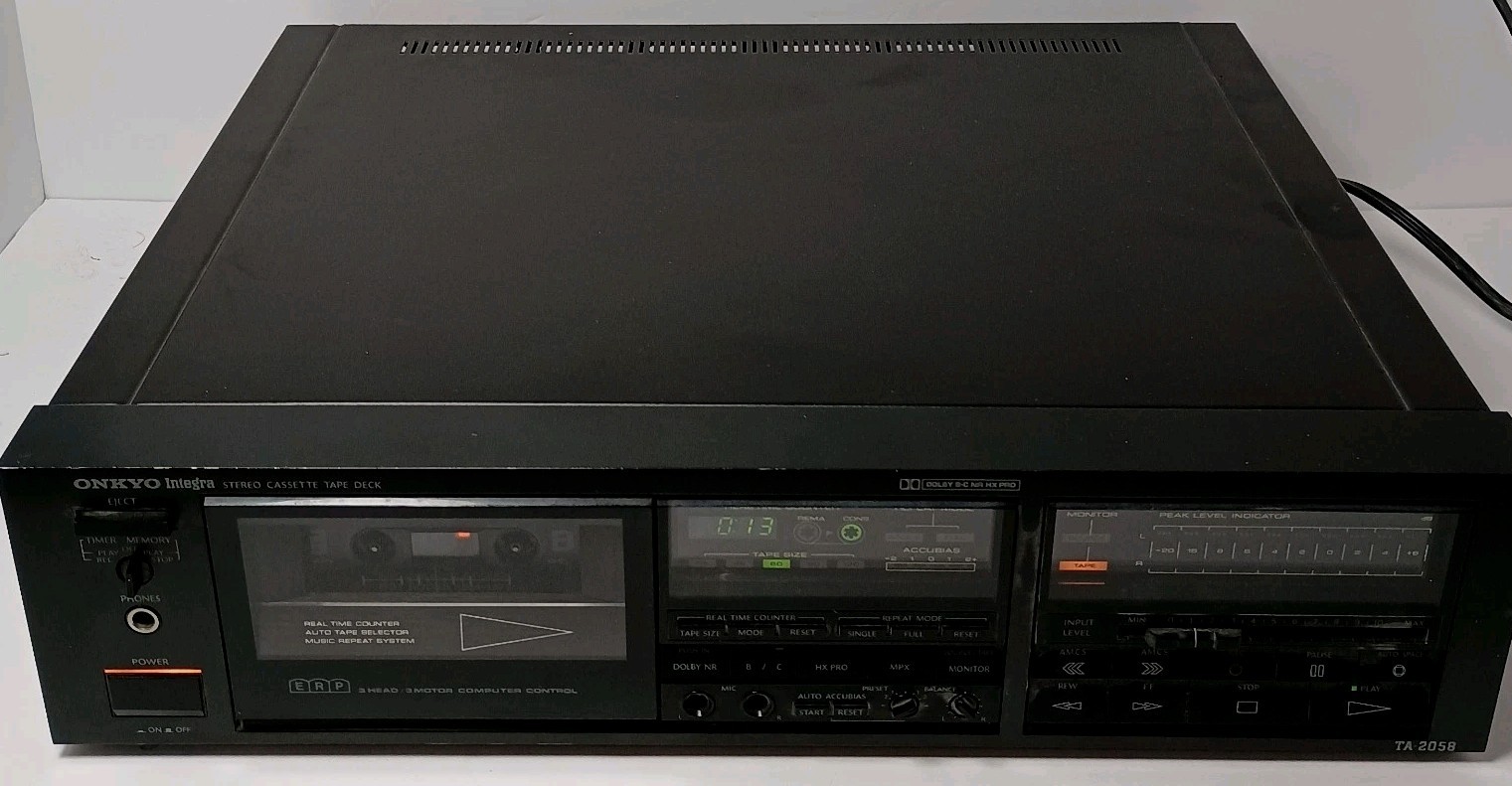


As an eBay Partner, we earn from qualifying purchases. This helps support our independent vintage technology research.
Related Models
- Onkyo SC-1500 (1978)
- Onkyo TA-2047 (1976)
- Onkyo TA-2500 (1973)
- Onkyo A-812XG (1980)
- Onkyo TX-6500 (1977)
- Luxman L-530 (1975)
- Luxman R-404 (1975)
- Luxman RV-371 (1975)
- Luxman SQ-38U (1975)
- Luxman T-14 (1972)