Onkyo TA-2060 (1982–1984)
A no-nonsense, three-head cassette deck that nails the fundamentals—direct drive, bias control, and Dolby HX Pro—without the fuss.
Overview
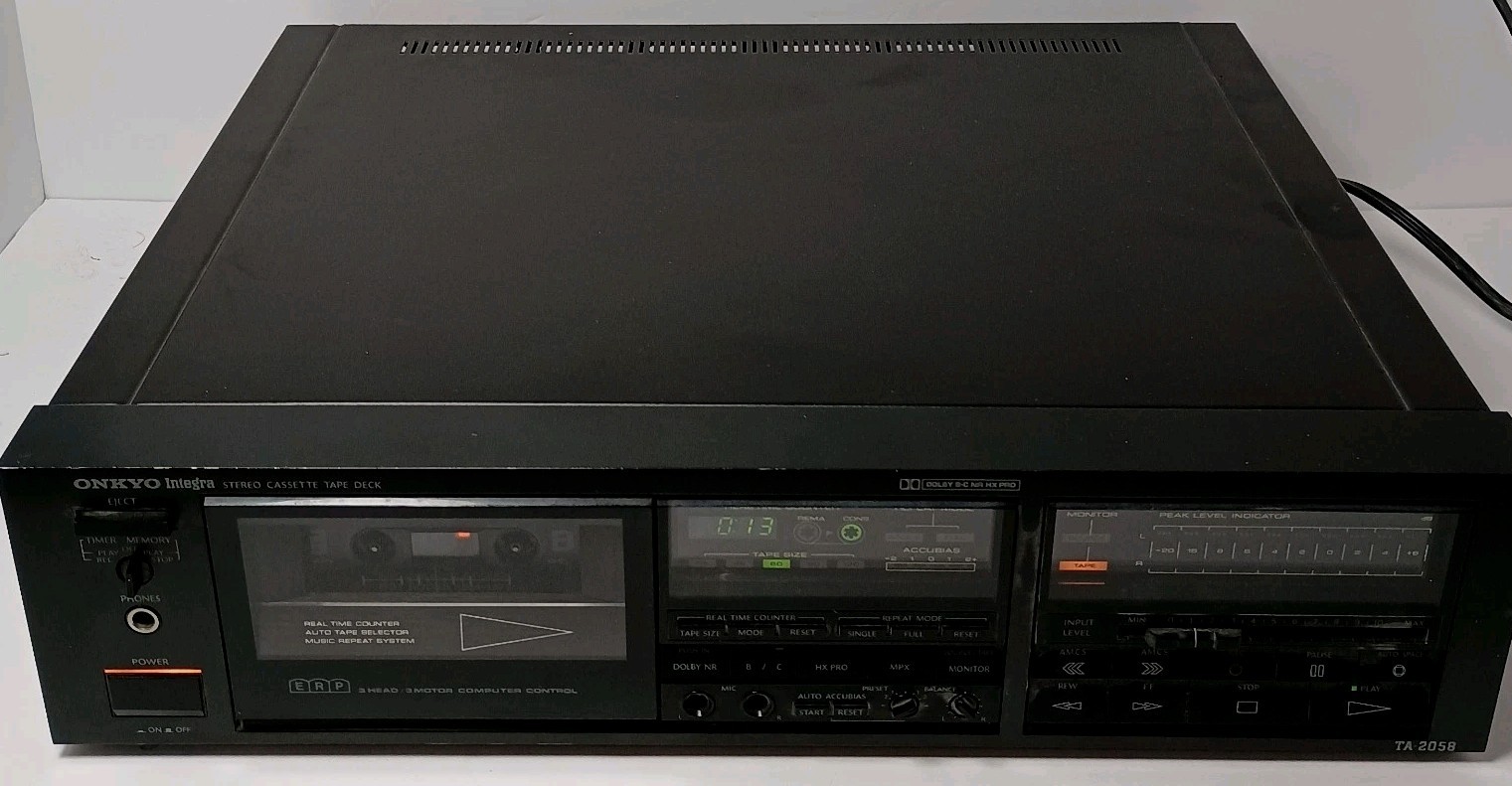
You know that feeling when you drop the needle on a well-maintained cassette deck and the tape glides through the heads like it’s floating? The Onkyo TA-2060 doesn’t dazzle with chrome trim or piano-key buttons, but it delivers something better: confidence. From the moment you press play, it feels like a machine built by people who actually listened to tapes, not just spec sheets. Released in 1982 and built in Japan, the TA-2060 arrived when cassette decks were hitting their technical peak—balancing affordability with high-end features that used to cost twice as much. This wasn’t Onkyo’s flagship, but it punched way above its weight, offering a full suite of pro-level tools in a clean, silver-fronted chassis that blends into any rack without screaming for attention.
Positioned just below the more ornate TX-8555, the TA-2060 was Onkyo’s sweet spot for serious tapers who wanted real performance without boutique pricing. It’s not flashy, but it’s packed with substance: three discrete heads (record, playback, erase), a direct-drive capstan motor, and full manual bias and level calibration for Type II and Type IV tapes. That last bit matters—this isn’t a deck that just slaps on Dolby B and calls it a day. It understands that metal tapes have different magnetic personalities, and it lets you tweak the recording process accordingly. And yes, it includes Dolby HX Pro, a feature still rare in mid-tier decks at the time, which dynamically adjusts headroom during recording to prevent high-frequency saturation. That means cleaner, more open highs on everything from cymbals to vocal sibilance.
The deck’s design philosophy is “engineer first.” No auto-reverse gimmicks, no dual-speed dubbing, no tape type guessing games. You tell it what tape you’re using, you set the bias if you want, and it executes with precision. The transport is built around a Sankyo mechanism—known for durability—and the direct-drive motor eliminates the rubber belt stretch that plagues so many contemporaries. It’s the kind of deck that, when properly serviced, will run for decades. And while it lacks the analog VU meters of some rivals, its crisp LED level indicators and sturdy, detented buttons make operation intuitive and satisfying.
Specifications
| Manufacturer | Onkyo |
| Production Years | 1982–1984 |
| Original Price | Approx. 1,050 DM (West Germany) |
| Type | Stereo Cassette Tape Deck |
| Heads | 3 (Record, Playback, Erase) |
| Motor Type | Direct Drive (Capstan), DC Motor (Supply and Take-up) |
| Tape Speed | 4.76 cm/s (1⅞ ips) |
| Wow and Flutter | 0.04% (Dolby off) |
| Frequency Response | 20 Hz – 21,000 Hz (Metal tape, Dolby off) |
| Signal-to-Noise Ratio | 69 dB (Dolby C), 56 dB (Dolby B) |
| Dynamic Range | 65 dB (Dolby C) |
| Dolby Noise Reduction | B, C, HX Pro |
| Tape Compatibility | Type I (Ferric), Type II (Chrome), Type IV (Metal) |
| Bias Control | Adjustable for Type II and Type IV |
| Record Level Control | Adjustable (Manual calibration) |
| Inputs | Line In (RCA, unbalanced) |
| Outputs | Line Out (RCA, unbalanced), Headphones (6.3mm) |
| Dimensions (W×H×D) | 418 × 120 × 330 mm |
| Weight | 6.5 kg |
| Power | AC 220 V |
| Country of Origin | Japan |
| Finish | Silver front panel, black side panels |
Key Features
Three-Head Design with Manual Calibration
The TA-2060’s three-head configuration is its backbone. Unlike single-head decks that have to switch modes, or two-head designs that compromise on erase efficiency, this deck keeps each function separate. The result? Cleaner recordings, minimal crosstalk, and the ability to monitor your recording in real time through the playback head. But the real magic is in the manual controls. Most decks in this class offered fixed bias settings, but the TA-2060 lets you fine-tune bias for chrome and metal tapes—critical for maximizing high-frequency response and minimizing distortion. Combined with adjustable record level calibration (via internal trim pots), this turns the TA-2060 into a semi-professional tool. You can tailor it to your favorite tape brand, whether you’re running TDK SA-X or Maxell UR-XL. It’s not fully automated, but that’s the point: it rewards knowledge and involvement.
Direct Drive Capstan for Precision Speed Control
While many mid-tier decks still relied on rubber belts to drive the capstan, the TA-2060 went direct. That means no belt slippage, no speed drift over time, and no need to worry about dried-out rubber down the road. The motor is a DC type, known for smooth torque and low wow and flutter—measured here at an excellent 0.04%. This is the kind of spec that separates good decks from great ones, especially when recording acoustic music or vocals where timing nuances matter. The take-up and supply reels are belt-driven, but those are lower-stress functions, and replacement belts are still widely available. The direct-drive system also contributes to the deck’s solid, almost industrial feel—there’s no wobble, no hesitation, just a smooth, confident tape motion.
Dolby HX Pro: The Hidden Weapon
Dolby HX Pro (Headroom Extension) wasn’t just marketing fluff—it was a clever analog trick that dynamically reduced bias during high-frequency passages, giving tapes more headroom and preventing pre-emptive saturation. Most budget and mid-range decks skipped it, reserving it for flagship models. But Onkyo included it here, and it makes a real difference. When recording metal tapes, which are already high-output, HX Pro keeps the highs clean and open, avoiding that “crunchy” distortion that plagues overdriven tapes. It works automatically, so you don’t have to think about it—just flip the switch and let it do its thing. Combined with Dolby B and C noise reduction, the TA-2060 gives you a complete toolkit for making tapes that rival pre-recorded commercial cassettes in fidelity.
Historical Context
The early 1980s were a turning point for cassette technology. No longer just a medium for car stereos and mixtapes, cassettes were now being taken seriously as a high-fidelity format—thanks to metal tapes, better noise reduction, and decks like the TA-2060 that could exploit their potential. Onkyo entered this arena with a clear strategy: offer near-flagship performance at a realistic price. The TA-2060 competed directly with decks like the Technics RS-B15, the Sony TC-K655, and the Pioneer RT-707—all solid machines, but few matched the Onkyo’s combination of manual calibration and HX Pro at this price point.
At the same time, the market was shifting. Auto-reverse decks were gaining popularity, and some manufacturers were cutting corners to hit lower price points. Onkyo didn’t play that game. The TA-2060 was built for people who cared about tape quality, not convenience features. It arrived just before the CD boom, making it one of the last great analog tape decks before digital began to dominate. In Japan, where it was made, it was part of a wave of high-value, high-performance electronics that cemented the country’s reputation for engineering excellence. While not as flashy as some Nakamichi or Revox models, the TA-2060 represented the democratization of high-end cassette performance.
Collectibility & Value
The TA-2060 isn’t a blue-chip collector’s item like a Nakamichi Dragon, but it’s quietly respected among cassette enthusiasts and vintage audio restorers. Its value lies in its reliability, serviceability, and real-world performance. Units in working condition typically sell for $120–$200, depending on region and condition. Fully restored decks—with new belts, cleaned heads, recalibrated bias, and fresh tape path rollers—can fetch $250 or more, especially if sold with original documentation or packaging.
Common failures are predictable and manageable. The rubber belts on the supply and take-up reels will degrade after 30+ years, so replacement is almost always necessary on untested units. The capstan motor doesn’t have a belt, but the idler tires and pinch roller can harden and lose grip, requiring replacement. The tape heads, being metal and well-shielded, usually survive if the deck was stored reasonably, but they should be demagnetized and cleaned before use. Service technicians observe that the internal electronics are robust, with minimal capacitor leakage issues compared to other brands of the era.
When buying, check that the tape counter works, that the transport engages smoothly, and that the record safety tab detection functions (to prevent accidental erasure). Avoid units with seized motors or visible corrosion on the heads. A working TA-2060 is a joy; a neglected one is a project, but not a hopeless one. Parts and schematics are still available, and the Sankyo mechanism is well-documented in repair circles.
eBay Listings


As an eBay Partner, we earn from qualifying purchases. This helps support our independent vintage technology research.
Related Models
- Onkyo T-4090 (1975)
- Onkyo T-4050 (1975)
- Onkyo CP-1057F (1975)
- Onkyo T-4060 (1975)
- Onkyo T-4070 (1975)
- Aiwa CS-250 (1978)
- Denon TU-1500RD (1995)
- Denon TU-280 (1976)
- Denon TU-501 (1977)
- Denon TU-550 (1978)