Nakamichi ZX-5 (1984–1987)
It doesn’t have the Dragon’s throne, but it brought true three-head performance to a price within reach—just don’t expect the same royal treatment.
Overview
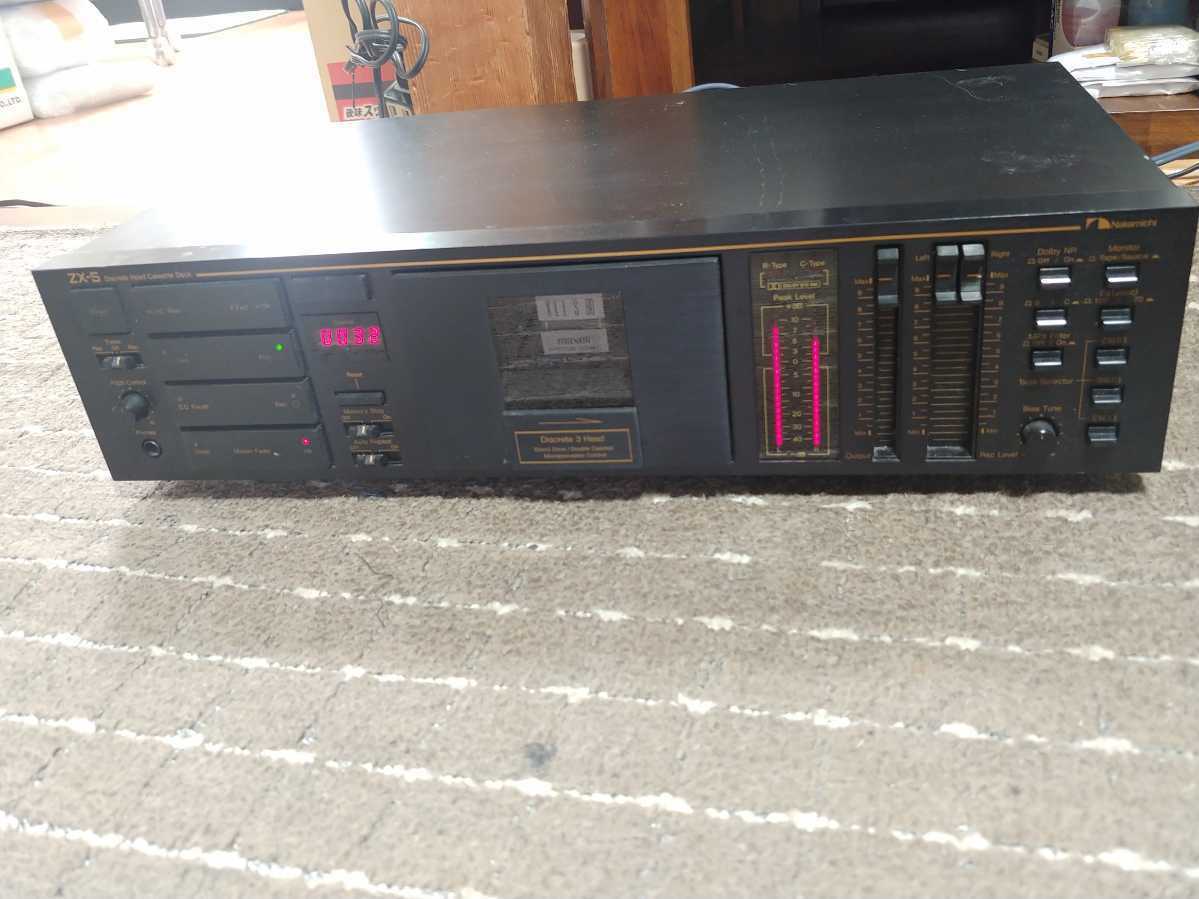
If you're hunting for a Nakamichi cassette deck and your budget isn’t six figures, the ZX-5 might just be your sweet spot. Introduced in 1984 and produced through 1987, this black, 5.6 kg workhorse was Nakamichi’s most affordable model with a pure three-head mechanism—meaning separate record, playback, and erase heads for maximum fidelity and minimal crosstalk. At 128,000 yen in Japan, it was a serious investment, but a fraction of the cost of the flagship ZX-7 or ZX-9. It wasn’t trying to be a Dragon, but it was built to deliver the core Nakamichi advantage: precision engineering, discrete heads, and a transport that could push metal tapes to their limits.
Owners report it handles normal tape with ease, calmly recording up to 20 kHz, and its frequency response spans the full 20–20,000 Hz range (±3 dB). But make no mistake—this is an entry-level machine in Nakamichi’s three-head lineup, and it shows. Reviewers noted the build quality feels a step down from its siblings, with a lighter body, more plastic parts, and a volume knob and button operation that give off a “slightly cheap feeling.” Still, for those who prioritize performance over prestige, the ZX-5 delivers. It’s compact, made in Japan, and packed with high-end features like independent bias and recording level adjustments for left and right channels, a peak level meter calibrated to Dolby level, and a discrete Crystalloy head system—just not the legendary P-8L found in the top models, but the P2H-3L instead.
It’s also a machine that demands care. Being based on a Sankyo-sourced mechanism—centrally mounted in what enthusiasts call “center mecha” layout—means it shares some of the quirks and failure points common to that design. But for those willing to service it, the ZX-5 remains a capable, no-nonsense deck that can still outperform most modern digital playback when properly aligned.
Specifications
| Manufacturer | Nakamichi |
| Model | ZX-5 |
| Type | Cassette Tape Deck |
| Years of manufacture | 1984 - 1987 |
| Original price | 128,000 Yen (Japan, 1984) |
| Dimensions | 430 x 110 x 250 mm (WxHxD) |
| Weight | 5.6 kg |
| Wow & flutter | 0.024% (WRMS) |
| Frequency response | 20-20,000 Hz (±3 dB) |
| Distortion factor | < 1% |
| Signal-to-noise ratio | >64/70 dB with Dolby B/C |
| Head type | 3-head system, discrete type, Crystalloy head |
| Mechanism drive | Logic control, cam motor drive |
| Capstan rotation | Direct drive motor (with pitch control) |
| Tape transport | Closed-loop dual capstan |
| Cassette holder opening/closing | Manual (with slack take-up function) |
| Tape selector | Manual (playback EQ switching is a separate switch) |
| Noise reduction | Dolby B, Dolby C |
| Dolby HX-Pro | None |
| MPX filter | yes, switchable |
| Music search function | None |
| Auto Reverse | no |
| Meters | Peak level meter (0dB = Dolby level) |
| Calibration function | None (bias adjustment possible) |
| Bias frequency | 105 kHz |
| Other functions | Auto fade function, auto repeat function, memory stop function |
| Line input | RCA terminals, 1 system |
| Line output | RCA terminals, 1 system (variable, linked to OUTPUT volume) |
| Counter | 4-digit counter |
| Power consumption | 23 W |
| Made in | Japan |
| Color | Black |
| Remote control | no |
| CD synchro recording | no |
Key Features
Discrete Three-Head System with Precision Alignment
The ZX-5’s standout feature is its discrete three-head system—separate heads for record, playback, and erase—mounted in a fixed, non-moving assembly. This design eliminates the compromise of single-head systems that switch functions, allowing for perfect magnetic azimuth alignment on each head. The playback head uses a Crystalloy core (model P2H-3L), a high-permeability alloy optimized for wide frequency response and low noise, though it’s not the same P-8L head found in higher-end Nakamichi decks. The result is a clean, open sound with excellent stereo separation and minimal print-through.
Asymmetrical Dual Capstan Transport
Nakamichi’s “Asymmetrical Dual Capstan Diffused” system—essentially a closed-loop dual capstan with direct drive—ensures rock-solid tape speed and minimal flutter (just 0.024% WRMS). The capstan motor is directly driven, with pitch control allowing for ±6% speed adjustment, useful for tuning playback to match source material or syncing with turntables. The dual capstan design grips the tape on both sides of the head, reducing slippage and ensuring consistent tape-to-head contact, which is critical for high-frequency response and low modulation noise.
Independent Bias and Level Calibration
One of the ZX-5’s most valuable features for serious users is the ability to adjust bias and recording level independently for left and right channels. This level of fine-tuning is rare at this price point and allows for optimal performance with different tape formulations. While the deck lacks a full calibration mode, bias adjustment is possible via internal trim pots, making it a favorite among tinkerers who want to squeeze every last bit of performance from their metal or high-bias tapes.
Analog Signal Path with High-Grade Components
Inside, the ZX-5 uses J-FET input op-amps (NJM072 series) in the playback amplifier, known for low noise and high input impedance, preserving signal integrity. The power supply relies on a modest number of large smoothing electrolytic capacitors, and audio-grade parts like Nichicon 'MUSE' capacitors are used in critical signal paths. Noise reduction is handled by the TEA0652 IC, which integrates both Dolby B and Dolby C decoding into a single chip—efficient, if not as discrete as some purists might prefer.
Rear Tape Control and Mechanical Design
The deck features rear tape control (back-tension mechanism) via a rubber belt and cross-shaped spring, which helps maintain consistent tape tension and reduce wow. Reel rotation is driven by rubber idlers, a common wear point in vintage decks. The entire mechanism is centrally mounted (“center mecha”), which improves balance and reduces vibration, but also means the deck inherits the Sankyo mechanism’s known failure modes—especially in the cam detection switch and reel motors.
Historical Context
The ZX-5 was Nakamichi’s entry-level three-head machine, positioned below the high-end ZX-7 and ZX-9 in the ZX series lineup. It was the most affordable way to get a true discrete three-head system from Nakamichi until the CR series arrived. As a descendant of the ZX series, it carried forward the brand’s commitment to high-fidelity tape reproduction, but in a more compact and cost-conscious package. It was marketed as a “compact Nakamichi cassette deck” with specs that were “more than sufficient for a high-end machine,” even if the build quality didn’t quite match the flagship models.
Collectibility & Value
The ZX-5 has a quiet cult following. One user put it plainly: “I think the rarity of it being an actual zx5 is pretty cool. Ya anyone can get a BX300.” While not as legendary as the Dragon, it’s increasingly recognized as a capable, serviceable deck that offers real Nakamichi performance at a fraction of the price. However, condition is everything. The Sankyo mechanism brings known failure points: the cam detection switch contacts can blacken and lose conductivity, the idler tires harden and crack, the back-tension spring can warp, and reel motors can develop dead spots from worn commutators.
Maintenance is doable but not trivial. The cam switch can be cleaned with electronic cleaner and a swab. A warped back-tension spring can be carefully straightened with pliers. A slipping worm gear can sometimes be fixed with alcohol cleaning and a touch of blue Loctite. But reel motor issues are tougher—repair options are limited to replacement or refurbishment, as the “solder fix” trick doesn’t apply here. Routine servicing involves replacing all rubber parts, cleaning, and lubrication, followed by azimuth, output level, and speed calibration.
Market data is sparse, but one ZX-5 appeared on eBay priced at $546.03—listed “for parts or not working.” Another listing noted that four units had already sold, suggesting steady demand. Given the lack of completed sale data, actual value depends heavily on condition and service history. As one user wisely advised: “be more concerned about its condition and service history than about the merits or demerits of some Platonic Ideal of a particular model vs some other model.”
eBay Listings


As an eBay Partner, we earn from qualifying purchases. This helps support our independent vintage technology research.
Related Models
- Nakamichi 1000ZXL (1985)
- Nakamichi BX-150 (1983)
- Nakamichi CR-4 (1969)
- Nakamichi 1000-II (1974)
- Nakamichi 1000ZXL-LIMITED (1985)
- Sony TC-2050SD (1978)
- Aiwa AD-F990 (1993)
- Kenwood KX-3060 (1982)
- Sony TC-2130A (1974)
- Sony TC-2220 (1972)