Nakamichi CR-7 (1986–1993)
The last true high-end cassette deck that treated every tape like a master
Overview
You press play, and the Nakamichi CR-7 doesn’t just start—it declares. The dual capstans engage with a deep, mechanical thud, the tape glides forward with unnerving precision, and the digital display flicks to life showing elapsed time like a stopwatch at a world record attempt. This isn’t some background appliance; it’s a statement. The CR-7, introduced in 1986 and built through 1993, arrived when cassette decks were supposed to be fading into obsolescence, replaced by CDs and DAT. Instead, Nakamichi doubled down—delivering a machine so technically advanced, so sonically uncompromising, that it became the final apex of analog tape performance.
Positioned just below the legendary Dragon in the Nakamichi hierarchy, the CR-7 wasn’t a downgrade so much as a refinement—an evolution toward usability without sacrificing the core values of the brand. Where the Dragon was a flagship engineered to dominate measurements, the CR-7 aimed to deliver that same performance in a more accessible, serviceable, and user-friendly package. It succeeded. With its discrete three-head design, direct-drive dual capstan transport, and Auto Calibration system, the CR-7 offered studio-grade fidelity in a home audio component. It could record and play back any cassette—normal, chrome, or metal—with near-perfect alignment, bias, and azimuth, all adjustable on the fly or automatically set at the push of a button.
And yet, it wasn’t perfect. It carried the weight of its era—complex electronics, aging rubber parts, and a price tag that hovered near $1,850 at launch, putting it out of reach for most. But for those who bought in, the CR-7 wasn’t just a deck. It was a commitment to the idea that analog tape still had something to say—and that Nakamichi was the only brand saying it right.
Specifications
| Manufacturer | Nakamichi |
| Production Years | 1986–1993 |
| Original Price | $1,850 (USD) |
| Format | Compact Cassette |
| Track Configuration | 4-Track, 2-Channel Stereo |
| Heads | 3 Discrete Heads (Record, Playback, Erase) |
| Head Material | Ferrite |
| Motor System | Direct Drive Dual Capstan with Closed-Loop Control |
| Tape Speed | 4.76 cm/s (1⅞ ips) |
| Wow and Flutter | 0.027% WRMS |
| Frequency Response | 20–20,000 Hz (-2 dB, with CrO₂ tape) |
| Signal-to-Noise Ratio | 66 dB (Dolby C), 72 dB (Dolby B) |
| Total Harmonic Distortion | 0.05% at 1 kHz |
| Dolby Noise Reduction | B, C, and Off |
| Tape Type Selection | Manual or Auto (Normal, CrO₂, Metal) |
| Equalization | 120 μs (CrO₂/Metal), 70 μs (optional for Metal), 180 μs (Normal) |
| Inputs | Line In (RCA), Mic In (¼") |
| Outputs | Line Out (RCA), Headphones (¼") |
| Counter | 4-Digit Real-Time Elapsed/Remaining Time |
| Remote Control | RM-7C (Infrared, Wireless) |
| Dimensions | 435 × 135 × 306 mm (W×H×D) |
| Weight | 9.0 kg (19.8 lbs) |
| Power Consumption | 55 W |
| Special Features | Auto Calibration, Manual Playback Azimuth, Memory Stop, Timer Record/Playback, Dual-Speed Master Fader, Subsonic Filter |
Key Features
Discrete Three-Head Design and Dual Capstan Transport
Most cassette decks of the era used a single head for both record and playback, flipping functions electronically. The CR-7 refused to compromise. It used three physically separate heads—record, playback, and erase—each optimized for its specific task. This meant no compromise in gap width, alignment, or frequency response. The playback head could be finely adjusted for azimuth while listening, a feature audiophiles still swear by for extracting every last bit of stereo imaging from a tape.
Backing that up was the asymmetrical dual-capstan transport, a Nakamichi hallmark. Unlike pinch-roller systems that could slip or deform the tape, the CR-7 used two motor-driven capstans—one on each side of the head gap—to pull the tape through with near-laser precision. This wasn’t just about wow and flutter specs (though at 0.027% WRMS, it crushed the competition); it ensured consistent tape-to-head contact across the entire width, reducing distortion and improving high-frequency response. The result? A sound that didn’t just mimic the source—it became it.
Auto Calibration and Real-Time Intelligence
The CR-7’s Auto Calibration system was nothing short of revolutionary. At the press of a button, it would analyze a blank section of tape and automatically set record level, bias, and azimuth for optimal performance with the specific cassette inserted. This wasn’t a one-size-fits-all preset; it was a live, dynamic adjustment based on how the tape actually responded. You could override it manually—essential for critical users—but for most, Auto Cal delivered results that were sonically indistinguishable from hand-tuned perfection.
Even more impressive was the real-time tape counter. Unlike basic mechanical counters, the CR-7’s digital display showed actual elapsed time and remaining playtime, even if the tape wasn’t fully rewound. It calculated this based on tape speed and spool diameter, adjusting on the fly during fast-wind. Combined with memory stop and timer functions, it turned the CR-7 into a semi-professional recording tool—something you could set up to record a radio broadcast overnight or cue to the exact second of a favorite track.
Wireless Remote and User-Centric Design
In an age when most high-end decks came with flimsy plastic remotes, the CR-7 shipped with the RM-7C: a full-featured infrared remote that let you control every function from your listening position. Volume, transport, fader, calibration, azimuth adjustment—yes, azimuth—all from the couch. Being able to tweak playback head alignment while actually hearing the changes was a game-changer, eliminating the guesswork of front-panel adjustments.
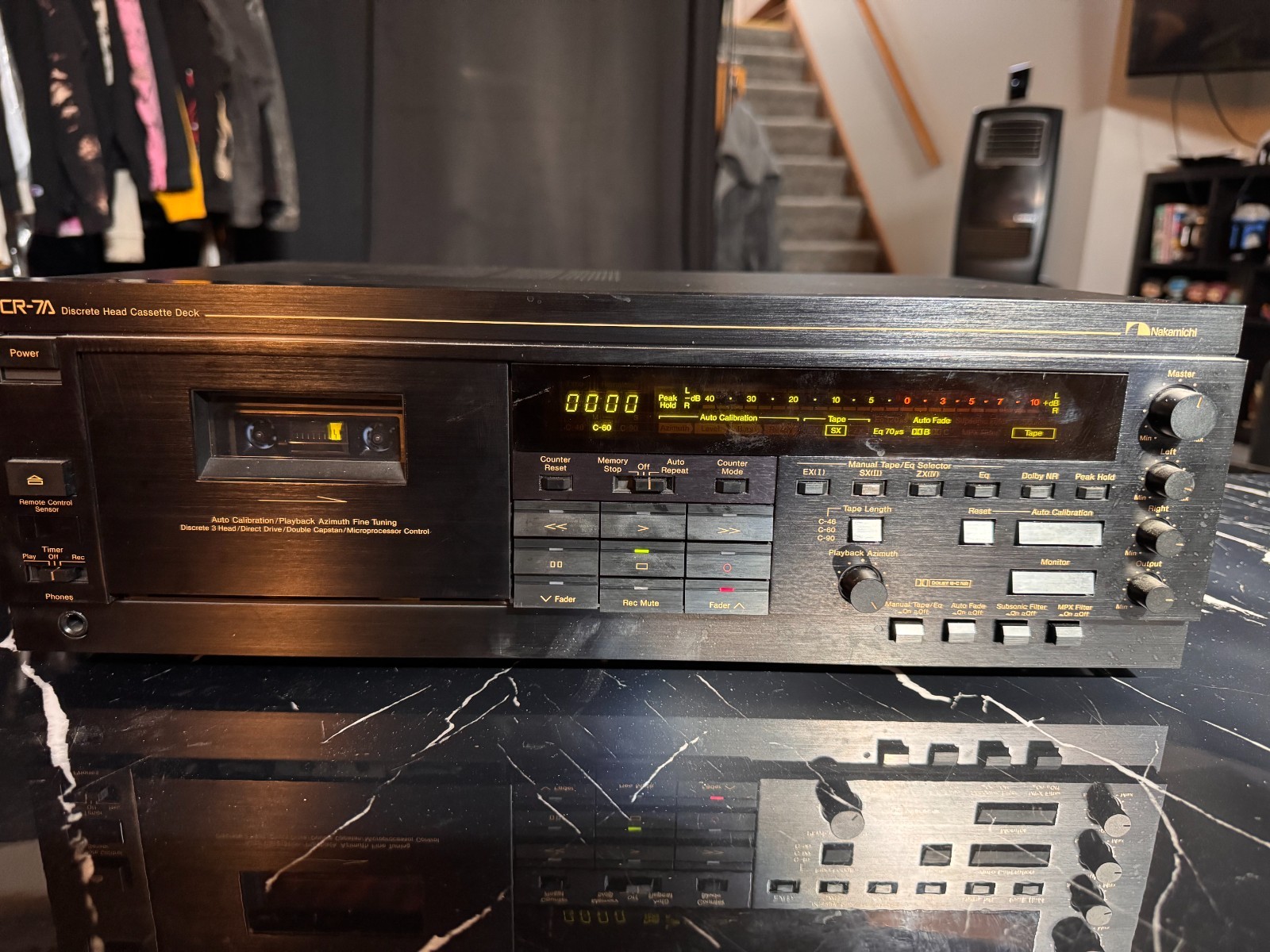
The front panel itself was a study in clarity: large VFD display, tactile aluminum buttons, and a headphone jack with level control. It looked like a piece of test equipment—and that was the point. This wasn’t designed to blend into your furniture. It was meant to be used, adjusted, and respected.
Historical Context
The CR-7 arrived at a paradoxical moment. By 1986, the CD had already been on the market for five years. Digital audio was the future. Cassettes were supposed to be disposable—cheap, convenient, and sonically inferior. But Nakamichi, ever the contrarian, saw untapped potential. While other brands simplified and downsized, Nakamichi engineered the CR-7 as a final statement: that analog tape, when treated with respect, could still outperform early digital formats in warmth, dynamics, and musicality.
It competed not with mass-market decks, but with itself. The Dragon, released a year earlier, was more extreme—featuring auto-azimuth during playback and a higher price. The CR-7 was the more practical sibling: slightly less exotic, but more reliable, easier to service, and just as capable in most real-world conditions. It also shared DNA with the CR-5, a slightly cut-down version without wireless remote or real-time counter, making the CR-7 the sweet spot of the late-era Nakamichi lineup.
Critics at the time were divided. Some called it overkill, a solution in search of a problem. Others, like Hi-Fi World, admitted that while DAT decks offered lower noise and perfect digital copies, the CR-7 simply sounded better—more alive, more dimensional. It wasn’t just recording music; it was performing it.
Collectibility & Value
Today, the Nakamichi CR-7 is a sought-after machine among analog enthusiasts, but it’s not without its quirks. Units in excellent working condition typically sell for **$1,200 to $2,000**, with fully restored examples—recapped, realigned, with new belts and idler tires—commanding the higher end. The CR-7E, the final revision, is the most common variant, but all versions (CR-7, CR-7A, CR-7E) are functionally similar, with minor cosmetic and firmware updates.
The biggest threat to longevity? The Sankyo transport mechanism. While robust, it relies on several rubber belts and a “sensor belt” (also called a back-tension belt) that commonly degrade over time. When this belt fails, the tape spools loosely, leading to poor winding and potential tape damage. Replacement kits exist, but sourcing the correct sensor belt can be tricky—some third-party kits include the wrong size, requiring careful vetting.
Another known issue is the mode motor, which controls transport functions. If the deck sits unused for months, the motor can seize or wear out, requiring replacement. The calibration memory is stored in volatile RAM backed by a soldered-in battery—another weak point. Savvy owners replace it with a clip-on holder to avoid future board damage.
Despite these issues, the CR-7 is considered more serviceable than the Dragon. Its modular design and widespread parts support (thanks to the dedicated Tapeheads community) make restoration feasible. And once dialed in, it delivers a listening experience that modern digital can’t replicate: a sound that’s detailed without being clinical, precise without being cold.
Buyers should insist on a working demo. Look for smooth tape handling, tight spooling, accurate counter behavior, and full remote functionality. Avoid units with oxidized head gaps or cracked display segments. And if the azimuth adjustment doesn’t respond via remote, suspect a dead mode motor or failed calibration circuit.
eBay Listings


As an eBay Partner, we earn from qualifying purchases. This helps support our independent vintage technology research.
Related Models
- Nakamichi BX-1 (1985)
- Nakamichi 600-II (1977)
- Nakamichi BX-2 (1983)
- Nakamichi CR-3 (1971)
- Nakamichi MR-1 (1983)
- Akai AM-2850 (1975)
- Akai AP-206 (1975)
- Acoustic Research research-ar-17 (1978)
- Acoustic Research AR-19 (1994)
- Acoustic Research AR-1W (1954)