Nakamichi BX-300: The Precision Cassette Deck from a Golden Era
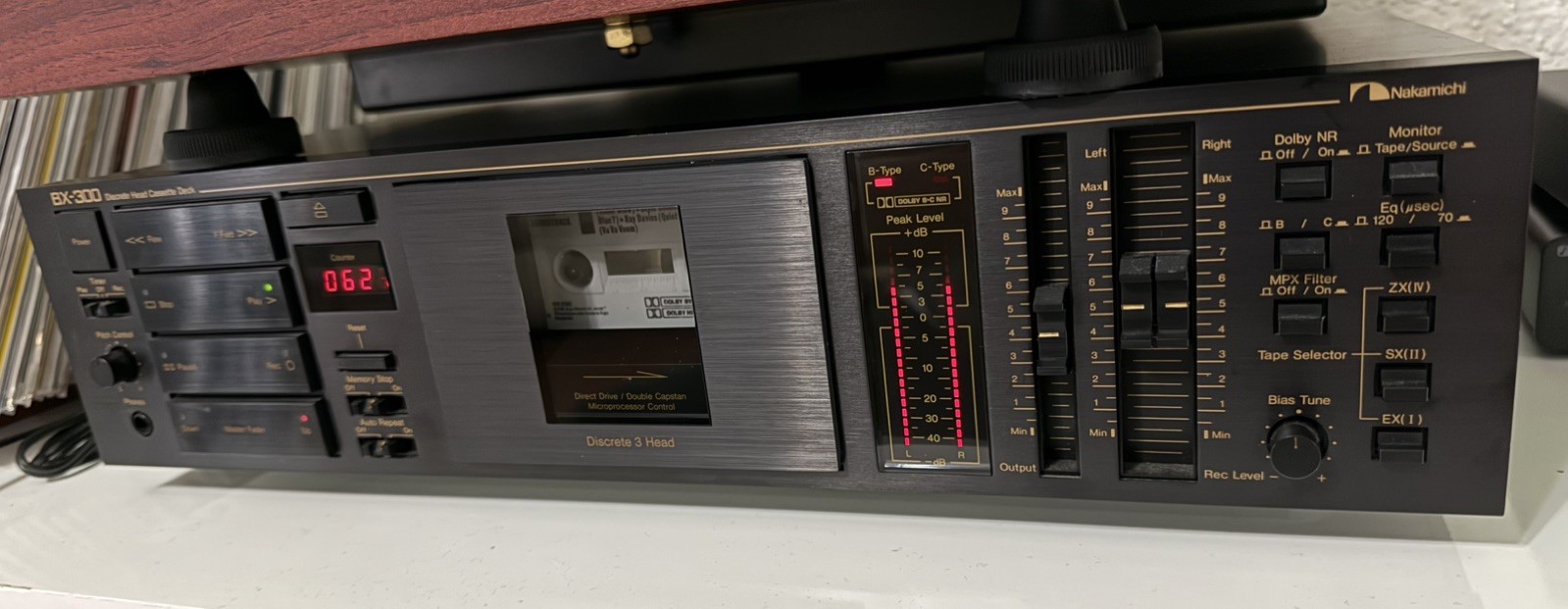
In the early 1980s, Nakamichi stood at the pinnacle of cassette deck engineering, pushing the boundaries of what analog tape could achieve. While models like the legendary Nakamichi Dragon often steal the spotlight, the BX-300 occupies a respected place in the company’s lineage as a high-performance, technologically advanced cassette deck designed for serious audiophiles who demanded accuracy, reliability, and exceptional sound quality—all within a more compact and refined form factor.
Released in 1984, the BX-300 arrived during a golden age for high-fidelity cassette technology. At a time when compact cassettes were the dominant medium for portable and home music consumption, Nakamichi was committed to proving that cassettes could rival reel-to-reel tape in fidelity. The BX-300 embodied this philosophy, offering a blend of cutting-edge engineering, meticulous build quality, and user-friendly design that made it a favorite among discerning listeners and professionals alike.
Technical Specifications
The BX-300 was engineered with precision and built to last. It featured a dual-capstan, three-head design—a hallmark of Nakamichi’s top-tier decks—ensuring stable tape speed, minimal wow and flutter, and excellent head alignment for optimal playback and recording performance.
| Specification | Detail |
| Model | Nakamichi BX-300 |
| Year of Release | 1984 |
| Type | 3-Head, Dual Capstan Cassette Deck |
| Recording Heads | 1 (Full-Track Mono / Stereo) |
| Playback Heads | 1 (Stereo) |
| Erase Head | 1 (AC Bias) |
| Tape Speed | 1⅞ ips (4.76 cm/s) |
| Wow and Flutter | < 0.055% (weighted) |
| Frequency Response | 20Hz – 20kHz (with CrO₂ tape) |
| Signal-to-Noise Ratio | 72 dB (Dolby C), 68 dB (Dolby B) |
| Total Harmonic Distortion | < 1.5% |
| Input Level | 200 mV (line), 2 mV (mic) |
| Output Level | 150 mV (line) |
| Inputs | Line In (RCA), Mic In (¼") |
| Outputs | Line Out (RCA) |
| Head Amplifier | Discrete transistor circuitry |
| Motors | Two direct-drive capstan motors |
| Display | Fluorescent VU meters, status indicators |
| Dimensions | 435 mm × 140 mm × 330 mm (W×H×D) |
| Weight | 10.5 kg (23.1 lbs) |
The BX-300 supported all three major tape types—Type I (ferric), Type II (chrome), and Type IV (metal)—and included automatic tape bias and equalization detection via a sensing pin in the cassette shell. This allowed the deck to optimize recording settings without user intervention, a significant convenience feature at the time.
Sound Characteristics and Performance
The BX-300 was engineered for sonic neutrality and transparency. Unlike some cassette decks that colored the sound with a warm or bright signature, the BX-300 aimed for accuracy, making it ideal for critical listening, duplication, and semi-professional use.
Its three-head configuration allowed for true separate record and playback heads, meaning you could monitor your recordings in real time through the playback head while recording—a feature previously found only on professional reel-to-reel machines. This eliminated the latency and sound degradation associated with using the record head for monitoring.
The dual-capstan transport system ensured rock-solid tape-to-head contact, minimizing speed fluctuations and tape slippage. Combined with precision-ground heads from Hitachi or equivalent, the BX-300 delivered a frequency response that extended to the full 20Hz–20kHz range when using high-quality chrome or metal tapes, with tight bass, clear mids, and detailed highs.
With Dolby C noise reduction, the BX-300 achieved a remarkably low noise floor, making tape hiss nearly inaudible even during quiet passages. This, paired with its low distortion and excellent channel separation (typically over 50 dB), made it a favorite for archiving vinyl records and creating high-quality cassette dubs.
Notable Features and Innovations
The BX-300 packed several advanced features that set it apart from its contemporaries:
- Dual Capstan Transport: Reduced tape flutter and ensured consistent tape speed, critical for high-fidelity playback.
- Auto Tape Sensing: Detected tape type (I, II, IV) and automatically adjusted bias and EQ, reducing user error.
- Manual Bias Override: For advanced users who wanted to fine-tune recordings with non-standard tapes.
- Front-Panel Dolby Selection: Easy switching between Dolby B and C, with a defeat option for raw tape monitoring.
- Fluorescent VU Meters: Provided precise level monitoring with excellent visibility.
- Direct Drive Motors: Enhanced speed stability and reduced mechanical wear over time.
- Solid Chassis Construction: A heavy, rigid frame minimized vibration and resonance, contributing to sonic clarity.
Unlike the more flamboyant Dragon, the BX-300 had a clean, understated design with a brushed aluminum front panel, recessed controls, and a professional aesthetic that fit seamlessly into high-end audio racks.
Common Issues and Maintenance
Like all high-performance cassette decks from the 1980s, the BX-300 requires careful maintenance to perform at its best today. The most common issues include:
- Deteriorated Rubber Components: The pinch roller, capstan tires, and drive belts (if used in certain subassemblies) can harden or crack over time. These should be replaced during a full servicing.
- Dirty or Worn Tape Heads: Oxide buildup and wear can degrade frequency response. Regular cleaning with isopropyl alcohol and demagnetizing are essential.
- Capstan Shaft Oxidation: Can cause speed instability. Light polishing during servicing usually resolves this.
- Sticky Mode Switches or Pots: Due to age, controls may become noisy or intermittent. Contact cleaner or replacement may be needed.
- Degraded Capacitors: In the power supply or signal path, old electrolytic capacitors can leak or lose capacitance, potentially affecting performance or causing failure.
A well-maintained BX-300, however, is remarkably reliable. Its discrete circuitry and robust mechanical design mean that with proper care, it can continue to deliver outstanding performance decades after its manufacture.
Current Market Value and Collectibility
The Nakamichi BX-300 is not as widely collected as the Dragon or CR-7A, but it holds a loyal following among cassette enthusiasts and vintage audio purists. Its value has been steadily increasing as interest in analog tape formats resurges.
As of 2024, a fully functional, serviced BX-300 typically sells for $400–$700, depending on condition, included accessories, and provenance. Units with original packaging, manuals, or low usage hours may command higher prices, especially in Europe and Japan where cassette culture remains strong.
While not a "trophy" deck like the Dragon, the BX-300 offers nearly equivalent performance at a more accessible price point, making it an excellent entry into high-end vintage cassette playback.
Conclusion and Legacy
The Nakamichi BX-300 stands as a testament to the engineering excellence that defined Nakamichi during the 1980s. It may not have the fame of the Dragon, but it delivers a substantial portion of that flagship’s performance in a more practical, serviceable package.
For audiophiles who appreciate the warmth and character of analog tape, the BX-300 remains a compelling choice. It bridges the gap between consumer convenience and professional-grade fidelity, offering a listening experience that modern digital formats often struggle to replicate.
In an era where music is increasingly intangible, the BX-300 reminds us of the tactile joy of handling tapes, watching VU meters dance, and hearing music unfold with richness and presence. It’s not just a cassette deck—it’s a piece of audio history, built to last and still capable of delivering magic, one tape at a time.
eBay Listings


As an eBay Partner, we earn from qualifying purchases. This helps support our independent vintage technology research.
Related Models
- Nakamichi 1000ZXL (1985)
- Nakamichi BX-150 (1983)
- Nakamichi CR-4 (1969)
- Nakamichi 1000-II (1974)
- Nakamichi 1000ZXL-LIMITED (1985)
- Sony TC-2050SD (1978)
- Aiwa AD-F990 (1993)
- Kenwood KX-3060 (1982)
- Sony TC-2130A (1974)
- Sony TC-2220 (1972)