Nakamichi 700II (1976–1979)
There is a tactile confidence in pressing the touch-command pads of this deck, knowing the tape is being guided by pneumatically damped precision rather than brute mechanical force.
Overview
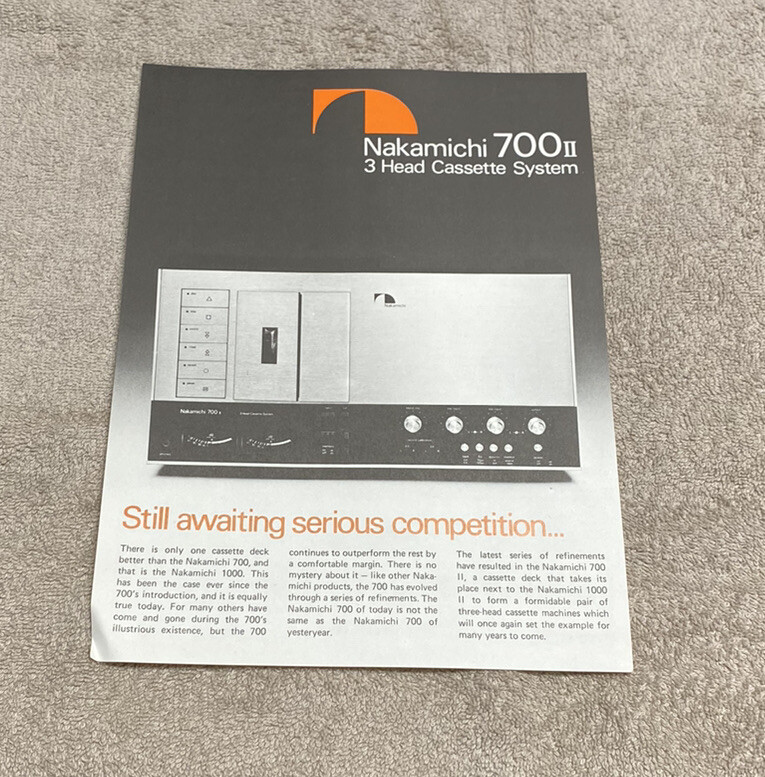
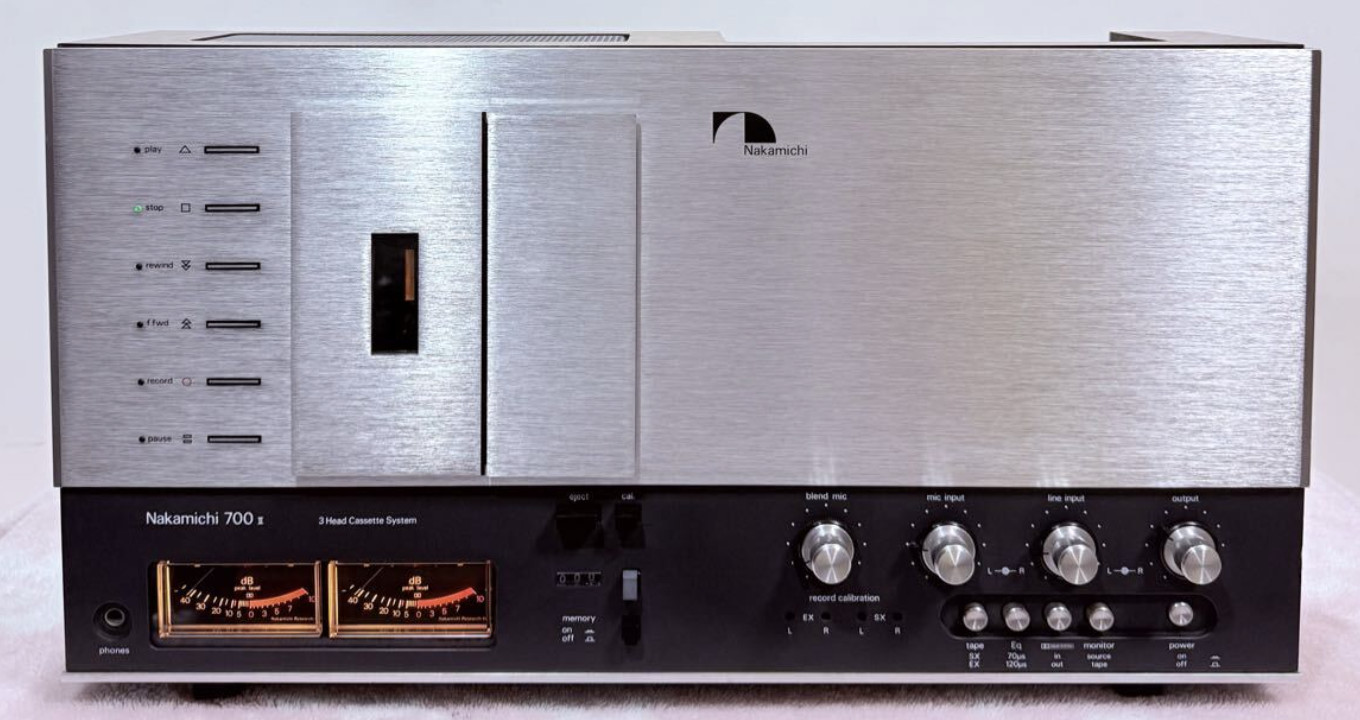
The Nakamichi 700II stands as a refined evolution of the groundbreaking 1973 Nakamichi 700, representing a period where the company balanced raw performance with aesthetic elegance. While the legendary 1000 Series chased ultimate performance metrics, the 700 Series aimed for beauty without sacrificing engineering integrity. This model is not merely a cassette player; it is a statement of high-fidelity intent from an era when magnetic tape was the primary medium for domestic music reproduction. Owners often describe the unit as a magnificent engineering monster, possessing a weight and presence that commands respect on a shelf. The chassis carries thirteen kilograms of internal complexity, housing a transport system that treats the cassette cartridge with a gentle, air-damped touch rather than the harsh mechanical engagement found in lesser contemporaries.
Refinements over the original 700 are located primarily in the transport mechanism, the head assembly, and the electronic circuitry. The touch-command transport pads were updated to provide a more responsive user interface, while phase-compensation circuitry was added to the playback amplifier to maintain signal integrity within thirty degrees. This phase correction helps dynamic circuits such as Dolby handle complex signals more accurately, ensuring that the noise reduction system does not artifact the music during transient peaks. The playback head design and material were refined sufficiently to be named the Super Head, utilizing a composite of nickel, niobium, and tantalum known as Crystalloy. This material choice extended the life of the head while maintaining a gap of 0.9 microns, a slight increase from the 0.7 micron gap of the original 700's permalloy core, yet optimized to prevent alternating cancellations and reinforcements at low wavelengths.
For recording, crystal ferrite was chosen because the material fits wide-gap uses exceptionally well. To circumvent the high-frequency losses inherent in wide-gap design, a sophisticated design and low-stress manufacturing process was adopted. This allows the bias frequency to operate at a lofty 105 kHz, pushing the limits of what was standard for consumer tape decks in the late 1970s. The erase head also utilizes crystal ferrite instead of the conventional AC erasing method, which succeeded in reducing temperature rise and improving erasing efficiency. Stainless steel tape guides are attached to the top and bottom of this erasing head to improve the running accuracy of the tape, ensuring that the path from supply to take-up is linear and stable. These material choices distinguish the 700II from competitors who often relied on standard ferrite or permalloy without the same level of composite engineering.
Specifications
| Manufacturer | Nakamichi |
| Production Years | 1976–1979 |
| Original Price | ¥210,000 (1977) |
| Tape Format | Stereo Cassette |
| Head Configuration | 3 Heads (Erase, Record, Play) |
| Playback Head Material | Crystalloy (Nickel + Niobium + Tantalum) |
| Record Head Material | Crystal Ferrite |
| Erase Head Material | Crystal Ferrite |
| Playback Head Gap | 0.9 microns |
| Record Head Gap | 5 microns |
| Tape Speed | 4.8 cm/s |
| Wow & Flutter (RMS) | <0.05% (Weighted) |
| Wow & Flutter (DIN Peak) | <0.1% (Weighted) |
| Frequency Response | 35 Hz – 20 kHz (±3 dB, Dolby IN) |
| Signal-to-Noise Ratio | >65 dB (Dolby IN, WRMS, 400 Hz) |
| Total Harmonic Distortion | <1.5% (400 Hz, 0 dB) |
| Channel Separation | >35 dB (1 kHz, 0 dB) |
| Crosstalk | >60 dB (1 kHz, 0 dB) |
| Bias Frequency | 105 kHz |
| Erasure Rate | >60 dB (1 kHz) |
| Microphone Input | 0.2 mV (10 kΩ) |
| Line Input | 50 mV (50 kΩ) |
| Line Output | 1 V max (Variable) |
| Headphone Output | 40 mW (8 Ω) |
| Power Consumption | 60W max |
| Dimensions | 520 x 267 x 130 mm |
| Weight | 13 kg |
| Remote Control | RM-10 (Wired) |
| Semiconductor Count | 138 Transitors, 9 ICs, 54 Diodes |
Key Features
The Super Head Assembly
The transition from the original 700 to the 700II is most visibly marked by the head assembly engineering. Documentation shows that the playback head was renamed the Super Head due to the adoption of Crystalloy, a composite material combining nickel, niobium, and tantalum. This alloy was selected to extend the operational life of the head while maintaining high-frequency extension. The contour was reshaped so that low wavelengths approaching the physical dimension of the head would not cause alternating cancellations and reinforcements, a phenomenon that can muddy the bass response on lesser decks. The record head utilizes crystal ferrite, chosen because the material fits well with wide-gap uses. To circumvent the high-frequency losses of wide-gap design and extension of the magnetic field, a sophisticated design and low-stress manufacturing process was adopted. This allows the deck to handle EX and SX tapes with manual record level calibration, ensuring that the high bias frequency of 105 kHz is utilized effectively without saturating the tape prematurely.
Pneumatic Damping and Transport
Mechanical violence is absent from the 700II's operation. The unit uses an air damper that utilizes a cylinder to ensure that the contact between the tape and the head occurs quietly and slowly. Similarly, a cylinder-type air damper is used for tape ejection, and the ejection speed can be varied by a needle throttle. This pneumatically damped cassette and heads movement prevents the abrupt shocks that can damage tape coatings or misalign heads over time. The transport itself is a closed-loop dual capstan system that is belt-driven with staggered flywheels. An induction reel hubs motor assists in handling larger tape reels, while the main drive is an optical-sensing DC motor with 120 pulses per rotation allowing speed control by altering the motor's voltage. This pulse-controlled DC motor system contributes to the wow and flutter figures remaining below 0.05% RMS weighted, a specification that rivals many full-size reel-to-reel machines of the same period.
Monitoring and Mixing Capabilities
Off-tape monitoring is a critical feature for serious recording, allowing the user to hear exactly what is being captured on the magnetic medium rather than just the source input. The 700II facilitates this through its three-head configuration, enabling real-time verification of recording levels and noise reduction effectiveness. A 400 Hz tone generator is included to enable accurate Dolby level adjustment, a necessary calibration step that many competitors omitted. Beyond tape playback, the deck functions as a mixing hub. Five-channel three-way mixing is possible with a blend microphone input, accommodating three MIC inputs (Left, Center, Right). This makes the unit suitable for live sound reproduction or simple multi-source recording sessions without requiring an external mixer. The headphone amp is high-output, delivering 40 mW into 8 ohms, which provides sufficient drive for monitoring critical details in the signal path without external amplification.
Historical Context
When first introduced in 1973, the Nakamichi 700 offered the essential performance of the world-renowned Nakamichi 1000 at a comparatively modest price. These were among the first cassette decks to incorporate three separate heads: erase, record, and play. They were also among the first to feature user-adjustable record head azimuth, empowering the owner to align the head for maximum high-frequency response. By 1976, the industry moment had shifted toward refining these initial breakthroughs. Competitors were beginning to offer three-head configurations, but Nakamichi focused on material science and transport stability. The 700II was one of the few 3-head cassette decks at that time to combine such head technology with a dual-capstan transport.
While the 1000 Series pursued performance metrics aggressively, the 700 Series aimed for something with beauty. The performance was as good as the 1000 Series, but the aesthetic and operational experience were prioritized. This distinction mattered in the high-end audio market of the late 1970s, where furniture-style audio components were becoming desirable. The 700II is probably Nakamichi's most elegantly designed machine, as it isn't all-black like the professional racks of the 1000 series. It sits in the hierarchy above budget entry models like the later 500 series, but below the flagship 1000II in terms of raw modification potential. It represents a sweet spot where engineering rigor met domestic usability. During this era, Dolby B was standard, and the ability to handle chrome tapes (SX and EX) manually gave the user control over the dynamic range that automatic switching often compromised.
Collectibility & Value
The Nakamichi 700II is a very collectible vintage artifact, often described by owners as "THE BEST" cassette player/recorder of its era. Original pricing in Japan was ¥210,000 in 1977, with the optional RM-10 wired remote control sold separately for ¥9,000. In the current market, units in perfect condition with meticulous maintenance command significant premiums. Reverb listings note that faceplates are often absolutely perfect on well-kept units, with only slight marks on the upper front edge being common. The brush aluminium finish is a bonding point for collectors, as it resists corrosion better than painted steel but requires careful cleaning to avoid scratching.
Common failures center on the belt-driven transport. The long-term elastic characteristics of modern belts ensure stability for years to come, but original rubber belts harden and slip over forty years. A belt replacement is a Saturday project that restores the rewind time to approximately 50 seconds for a C-60 tape. Service technicians observe that the pinch rollers and idlers also require attention to maintain the wow and flutter specifications. Head wear is less of a concern than on single-head decks due to the Crystalloy material, but alignment should be checked if the unit has been used heavily. The foam surround on internal damping components may crumble, but replacement kits are accessible and the install is straightforward for those comfortable with basic disassembly.
Buying advice suggests bringing a flashlight and examining the faceplate at a raking angle to detect pitting or deep scratches that cannot be polished out. Owners report that the Peak VU meters with 300ms rise and 1.5s decay are highly desirable and should be tested for responsiveness. If the play function is inactive while rewind and fast forward work, the transport belt is likely the culprit, as noted in vintage audio exchange listings selling units as-is. Prices vary by condition, but fully serviced units with original remote controls are increasingly rare. The 700II works well and is truly magnificent when functioning, making it a worthwhile engineering investment for those who appreciate the tactile confidence of analog tape recording.
eBay Listings


As an eBay Partner, we earn from qualifying purchases. This helps support our independent vintage technology research.
Service Manuals & Schematics
- Manual — archive.org
- Service Manual — archive.org
- Manual — archive.org
- Manual — archive.org